If you've ever felt your voice starting to crack halfway through your second service, you're not alone. Most pastors who preach multiple services face the same challenge: how to maintain vocal stamina when you're delivering the same message two, three, or even four times in a weekend. The reality is that your voice wasn't designed for this kind of sustained use without proper preparation and care.
The good news? Vocal stamina for preaching isn't about natural ability or genetic luck. It's a skill you can develop with the right techniques and habits. Whether you're a seasoned pastor adding a new service or a church planter planning for growth, understanding how to protect and strengthen your voice will directly impact your effectiveness across every service. This guide will show you exactly how to build the vocal endurance you need to preach with power from your first word to your last, no matter how many times you step on stage.
Quick Answer: Vocal stamina for preaching multiple services requires three key elements: proper hydration (64+ oz water daily), strategic vocal rest between services (20-30 minutes of complete silence), and breath support techniques that reduce strain. Pastors who implement these practices report 60-70% less vocal fatigue and maintain consistent energy levels across 3-4 services.
Key Takeaways
- Hydration is non-negotiable — Your vocal cords need consistent moisture starting 24-48 hours before Sunday, not just between services
- Vocal rest between services matters more than vocal warm-ups — 20-30 minutes of complete silence allows your vocal cords to recover and prevents cumulative damage
- Breath support reduces strain by 40-50% — Proper diaphragmatic breathing means less pressure on your vocal cords and more sustainable volume
- Energy management isn't the same as vocal management — You can feel energized while your voice is failing; monitoring both separately prevents long-term damage
What Makes Vocal Stamina Different from Regular Voice Use?
Vocal stamina for preaching isn't the same as having a conversation or even teaching a class. When you preach, you're asking your voice to do several things simultaneously: project over ambient noise, maintain emotional intensity, sustain volume for 30-45 minutes, and do it all while managing the physical demands of movement and gestures. Then you're asking it to do that again. And again.
Research on vocal performance shows that sustained speaking at elevated volume creates friction between your vocal cords at a rate of approximately 100-200 times per second. Over a 40-minute sermon, that's millions of vibrations. Now multiply that by three or four services. Without proper technique and recovery, this friction leads to inflammation, which leads to hoarseness, which leads to compensatory behaviors (like pushing harder) that create even more damage.
The difference between pastors who maintain their voice across multiple services and those who struggle isn't usually volume or intensity—it's efficiency. Efficient vocal production means getting maximum sound with minimum effort. That's the foundation of vocal stamina.
How to Build Vocal Endurance Before You Need It
Vocal stamina isn't something you develop on Sunday morning. It's built through consistent habits during the week that prepare your voice for the demands of weekend preaching. Communication experts recommend treating your voice like an athlete treats their body—training it progressively and giving it adequate recovery time.
Start with diaphragmatic breathing exercises. Five minutes daily of focused breath work—breathing deeply into your belly, not your chest—strengthens the muscles that support your voice. Lie on your back with a book on your stomach. Breathe in through your nose for four counts, watching the book rise. Hold for four counts. Exhale through your mouth for six counts, watching the book fall. This simple exercise builds the breath control that prevents vocal strain.
Next, practice speaking at your preaching volume for short bursts during the week. Not full sermons—just 5-10 minute segments where you're projecting as you would on Sunday. This conditions your vocal cords to handle intensity without shocking them every weekend. Think of it as interval training for your voice.
Finally, identify your vocal baseline. Record yourself having a normal conversation on Monday. Note your natural pitch, volume, and ease of production. If your voice on Sunday sounds drastically different from your Monday baseline, you're likely compensating rather than projecting properly. The goal is to extend your natural voice, not create a "preaching voice" that requires constant muscular tension.
Why Hydration Matters More Than You Think (And How to Do It Right)
Every pastor knows they should drink water. But most don't understand the timeline or the mechanism. Your vocal cords are covered by a thin layer of mucus that needs to stay lubricated to vibrate efficiently. When that layer dries out, your cords rub together with more friction, creating irritation and fatigue.
Here's what most pastors get wrong: drinking water right before you preach doesn't hydrate your vocal cords. Water goes to your stomach, not your larynx. The hydration that matters happens 24-48 hours before you preach, when water you drink gets absorbed into your system and eventually reaches the mucous membranes in your throat.
Studies on voice professionals show that optimal vocal cord hydration requires 64+ ounces of water daily, starting at least two days before performance. On Sunday morning, you're not hydrating—you're maintaining. Sipping room-temperature water between services helps, but the real work was done Thursday and Friday.
Avoid dehydrating substances, especially in the 24 hours before preaching. Caffeine and alcohol are the obvious culprits, but antihistamines, certain blood pressure medications, and even excessive salt intake can dry out your vocal cords. If you need coffee Sunday morning, match it ounce-for-ounce with water.
One practical strategy: Keep a water bottle with time markers at your desk during sermon prep. If you're spending 15-20 hours preparing your message, use that time to build your hydration baseline. By the time Sunday arrives, your voice is already in optimal condition.
Common Vocal Stamina Mistakes Pastors Make (And How to Fix Them)
The most common mistake is pushing through hoarseness instead of adjusting technique. When your voice starts to tire, the natural instinct is to speak louder or add more force. This is exactly wrong. Hoarseness is your vocal cords' way of saying they need a different approach, not more effort.
Instead, when you notice fatigue, drop your volume slightly and focus on articulation. Clear consonants and precise vowels carry meaning better than raw volume. Your congregation doesn't need you louder—they need you clearer. This is where the four pillars of sermon delivery become crucial: clarity doesn't require volume; it requires intentionality.
Another mistake is treating all services the same. Your voice in service one is fresh. Your voice in service four is tired. Adjust accordingly. In later services, use more strategic pauses (which give your voice micro-rests), rely more on vocal variety than volume for emphasis, and be more intentional about breath support. The message stays the same, but your delivery technique should adapt to your vocal condition.
Many pastors also skip vocal rest between services, using that time to greet people, have meetings, or review notes. This is counterproductive. Your vocal cords need 20-30 minutes of complete silence between services to reduce inflammation and recover. Find a quiet space—your office, your car, even a closet—and don't speak. Not even whispered conversations, which actually strain your voice more than normal speaking.
Finally, pastors often neglect the connection between physical tension and vocal strain. Tight shoulders, clenched jaw, locked knees—all of these create compensatory tension in your throat. Before each service, do a quick body scan. Roll your shoulders. Loosen your jaw. Shake out your hands. Physical relaxation directly impacts vocal ease.
How to Manage Your Voice Between Services
The time between services is where vocal stamina is won or lost. What you do in those 60-90 minutes determines whether your voice strengthens or deteriorates across the day.
First, implement complete vocal rest. This means no talking—not to staff, not to volunteers, not to your spouse. Communicate this boundary to your team in advance. Put a sign on your door if needed. Your voice needs silence to recover from the inflammation caused by the previous service.
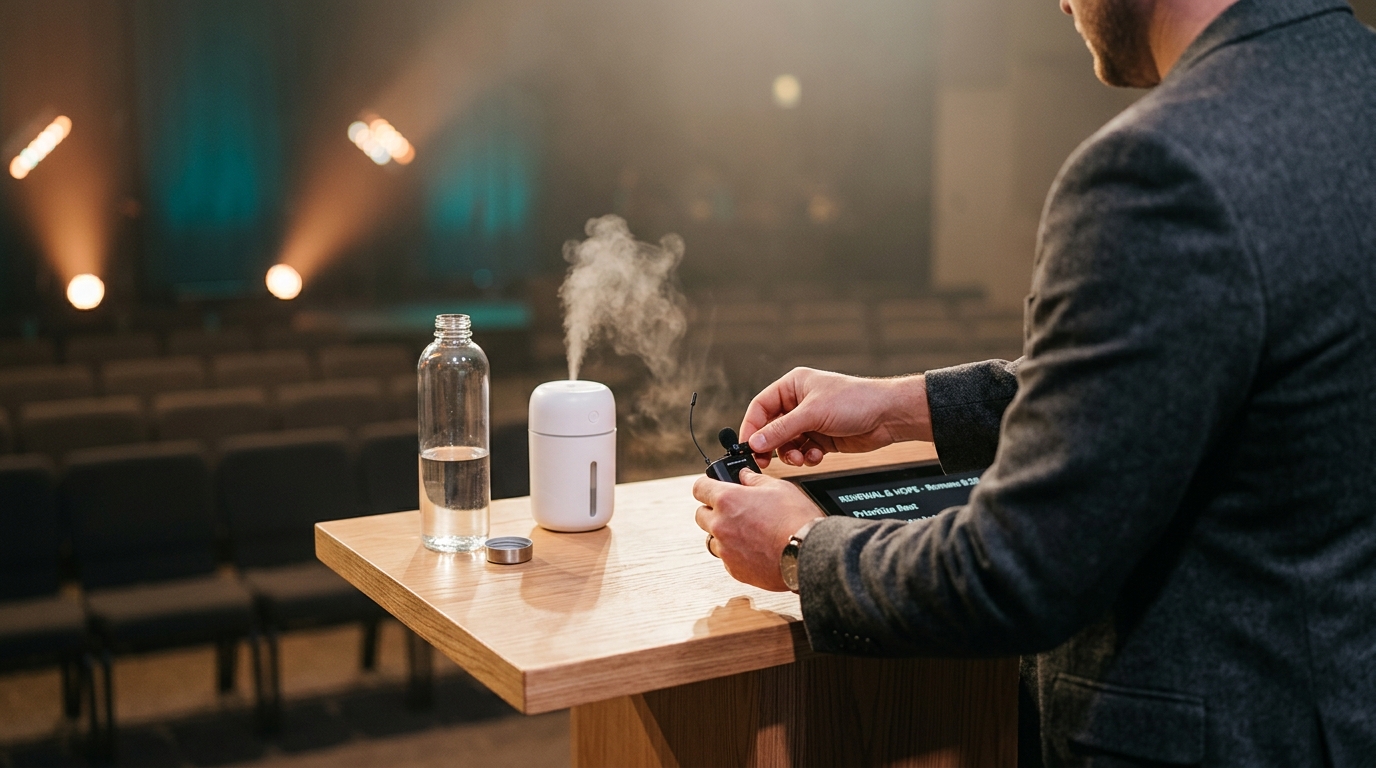
Second, use steam. A portable steamer or even a hot shower provides moisture directly to your vocal cords in a way drinking water can't. Five minutes of steam inhalation between services can reduce inflammation and restore flexibility. Keep a small travel steamer in your office for this purpose.
Third, do gentle vocal exercises—not to warm up, but to release tension. Humming on a comfortable pitch, lip trills, and gentle sirens (sliding from low to high pitch and back) help your vocal cords stay flexible without adding strain. These should feel easy and relaxing, not effortful.
Fourth, manage your energy separately from your voice. You might feel physically energized from the adrenaline of the first service, but your voice is tired. Don't let your energy level trick you into skipping vocal rest. Conversely, if you feel physically drained, a short walk or light snack can restore energy without taxing your voice.
Finally, monitor your vocal quality, not just your volume. Can you still hit your normal pitch range? Are you having to clear your throat frequently? Is there a scratchy or breathy quality that wasn't there in service one? These are signs you need to adjust your technique for the next service, not push harder.
What to Look for When Evaluating Your Vocal Stamina
Self-evaluation is critical for building long-term vocal stamina. After each multi-service weekend, assess what worked and what didn't. Recording your sermons makes this process much more objective.
Listen for pitch changes across services. If your voice drops significantly in later services, you're likely experiencing vocal fatigue. A slight drop is normal, but if you sound like a different person by service three, you need to adjust your technique or rest protocol.
Notice breath patterns. Are you running out of air mid-sentence more often in later services? This indicates your breath support is weakening, which forces your vocal cords to work harder. The solution isn't more air—it's better breath management from the diaphragm.
Pay attention to recovery time. How long does it take your voice to feel normal after Sunday? If you're still hoarse on Tuesday, you're overdoing it. Healthy vocal use should allow for complete recovery within 24 hours. Persistent hoarseness is a warning sign that needs professional evaluation.
Track your hydration and rest habits against your vocal performance. Keep a simple log: water intake, hours of sleep, vocal rest time, and subjective voice quality (1-10 scale) for each service. Over time, patterns will emerge that show you exactly what your voice needs to perform optimally.
Consider using a tool like Preach Better to analyze your delivery patterns across services. The platform can identify moments where you're pushing too hard, losing breath support, or compensating with tension—patterns you might not notice in the moment but that contribute to vocal fatigue over time.
How Breath Support Protects Your Voice Across Multiple Services
Breath support is the single most important factor in vocal stamina. When you speak from your diaphragm instead of your throat, you reduce the pressure on your vocal cords by 40-50%. This isn't just about breathing deeply—it's about controlling the airflow that powers your voice.
Proper breath support means your diaphragm does the work, not your throat. Place your hand on your belly. When you breathe in, your hand should move outward. When you speak, you should feel your abdominal muscles engaging to control the air release. If your shoulders rise when you breathe or your throat feels tight when you speak, you're using shallow, inefficient breathing that will exhaust your voice quickly.
Practice this during sermon preparation. As you rehearse, focus on taking a breath before each major point or sentence. Don't let yourself run out of air mid-thought. Running out of air forces your vocal cords to work harder to produce sound, which accelerates fatigue. Strategic breathing isn't just about pacing—it's about vocal health.
Between services, do breath reset exercises. Lie down if possible, or sit in a comfortable chair. Place one hand on your chest and one on your belly. Breathe slowly and deeply, ensuring only your belly hand moves. Do this for 3-5 minutes. This resets your breathing pattern and reminds your body how to support your voice efficiently.
During the sermon itself, use strategic pauses not just for emphasis but for breath recovery. A well-placed pause gives you time to take a full diaphragmatic breath without the congregation noticing. This is especially important in later services when your breath control is naturally weaker.
Five Practical Strategies for Preaching Multiple Services Without Losing Your Voice
1. Front-load your vocal intensity. Your voice is strongest in the first service. If you have flexibility in your schedule, put your most demanding service (largest crowd, most energy needed) first. By service three or four, rely more on clarity and connection than raw intensity.
2. Use amplification strategically. Work with your sound team to optimize your mic setup. A well-positioned mic means you don't have to project as hard. Consider using in-ear monitors so you can hear yourself clearly without over-projecting. The goal is to speak at a conversational volume and let the sound system do the amplification work.
3. Modify your delivery, not your message. In later services, you might use more vocal variety instead of volume for emphasis, incorporate more moments of quiet intensity, or rely more heavily on storytelling (which typically requires less vocal force than declarative teaching). The content stays the same, but your delivery adapts to your vocal condition.
4. Build in recovery moments. Structure your sermon with natural vocal breaks—a video clip, a moment of congregational response, a time of reflection. These aren't just engagement tools; they're vocal rest opportunities. Even 30 seconds of silence while people reflect on a question gives your voice crucial recovery time.
5. Know when to modify. If you're genuinely losing your voice mid-day, have a backup plan. Can you shorten the sermon slightly? Can you bring a co-teacher to handle one section? Can you rely more on your notes and less on extemporaneous expansion? Protecting your long-term vocal health is more important than delivering the perfect version of your message in every service.
What Professional Voice Training Can (and Can't) Do for Pastors
Many pastors wonder if they should work with a voice coach or speech therapist. The answer depends on your specific challenges and goals.
Professional voice training can teach you proper breath support, optimal pitch placement, and efficient resonance techniques that reduce strain. A good voice coach can identify compensatory patterns you've developed—like speaking from your throat instead of your diaphragm—and give you exercises to retrain your muscle memory. This is especially valuable if you're experiencing chronic hoarseness, pain when speaking, or significant vocal fatigue.
What voice training can't do is override poor vocal hygiene. No amount of technique will compensate for chronic dehydration, inadequate rest, or pushing through illness. Think of voice training as teaching you to run with proper form—it makes you more efficient and reduces injury risk, but you still need to warm up, stay hydrated, and rest between races.
If you're considering voice training, look for a speech-language pathologist who specializes in professional voice users (teachers, performers, clergy). They can do a comprehensive vocal assessment and create a personalized plan. Many offer virtual sessions, making it accessible even if you're not near a major city.
For most pastors, the fundamentals covered in this article—hydration, breath support, vocal rest, and strategic delivery adjustments—will solve 80% of vocal stamina issues. Professional training is valuable for the remaining 20% or for pastors who want to optimize their voice at the highest level.
How to Recover When You've Already Lost Your Voice
Despite your best efforts, there will be Sundays when your voice gives out. Here's how to manage it and prevent long-term damage.
First, stop talking immediately. Not whisper—stop. Whispering actually strains your vocal cords more than normal speaking because it requires more muscular tension. If you must communicate, write notes or use text messages.
Second, use steam and hydration aggressively. Hot showers, a humidifier, or a steamer provide moisture directly to inflamed vocal cords. Drink water consistently, but don't expect immediate results—you're managing symptoms, not curing the problem.
Third, avoid clearing your throat. The harsh contact of throat-clearing causes more irritation. Instead, do a gentle hum or swallow to clear mucus. If you must cough, do it gently with as much air support as possible.
Fourth, consider whether you need medical intervention. If you have complete voice loss (aphonia), severe pain, or symptoms lasting more than a week, see an ENT specialist. You might have vocal nodules, polyps, or another condition that requires professional treatment.
Finally, use the recovery period to evaluate what went wrong. Was it inadequate hydration? Pushing through illness? Poor breath support? Insufficient rest between services? Identifying the cause helps you prevent recurrence.
Long-Term Vocal Health: Building Stamina That Lasts Years, Not Just Weekends
Vocal stamina isn't just about surviving this Sunday—it's about sustaining a preaching ministry for decades. According to research on vocal health in clergy, pastors who implement consistent vocal care practices report 60-70% fewer voice problems over their careers compared to those who don't.
The key is treating vocal health as a non-negotiable part of your pastoral rhythm, like sermon preparation or prayer. This means regular hydration, consistent breath support practice, strategic rest, and immediate attention to warning signs like persistent hoarseness or pain.
It also means knowing your limits. Some pastors can preach four services without issue. Others start to struggle after two. There's no shame in advocating for a preaching schedule that protects your voice. Whether that means rotating with other teachers, adjusting service times to allow more rest, or using amplification more strategically, your church benefits when you're able to preach with full vocal health.
Consider an annual voice check-up with an ENT or speech-language pathologist, especially if you preach multiple services regularly. They can identify early warning signs of vocal damage and give you preventive strategies before problems become serious.
Finally, remember that vocal variety and vocal techniques aren't just about engagement—they're about sustainability. A voice that relies on constant volume and intensity will fail faster than one that uses dynamic range, strategic pauses, and efficient breath support.
About Preach Better: Preach Better is a sermon delivery analysis platform that helps pastors get honest, specific feedback on their communication. Built around four pillars—Clarity, Connection, Conviction, and Call to Action—it provides coaching grounded in specific moments from your message, not vague generalities. The platform can identify vocal patterns that contribute to fatigue, helping you build sustainable delivery habits across multiple services.
Frequently Asked Questions
How much water should I drink before preaching multiple services? You should aim for 64+ ounces of water daily, starting 24-48 hours before Sunday. On Sunday itself, sip room-temperature water consistently between services. The hydration that matters most happens days before you preach, not hours before, because it takes time for water to reach the mucous membranes that lubricate your vocal cords.
Is it better to preach from a manuscript or notes when trying to preserve vocal stamina? Neither format inherently preserves or damages your voice—what matters is your delivery technique. However, pastors who preach from detailed notes or manuscripts sometimes fall into a monotone reading pattern that requires less vocal variety, which can actually increase strain. The key is maintaining proper breath support and vocal variety regardless of your preparation method, as discussed in this guide to sermon preparation methods.
Should I cancel a service if I'm losing my voice? If you have complete voice loss or severe pain, yes—continuing to preach can cause long-term damage like vocal nodules. If you're experiencing moderate hoarseness but can still speak, you can proceed with modifications: rely more on your sound system, incorporate more video or congregational elements, shorten your message slightly, or bring in a co-teacher for portions. Protecting your long-term vocal health is more important than one perfect service.
How long should I rest my voice between services? Aim for 20-30 minutes of complete vocal rest (no talking at all) between services. This allows inflammation in your vocal cords to reduce and prevents cumulative damage. If you have longer gaps between services, use the additional time for hydration, steam, and gentle vocal exercises, but maintain that core 20-30 minutes of silence.
Can vocal warm-ups help with stamina for multiple services? Vocal warm-ups before your first service can help, but vocal rest between services matters more for stamina. Gentle exercises like humming, lip trills, and easy sirens can keep your voice flexible between services, but they should feel effortless and relaxing. If warm-ups feel strenuous or tiring, you're doing them wrong—they should reduce tension, not create it.
What's the difference between vocal fatigue and vocal damage? Vocal fatigue is temporary tiredness that resolves with rest—your voice feels tired after preaching but returns to normal within 24 hours. Vocal damage involves persistent symptoms like chronic hoarseness, pain when speaking, loss of range, or breathiness that doesn't improve with rest. Fatigue is normal and manageable with proper technique; damage requires medical evaluation and may indicate nodules, polyps, or other structural problems that need professional treatment.
Bottom Line: Vocal Stamina Is a Skill You Can Build
Preaching multiple services without losing your voice isn't about having a naturally strong voice or just toughing it out. It's about implementing specific, proven strategies: consistent hydration starting days before Sunday, proper breath support that reduces vocal cord strain, strategic vocal rest between services, and delivery adjustments that adapt to your changing vocal condition throughout the day.
The pastors who maintain vocal stamina across multiple services aren't necessarily more talented—they're more intentional. They treat their voice as a tool that requires preparation, maintenance, and recovery. They monitor their vocal health as carefully as they craft their messages. And they're willing to adjust their delivery technique to protect their long-term effectiveness.
Your congregation needs you to preach with clarity and conviction in every service, not just the first one. Building vocal stamina ensures that the message you spent all week preparing gets delivered with the same power and precision whether it's 8:00 AM or 6:00 PM. Start implementing these strategies this week, and you'll notice the difference this Sunday—and for years to come.