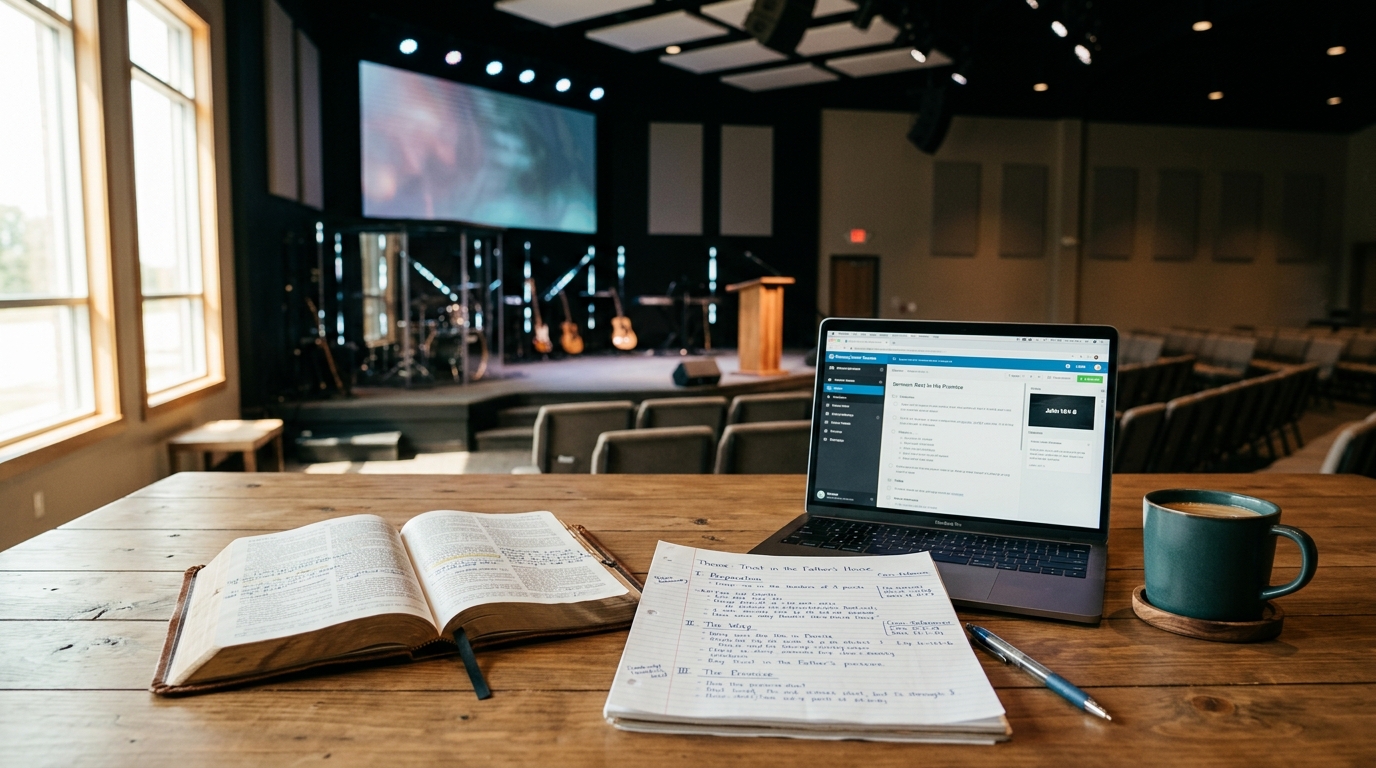
You've probably heard the debate a hundred times: Should you preach from a manuscript, memorize your sermon word-for-word, or go extemporaneous with just an outline? The answer isn't as simple as picking the "right" method and sticking with it forever. Each approach has strengths and weaknesses that show up differently depending on your message, your congregation, and your own communication style.
Here's what most preaching books won't tell you: the delivery method that works brilliantly for one pastor can feel completely unnatural for another. And what works for your Easter sermon might not work for a midweek teaching series. Understanding the real differences between extemporaneous preaching, manuscript delivery, and memorization isn't about finding the "best" method—it's about knowing which tool to use when, and why it matters for your effectiveness in the pulpit.
Quick Answer: Extemporaneous preaching uses a detailed outline or notes to guide delivery while allowing spontaneous wording, combining preparation with flexibility. Manuscript preaching reads or closely follows a written text for precision. Memorization delivers a fully prepared sermon from memory without notes. Research on public speaking suggests extemporaneous methods typically produce the most natural delivery and audience connection, though effectiveness depends on the preacher's preparation level and communication strengths.
Key Takeaways
- Extemporaneous preaching balances preparation and spontaneity — you prepare thoroughly but choose exact wording in the moment, creating natural delivery without sacrificing content quality
- Your delivery method directly affects congregation engagement — studies on audience retention show that overly scripted delivery reduces connection, while under-prepared delivery reduces clarity and authority
- The best preachers often blend methods strategically — using manuscript for complex theological sections, extemporaneous for stories, and memorization for key phrases creates dynamic, effective communication
- Your preparation process matters more than your delivery method — a poorly prepared extemporaneous sermon will always underperform a well-crafted manuscript, regardless of which method feels more "authentic"
What Is Extemporaneous Preaching (And What It's Not)?
Extemporaneous preaching means delivering a sermon from a prepared outline or notes while choosing the exact wording spontaneously as you speak. You know what you're going to say and in what order, but you're not locked into specific sentences or phrases. This is fundamentally different from improvisation or "winging it"—extemporaneous preaching requires thorough preparation, just not word-for-word scripting.
The confusion comes from how the term gets used. Many pastors say they preach "extemporaneously" when they actually mean they preach without notes after memorizing their content. Others use it to describe preaching with minimal preparation, relying on the Spirit to provide words in the moment. Neither of these is true extemporaneous delivery.
Communication experts recommend extemporaneous methods for most public speaking contexts because they produce conversational tone while maintaining structure. You sound like you're talking with your congregation, not reading to them. Your outline keeps you on track, but your brain is actively engaged in real-time communication, which creates natural vocal variety, appropriate pauses, and responsive adjustments to audience feedback.
The practical reality: extemporaneous preaching requires you to know your material so well that you can explain it multiple ways. You've internalized the content, not just memorized the words. This depth of preparation often takes longer initially but becomes more efficient as you develop the skill.
Why Manuscript Preaching Still Has a Place (Despite What You've Heard)
Manuscript preaching gets criticized for sounding wooden or disconnected, but that's a delivery problem, not a method problem. Reading a manuscript poorly produces bad preaching. Delivering a manuscript well—with practiced inflection, strategic eye contact, and natural pacing—can be extraordinarily effective, especially for certain sermon types.
When does manuscript preaching work best? Complex theological exposition, sensitive topics requiring precise language, doctrinal teaching where exact wording matters, and sermons that will be published or widely distributed all benefit from manuscript preparation. You eliminate the risk of misspeaking on critical points, and you can craft sentences with the precision that spoken language rarely achieves.
The real advantage of manuscript preaching is editorial control. You can revise, tighten, and strengthen your language before you ever step into the pulpit. Your transitions can be seamless. Your illustrations can be perfectly timed. Your call to action can be worded with maximum impact. This level of refinement is nearly impossible to achieve extemporaneously, no matter how skilled you become.
The challenge is delivery. According to homiletics research, manuscript preachers must practice their sermon aloud multiple times to internalize the rhythm and flow. You need to mark your manuscript for emphasis, pauses, and vocal variation. You need to know it well enough that you can look up frequently and maintain genuine connection with your congregation. When done well, manuscript preaching doesn't feel like reading—it feels like carefully chosen words delivered with conviction.
How Memorization Creates Both Power and Risk
Memorized preaching offers the structural benefits of manuscript preparation with the delivery freedom of extemporaneous methods. You've crafted every word, but you're not tied to notes or a lectern. Your hands are free, your eyes are up, and you can move naturally across the platform. For shorter messages or key sermon sections, memorization can be incredibly powerful.
The cognitive load is the hidden cost. When you're working to recall exact wording, part of your mental bandwidth is occupied with memory retrieval instead of audience connection. This is why memorized sermons sometimes feel slightly detached—the preacher is present physically but partially absent mentally, focused on remembering what comes next rather than fully engaging with the moment.
Best practices in sermon delivery indicate that selective memorization works better than full-sermon memorization for most preachers. Memorize your opening (the first 90 seconds set the tone), your key transitions, your most important illustrations, and your closing call to action. Let the middle sections flow more extemporaneously. This hybrid approach gives you the confidence of knowing your critical moments are locked in while maintaining conversational flexibility throughout.
The risk factor increases with sermon length. A 15-minute message can be memorized with reasonable confidence. A 40-minute sermon memorized word-for-word becomes a high-wire act where one forgotten phrase can derail your entire flow. Most experienced preachers who use memorization keep detailed notes as a safety net, even if they rarely reference them.
What Research Actually Says About Delivery Method Effectiveness
Studies on audience retention show that delivery method affects how well people remember your content, but not in the ways you might expect. The research consistently finds that natural, conversational delivery—regardless of method—produces better retention than stilted, overly formal delivery. In other words, a well-delivered manuscript outperforms a poorly executed extemporaneous sermon every time.
The variable that matters most is authenticity perception. When your congregation perceives your delivery as genuine and personally engaged, they retain more content and report higher satisfaction with the message. This authenticity can be achieved through any method, but it requires different skills for each approach.
Research on public speaking suggests that extemporaneous delivery naturally produces more vocal variety, more natural pausing, and more responsive body language than manuscript reading. These elements significantly impact how engaged your audience stays throughout your message. However, the same research shows that practiced manuscript delivery can achieve similar results when the preacher invests time in vocal preparation and delivery rehearsal.
The effectiveness gap appears most clearly in emotional connection. Communication experts recommend extemporaneous or memorized delivery for stories, personal testimonies, and emotional appeals because the spontaneity creates authenticity. Manuscript delivery works better for complex arguments, theological precision, and content-dense teaching where clarity trumps emotional resonance.
Here's what the data won't tell you: your congregation's expectations shape their perception of effectiveness. A traditional congregation accustomed to manuscript preaching may find extemporaneous delivery less authoritative. A contemporary congregation expecting conversational teaching may find manuscript delivery disconnected. Know your context.
How to Choose Your Delivery Method for Different Sermon Types
Not every sermon deserves the same delivery approach. Your method should serve your content and your communication goals, not just your personal preference or habit. Here's how to match method to message type:
Topical teaching series: Extemporaneous delivery works best because you're covering practical, accessible content that benefits from conversational tone. Your outline keeps you structured, but your flexibility allows you to adjust based on congregation response and add relevant examples as they occur to you.
Expository preaching through difficult texts: Consider manuscript or detailed notes for the exposition sections where precision matters, then shift to extemporaneous delivery for application. This hybrid approach maintains theological accuracy while creating relational connection when you move to life application.
Narrative sermons and story-driven messages: Memorize your key stories or deliver them extemporaneously. Stories lose power when read from a manuscript because the conversational flow and emotional authenticity get trapped in the text. Your preparation should focus on internalizing the story arc, not scripting exact words.
Doctrinal or theological teaching: Manuscript preparation with practiced delivery gives you the precision these topics require. You can't afford to misspeak on core doctrine, and the complexity often demands carefully constructed explanations that are hard to generate spontaneously.
Evangelistic or invitation messages: Extemporaneous or memorized delivery creates the personal urgency these messages need. Reading an invitation to follow Christ feels disconnected from the gravity of the moment. Your preparation should make the content so internalized that you can deliver it with full emotional presence.
The practical approach many effective preachers use: prepare a full manuscript for every sermon (this forces thorough preparation), then decide how much of it you'll actually use in delivery. Some sections you'll deliver extemporaneously from your outline. Others you'll read or closely follow. The manuscript exists as your safety net and preparation tool, not necessarily your delivery script.
Common Extemporaneous Preaching Mistakes (And How to Fix Them)
The biggest mistake pastors make with extemporaneous preaching is confusing "spontaneous wording" with "minimal preparation." True extemporaneous delivery requires more preparation than manuscript preaching in some ways—you need to know your content so thoroughly that you can explain it multiple ways and adjust on the fly.
Rambling is the second major pitfall. Without the discipline of written sentences, extemporaneous preachers can circle the same point repeatedly, use three illustrations where one would work, or lose track of their main argument. The fix: create a detailed outline with clear transitions and time allocations for each section. Your notes should tell you not just what to say, but how long to spend saying it.
Over-reliance on filler words and verbal crutches increases with extemporaneous delivery because you're generating language in real-time. "Um," "uh," "you know," "like," and "so" proliferate when you're thinking about what comes next. The solution isn't to script everything—it's to practice your transitions and key phrases enough that your brain has clear pathways between ideas. Tools like Preach Better can help you identify these patterns by analyzing your actual sermon delivery and showing you exactly where filler words cluster.
Inconsistent depth is another challenge. Some sections of your sermon get thorough treatment because you're particularly passionate or prepared, while others get rushed or superficial coverage. Your outline should include not just topics but key points you must hit in each section. Check off these points as you preach to ensure balanced coverage.
The final mistake: never reviewing your extemporaneous delivery. Because you don't have a manuscript to review, many pastors assume they can't evaluate what they actually said. Record every sermon. Listen back. Note where you were clear and where you wandered. Track your actual time spent on each section versus your planned time. This feedback loop is how you improve extemporaneous delivery over time.
What to Look For When Evaluating Your Delivery Method
Your delivery method is working when your congregation can follow your argument easily, connect emotionally with your content, and remember your main points days later. These outcomes matter more than how comfortable you felt or how smoothly you delivered.
Watch for engagement signals during delivery. Are people taking notes? Making eye contact? Leaning forward during key moments? These behaviors indicate your method is serving your content well. Disengagement—checking phones, glazed expressions, shifting attention—suggests your delivery is creating barriers to connection, regardless of method.
Listen to recordings with specific questions: Does your delivery sound natural or stilted? Are your pauses strategic or awkward? Does your vocal variety match your content's emotional arc? Can you hear genuine conviction, or does it sound like you're performing? These qualities transcend delivery method—you can achieve them with manuscript, memorization, or extemporaneous preaching, but each requires different preparation approaches.
Track your preparation time honestly. If manuscript preparation takes you 20 hours but produces sermons that don't connect, that's inefficient. If extemporaneous preparation takes 8 hours but results in rambling messages that lose your congregation, that's equally problematic. The goal is finding the method that produces the best results for the time invested.
Consider using the Four Pillars framework—Clarity, Connection, Conviction, and Call to Action—to evaluate whether your delivery method supports or undermines each element. Manuscript preaching might excel at Clarity but struggle with Connection. Extemporaneous delivery might create strong Connection but sacrifice Clarity. Understanding these trade-offs helps you choose strategically.
How Hybrid Approaches Combine the Best of Each Method
The most effective preachers rarely use a single delivery method for an entire sermon. They blend approaches strategically, using each method where it works best. This hybrid approach requires more sophisticated preparation but produces more dynamic, engaging delivery.
Here's a common hybrid structure: manuscript your introduction and conclusion, use detailed notes for your main teaching points, and deliver illustrations and applications extemporaneously. This gives you precision where it matters most (framing your message and landing your call to action) while maintaining conversational flow through the body.
Another effective blend: prepare a full manuscript, then practice it enough times that you can deliver most of it from memory with notes as backup. This combines manuscript precision with memorization's freedom, while the notes eliminate the anxiety of forgetting. You get the editorial benefits of writing without the delivery limitations of reading.
Some preachers manuscript their first draft, then convert it to a detailed outline for delivery. This process forces thorough preparation (you've thought through every point carefully enough to write it) while creating the flexibility of extemporaneous delivery. Your outline becomes a distilled version of your manuscript, capturing key phrases and transitions without locking you into exact wording.
The strategic question for hybrid approaches: which parts of your sermon require precision, and which benefit from spontaneity? Theological exposition, key definitions, and critical distinctions usually need precision. Personal stories, contemporary applications, and emotional appeals usually need spontaneity. Match your method to your content's needs.
Frequently Asked Questions
Is extemporaneous preaching better than using a manuscript? Neither method is inherently better—effectiveness depends on your preparation quality, delivery skill, and sermon content. Extemporaneous preaching typically produces more natural, conversational delivery and stronger audience connection, while manuscript preaching offers greater precision and editorial control. Most effective preachers use both methods strategically depending on the message type and content complexity.
How much preparation does extemporaneous preaching actually require? Extemporaneous preaching requires thorough preparation including research, outline development, illustration selection, and practice delivery. Most pastors spend 12-20 hours preparing an extemporaneous sermon, similar to manuscript preparation time. The difference is you're internalizing concepts and structure rather than memorizing exact wording, which requires deep content mastery but allows flexible delivery.
Can you switch delivery methods mid-career without losing effectiveness? Yes, but expect a transition period of 3-6 months where your delivery feels less natural as you develop new skills. Start by incorporating small elements of the new method—if you typically manuscript, try delivering one illustration extemporaneously. If you typically preach extemporaneously, try manuscripting your introduction. Gradual integration helps you build competency without disrupting your overall effectiveness.
What delivery method works best for new pastors still developing their preaching voice? New pastors often benefit from starting with detailed manuscripts to develop content quality and theological precision, then gradually moving toward extemporaneous delivery as confidence grows. Manuscript preparation teaches sermon structure and forces thorough preparation, while extemporaneous delivery develops conversational skills and audience connection. Most experienced preachers eventually blend both approaches.
How do I know if my current delivery method is holding me back? Record and review your sermons honestly, or use feedback tools to identify patterns. Warning signs include: consistent congregation disengagement, difficulty maintaining eye contact, frequent loss of place or train of thought, inability to adjust to audience response, or feedback that your delivery feels disconnected or overly scripted. If your method creates barriers between you and your congregation, it's time to experiment with alternatives.
Does extemporaneous preaching mean I don't need to practice my sermon? No—extemporaneous delivery requires practice, just different practice than manuscript preaching. You should rehearse your sermon outline multiple times, practicing transitions, key phrases, and illustration delivery. The goal is internalizing your content structure so thoroughly that you can navigate it confidently while choosing exact wording spontaneously. Lack of practice produces rambling, disorganized delivery regardless of method.
About Preach Better: Preach Better is a sermon delivery analysis platform that helps pastors get honest, specific feedback on their communication. Built around four pillars—Clarity, Connection, Conviction, and Call to Action—it provides coaching grounded in specific moments from your message, not vague generalities. Whether you preach from manuscript, extemporaneously, or from memory, Preach Better analyzes your actual delivery to show you exactly where your method is working and where it's creating barriers to effectiveness.
Bottom Line: Choose the Method That Serves Your Message (Not Just Your Comfort)
The delivery method debate misses the point when it focuses on finding the "right" approach and defending it. Extemporaneous preaching, manuscript delivery, and memorization are tools, not identities. The question isn't which method you prefer—it's which method best serves this particular message for this particular congregation.
Your effectiveness in the pulpit comes from preparation depth, delivery skill, and strategic method selection. A poorly prepared extemporaneous sermon will always underperform a well-crafted manuscript. A perfectly written manuscript delivered without practice will always feel disconnected. A memorized sermon delivered with anxiety about forgetting will always create tension.
The path forward: experiment with different methods for different sermon types. Pay attention to congregation response. Record and review your delivery. Get honest feedback from trusted sources. Most importantly, remember that your delivery method should make your content more accessible and your conviction more apparent, not create barriers between you and the people you're called to reach.
If you're ready to move beyond guesswork and get specific feedback on how your delivery method is actually working, Preach Better can show you exactly where your communication is connecting and where it's falling short—grounded in specific moments from your actual sermons, not generic advice. Because the best delivery method is the one that helps your congregation hear, understand, and respond to the truth you're proclaiming.