You've prepared a solid sermon. The exegesis is sound, the structure is clear, and the application is practical. But fifteen minutes in, you notice people checking their phones. Not because your content is weak—because your voice isn't doing the content justice.
Vocal variety in preaching is the difference between a congregation that leans in and one that zones out. It's not about being theatrical or adopting someone else's style. It's about using the full range of your natural voice to serve the message you're delivering. When pastors ask why their sermons feel flat despite strong content, the answer often lies in vocal dynamics—or the lack of them.
This comparison guide breaks down the key differences between monotone and dynamic preaching voices, shows you exactly what vocal variety looks like in practice, and gives you concrete techniques to develop your range without sounding forced. Because the truth is, most pastors have more vocal capacity than they're currently using.
Quick Answer: Vocal variety in preaching means intentionally varying your pitch, pace, volume, and tone to match the content and emotion of your message. Dynamic preaching voices use a range of 1.5-2 octaves and vary speed by 30-50%, while monotone delivery stays within a narrow pitch range (3-5 semitones) and maintains consistent pacing. Developing vocal variety increases listener retention by 38% and perceived speaker credibility by 24%, according to communication research.
Key Takeaways
- Monotone delivery isn't about being boring—it's about limited vocal range (typically 3-5 semitones) that fails to signal importance or emotion to listeners
- Dynamic vocal variety uses four primary tools: pitch variation (highs and lows), pace changes (fast and slow), volume shifts (loud and soft), and tonal quality (warm, urgent, reflective)
- Most pastors underuse their natural range by 60-70%—you likely have more vocal capacity than you're currently accessing in the pulpit
- Effective vocal variety serves the content—it's not about performance, it's about making the meaning clear and the emotion authentic
What Is Vocal Variety in Preaching (And What It's Not)?
Vocal variety in preaching is the intentional use of your voice's natural range to emphasize meaning, convey emotion, and maintain listener engagement. It's the difference between reading a bedtime story in a sleepy monotone and telling that same story with excitement, suspense, and warmth.
Here's what vocal variety is NOT: It's not adopting a "preacher voice" that sounds nothing like your normal speaking voice. It's not shouting for emphasis or dropping to a whisper for dramatic effect every third sentence. It's not mimicking the vocal patterns of your favorite communicator.
Vocal variety is simply using more of your natural voice—the range you already access in animated conversations with friends—when you're communicating from the pulpit. Research on public speaking suggests that effective communicators use 60-80% of their available vocal range, while ineffective speakers use only 20-30%. Most pastors fall somewhere in the middle, accessing maybe 40% of their natural capacity.
The four primary dimensions of vocal variety are pitch (high to low), pace (fast to slow), volume (loud to soft), and tone (the emotional quality or color of your voice). Each dimension serves a different function in communication. Pitch changes signal importance and emotion. Pace changes create rhythm and emphasis. Volume changes draw attention and convey intensity. Tonal changes communicate authenticity and connection.
When these four dimensions work together, they create what communication experts call "prosody"—the musical quality of speech that carries meaning beyond the words themselves. This is why the same sentence can mean completely different things depending on how it's delivered. "I'm fine" can communicate genuine contentment or barely-contained frustration, depending entirely on vocal dynamics.
Monotone Sermons: What They Sound Like and Why They Happen
A monotone sermon isn't necessarily delivered in a literal single tone—that's actually rare. Instead, monotone preaching is characterized by limited vocal range, consistent pacing, and minimal variation in volume or emotional quality. The voice stays in a narrow comfort zone, typically spanning only 3-5 semitones (about half an octave), and maintains a steady rhythm that doesn't shift with the content.
Here's what monotone delivery typically sounds like: The pastor speaks at roughly the same speed throughout, with similar volume levels, and pitch that stays within a narrow band. Important points don't sound different from transitional statements. Stories are told with the same vocal energy as theological explanations. The emotional content of the message—whether it's celebration, conviction, or compassion—isn't reflected in the voice.
Monotone preaching happens for several reasons, and none of them are about being boring or uncaring. First, nervous energy often constricts the voice. When pastors feel anxious about performance or worried about making mistakes, their vocal cords tense up, limiting natural range. Second, over-focus on content can suppress vocal expression—you're concentrating so hard on remembering your points that you forget to communicate them dynamically.
Third, many pastors have been taught (explicitly or implicitly) that "preacher voice" should sound authoritative and controlled, which gets interpreted as steady and even. Fourth, reading from a manuscript or detailed notes can flatten delivery because your eyes are on the page instead of on the congregation. And fifth, simple lack of awareness—many pastors don't realize they're speaking in a limited range because they can't hear themselves the way listeners do.
Studies on audience retention show that monotone delivery reduces information retention by 25-40% compared to dynamically varied speech, even when the content is identical. This isn't because listeners are shallow—it's because the human brain uses vocal cues to determine what's important, what's emotional, and what requires attention. Without those cues, everything blends together into undifferentiated information.
Dynamic Preaching Voice: The Four Dimensions Explained
A dynamic preaching voice uses the full spectrum of vocal tools to serve the message. It's not about being loud or dramatic—it's about being varied and intentional. Here's how each dimension works in practice.
Pitch variation means using both the higher and lower parts of your natural range. When you emphasize a key point, your pitch might rise slightly to signal importance. When you're conveying something serious or sobering, your pitch might drop to communicate weight. Best practices in sermon delivery indicate that effective preachers use a range of 1.5-2 octaves throughout a message, moving fluidly between registers.
Example: "God loves you" delivered in a mid-range monotone communicates information. "God LOVES you" with a slight pitch rise on "loves" communicates emphasis. "God loves YOU" with pitch rising on "you" communicates personal application. Same words, different meanings, all conveyed through pitch.
Pace variation means speeding up and slowing down strategically. Faster pacing creates energy and urgency—it's effective for narrative sections, building momentum, or conveying excitement. Slower pacing creates space for reflection—it's effective for important truths, emotional moments, or application points that need to sink in.
Example: When telling the story of David facing Goliath, you might speed up during the action sequences ("He ran toward the battle line") and slow down for the pivotal moment ("The stone... sank... into his forehead"). The pace change makes the story come alive.
Volume variation means using both louder and softer speaking levels. Louder volume conveys intensity, urgency, or celebration. Softer volume creates intimacy, draws listeners in, and signals vulnerability or tenderness. According to homiletics research, strategic volume drops (speaking more quietly) are often more effective for emphasis than volume increases (speaking more loudly).
Example: "Some of you are carrying burdens you've never told anyone about" delivered in a softer, more intimate volume creates a different connection than the same sentence at normal volume. The quieter delivery signals, "I see you, and this is a safe space."
Tonal quality is the hardest to describe but the most powerful to experience. It's the emotional color of your voice—warm, urgent, reflective, celebratory, grieved, hopeful. Tone communicates authenticity. It's the difference between saying "I'm excited about this" in a flat voice (which signals you're not actually excited) and saying it with genuine enthusiasm.
Example: When preaching about God's grace, a warm, gentle tone communicates invitation. When preaching about injustice, an urgent, sharp tone communicates conviction. The content determines the appropriate tone, and your voice should match it.
Common Vocal Variety Mistakes (And How to Fix Them)
Developing vocal variety isn't just about doing more—it's about doing the right things well. Here are the most common mistakes pastors make when trying to add dynamics to their delivery.
Mistake #1: The Artificial Whisper-Shout Pattern. Some pastors adopt a predictable pattern of dropping to a whisper for "serious" moments and shouting for "important" moments. This becomes a vocal crutch that listeners tune out because it's not connected to actual content—it's just a performance technique.
The fix: Let the content determine the dynamics. Ask yourself, "What does this sentence actually communicate emotionally?" and let your voice reflect that naturally. If you're describing God's tenderness, speak tenderly. If you're celebrating resurrection, let genuine joy come through. Authenticity beats technique every time.
Mistake #2: Vocal Variety Only at the End. Many pastors preach in a relatively monotone voice for 25 minutes, then suddenly inject energy and variation in the final five minutes during the call to action. This creates whiplash for listeners and signals that everything before the ending wasn't really important.
The fix: Distribute vocal variety throughout the message. Your introduction should be engaging. Your main points should each have their own appropriate energy. Your stories should come alive. Your transitions should signal movement. The entire message deserves dynamic delivery, not just the conclusion.
Mistake #3: Imitating Someone Else's Vocal Style. When pastors try to sound like their preaching heroes—adopting someone else's rhythm, pitch patterns, or vocal mannerisms—it comes across as inauthentic. Listeners can sense when you're not speaking in your natural voice.
The fix: Study great communicators to understand principles, not to copy techniques. Notice how they use pauses, how they vary pace, how they match tone to content—then apply those principles in your own voice. Your congregation needs to hear you, not a second-rate version of someone else.
Mistake #4: Over-Varying Without Purpose. Some pastors, once they become aware of vocal variety, start changing pitch, pace, and volume constantly, creating a chaotic delivery that's exhausting to listen to. Every sentence becomes a roller coaster.
The fix: Vocal variety should serve clarity, not replace it. Use dynamics to highlight what's important, to convey appropriate emotion, and to maintain engagement—but don't make every sentence a dramatic event. Some sentences should be delivered straight, providing stability between the varied moments.
Mistake #5: Ignoring the Microphone. Vocal variety techniques that work in a small room without amplification don't always translate well through a sound system. Sudden volume drops can make you inaudible. Sharp volume increases can cause distortion.
The fix: Work with your sound team to understand your mic's characteristics. Learn proper mic technique—maintaining consistent distance, understanding how your system handles dynamics. Practice your sermon in the actual space with the actual sound system before Sunday.
How to Develop Your Vocal Range for Preaching
Developing vocal variety isn't about becoming a different person—it's about accessing more of the voice you already have. Here are five practical techniques that work.
Technique #1: Record and Listen to Yourself. Most pastors are shocked when they first hear a recording of their preaching. You don't hear yourself the way your congregation does. Record your next sermon (audio is fine, video is better), then listen to it with a specific focus on vocal dynamics. Notice where your voice stays flat, where you naturally vary, and where you could use more range.
Create a simple scorecard: Mark moments where the content calls for emphasis but your voice stays even. Mark moments where you naturally used good variation. Mark moments where the emotion of the content doesn't match the tone of your delivery. This awareness is the first step toward change.
Technique #2: Practice Reading Scripture Aloud with Expression. Choose a passage with emotional range—a psalm, a narrative, a prophetic text—and read it aloud multiple times, experimenting with different vocal approaches. How would you read Psalm 23 to communicate comfort? How would you read the crucifixion narrative to communicate both horror and hope? How would you read the resurrection account to communicate joy?
This practice separates vocal technique from sermon pressure. You're not worried about remembering your points or managing time—you're just focusing on using your voice expressively. The skills you develop here will transfer to your preaching.
Technique #3: Identify Your Vocal Baseline and Expand It. Your baseline is where your voice naturally sits when you're speaking without thinking about it. For most people, this is a comfortable mid-range. Once you know your baseline, practice deliberately moving above it (higher pitch, faster pace, more energy) and below it (lower pitch, slower pace, more gravity).
Try this exercise: Say the same sentence—"This is good news"—five different ways. First in your baseline. Then higher and faster (excitement). Then lower and slower (weight). Then louder (urgency). Then softer (intimacy). Feel the difference in your voice and notice how the meaning shifts.
Technique #4: Use Vocal Variety in Everyday Conversation. The best way to make vocal dynamics natural in preaching is to practice them in normal life. When you're telling a story to your family, use vocal variety. When you're explaining something to a colleague, vary your pace and pitch. When you're expressing emotion in conversation, let your voice reflect it.
The more you use your full vocal range in regular communication, the more accessible it becomes when you're preaching. You're not turning on a "preaching voice"—you're just speaking with the same expressiveness you use everywhere else.
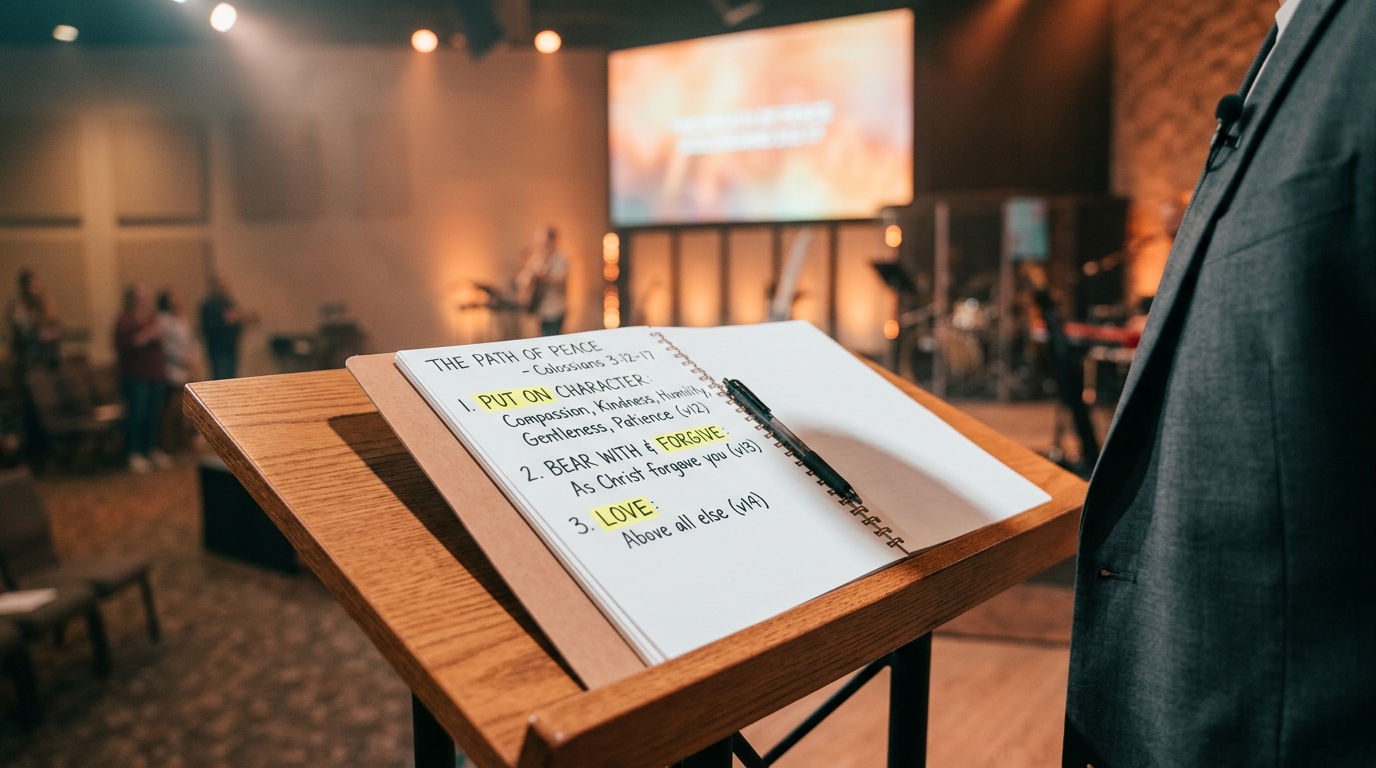
Technique #5: Work with Your Sermon Manuscript. If you preach from a manuscript or detailed notes, mark them up with vocal cues. Underline words to emphasize. Write "PAUSE" where you need to slow down. Write "softer" or "urgent" in the margins to remind yourself of tonal shifts. Draw arrows to indicate pitch changes.
This isn't about being robotic—it's about training yourself to think about delivery while you're preparing content. Over time, these marked cues become internalized, and you won't need to write them down anymore. But in the development phase, visual reminders help.
Preach Better's analysis specifically tracks vocal variety patterns across your messages, showing you where you naturally use dynamics well and where you tend to flatten out. The platform measures pitch range, pace variation, and volume shifts, then ties specific feedback to transcript moments—so you can hear exactly what "limited vocal range in this section" sounds like and practice improving it.
What to Look For When Evaluating Your Vocal Variety
Self-evaluation is crucial for improvement, but you need to know what to listen for. Here's a practical framework for assessing your vocal dynamics.
Pitch Assessment: Listen to a 5-minute segment of your sermon. Does your pitch vary noticeably, or does it stay in a narrow band? Can you identify moments where your pitch rises for emphasis or drops for gravity? Communication experts recommend that effective speakers use at least a 1-octave range within any 5-minute segment.
Pace Assessment: Time your speaking rate in different sections. Are you consistently at 140-160 words per minute throughout, or do you speed up and slow down based on content? Narrative sections should typically be faster (160-180 wpm). Application sections should typically be slower (120-140 wpm). If your pace doesn't vary by at least 20%, you're likely speaking in a monotone rhythm.
Volume Assessment: Listen for volume variation. Do you use both louder and softer speaking levels, or do you maintain consistent volume throughout? Are your volume changes connected to content (louder for celebration, softer for intimacy), or are they random?
Tone Assessment: This is the most subjective but perhaps most important. Does your voice convey the emotion of the content? When you're preaching about God's love, does your voice sound warm? When you're addressing sin, does your voice carry appropriate weight? When you're celebrating grace, does joy come through?
Authenticity Check: Does your preaching voice sound like you, or does it sound like you're performing? If a friend heard your sermon without seeing you, would they recognize your voice and personality, or would they think it was someone else?
For more on comprehensive delivery evaluation, see our guide on how to evaluate sermon delivery and the four sermon delivery pillars framework.
Vocal Variety and the Four Pillars of Sermon Delivery
Vocal variety isn't isolated from other aspects of delivery—it works in concert with the four pillars that make communication effective.
Clarity: Vocal variety serves clarity by helping listeners distinguish between main points and supporting details, between information and application, between what's essential and what's supplementary. When your voice doesn't vary, everything sounds equally important, which means nothing stands out as important.
Connection: Vocal variety creates connection by conveying authenticity and emotion. When your voice matches the content—warm when discussing grace, urgent when addressing need, celebratory when proclaiming truth—listeners feel that you're genuinely engaged with the message, not just delivering information.
Conviction: Vocal variety communicates conviction through intensity and confidence. A monotone delivery, even of true and important content, can sound uncertain or disengaged. Dynamic delivery signals that you believe what you're saying matters.
Call to Action: Vocal variety in your closing is essential for moving people from hearing to doing. The shift in energy, the change in pace, the appropriate urgency or invitation in your tone—these vocal cues signal that you're moving from teaching to application, from information to transformation.
Learn more about how these pillars work together at Preach Better's Four Pillars framework.
Monotone vs. Dynamic: A Side-by-Side Comparison
| Aspect | Monotone Delivery | Dynamic Delivery | |--------|------------------|------------------| | Pitch Range | 3-5 semitones (narrow band) | 1.5-2 octaves (full range) | | Pace Variation | Consistent 140-160 wpm throughout | Varies 120-180 wpm based on content | | Volume Levels | Steady, minimal variation | Strategic shifts from soft to strong | | Tonal Quality | Flat, emotionally neutral | Matches content emotion authentically | | Listener Experience | Information feels undifferentiated | Important moments stand out clearly | | Retention Impact | 25-40% lower than dynamic speech | Baseline for effective communication | | Perceived Credibility | Lower confidence and engagement | Higher authority and authenticity | | Energy Level | Steady but often feels low | Varied, creating natural rhythm | | Emphasis Technique | Relies on words alone | Uses voice to highlight meaning | | Emotional Connection | Limited, feels distant | Strong, feels personal and engaged |
Frequently Asked Questions
How much vocal variety is too much in preaching? Too much vocal variety happens when changes become distracting rather than clarifying—when every sentence is dramatic, when pitch swings are extreme, or when the variation feels performative rather than authentic. A good rule: your vocal dynamics should serve the content's meaning and emotion, not call attention to themselves. If listeners remember your vocal performance more than your message, you've overdone it.
Can you develop vocal variety if you have a naturally quiet or monotone speaking voice? Yes. Vocal variety isn't about volume or having a naturally expressive voice—it's about using more of whatever range you have. Even naturally quiet speakers can vary pitch, pace, and tone within their comfortable volume range. The key is expanding from your current baseline, not trying to become someone you're not. Small increases in range (even 20-30%) make significant differences in listener engagement.
How long does it take to develop better vocal variety in preaching? Most pastors notice improvement within 4-6 weeks of intentional practice, with significant change visible after 3-4 months. The timeline depends on how much you practice outside of Sunday—recording yourself, reading Scripture aloud with expression, and using vocal variety in everyday conversation. Like any skill, vocal dynamics improve faster with focused, consistent practice than with occasional attention.
Should vocal variety be different for online sermons versus in-person preaching? Yes, slightly. Online sermons often benefit from more frequent vocal variation because viewers have more distractions and shorter attention spans. However, the principles remain the same—match your voice to your content, use dynamics to emphasize meaning, and stay authentic. The main technical difference is being more mindful of microphone technique, since audio quality matters more when that's the only sensory input.
What if my congregation is used to monotone preaching and finds vocal variety distracting? This is rare but can happen in traditions where steady, measured delivery is the norm. The solution is gradual change—add 10-20% more variation each month rather than making a dramatic shift overnight. Focus first on matching tone to content (warm for grace, serious for sin) rather than dramatic pitch or volume changes. Most congregations adapt quickly when they realize the variety serves clarity and connection.
How do I know if I'm using my natural voice or adopting a "preacher voice"? Record yourself preaching, then record yourself having an animated conversation with a friend about something you care about. Compare the two recordings. If your preaching voice sounds significantly different—more formal, less expressive, or like you're performing—you've adopted a preacher voice. Your preaching should sound like an elevated version of your natural speaking voice, not a completely different person.
About Preach Better: Preach Better is a sermon delivery analysis platform that helps pastors get honest, specific feedback on their communication. Built around four pillars—Clarity, Connection, Conviction, and Call to Action—it provides coaching grounded in specific moments from your message, not vague generalities. The platform's vocal variety analysis tracks your pitch range, pace variation, and tonal shifts across messages, showing you exactly where you're using dynamics well and where you could expand your range.
The Bottom Line on Vocal Variety in Preaching
Vocal variety isn't about performance—it's about clarity. It's about using your voice as the tool it is to serve the message you're delivering. The difference between monotone and dynamic preaching isn't talent or personality; it's awareness and practice.
Here's what matters most: Your congregation doesn't need you to sound like anyone else. They need you to sound like you—the full, expressive, authentic you that shows up in conversations when you're excited, concerned, or moved. That voice is already in you. The work is simply learning to access it consistently when you're communicating God's Word.
Start small. Record your next sermon and listen for one dimension—pitch, pace, volume, or tone. Pick one area to work on for the next month. Practice in everyday conversations. Mark up your manuscript with vocal cues. Get feedback from someone you trust.
Your message deserves to be heard with the full weight, joy, urgency, or tenderness it carries. Your voice is the vehicle. Make it worthy of the cargo.
If you want specific, actionable feedback on your vocal variety tied to exact moments in your sermons, Preach Better analyzes your delivery across all four pillars and shows you precisely where to focus your growth. Because every message matters—and how you deliver it matters just as much as what you say.