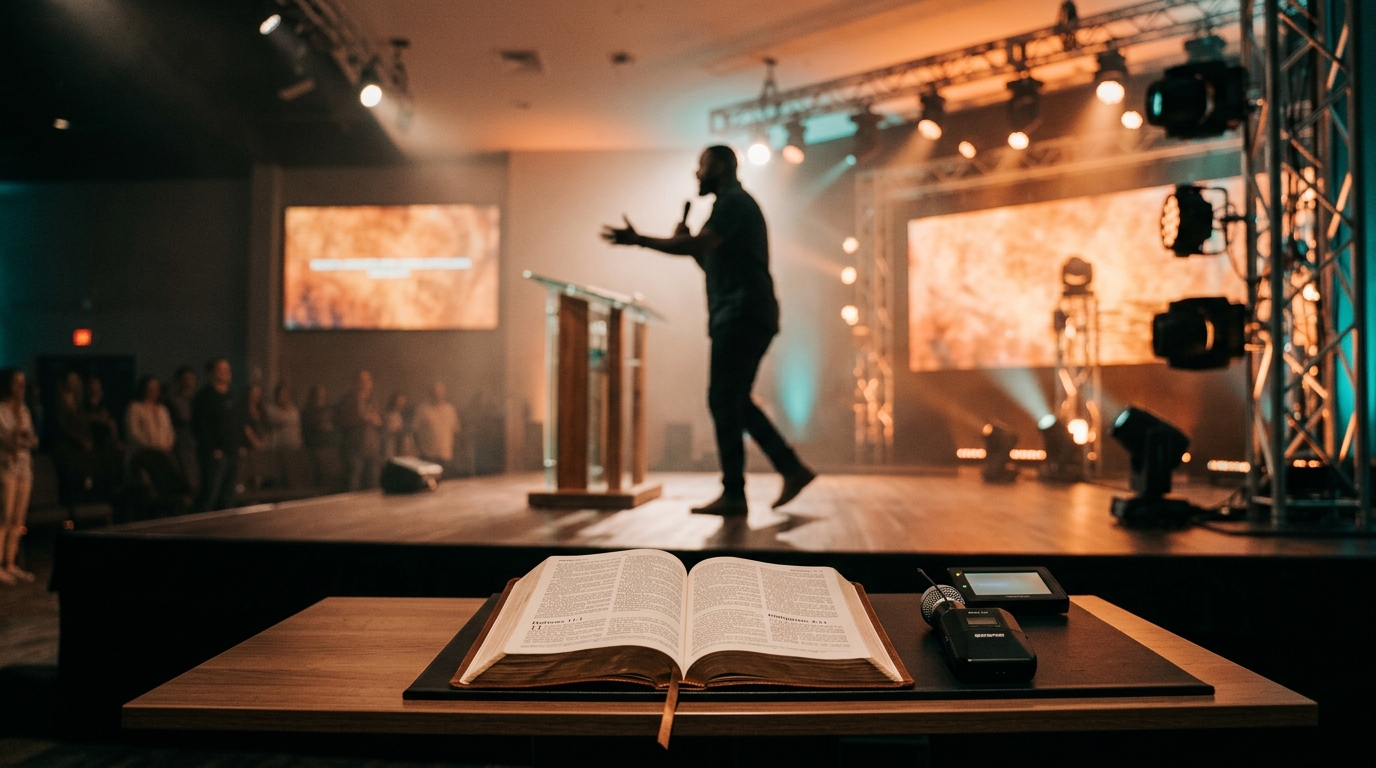
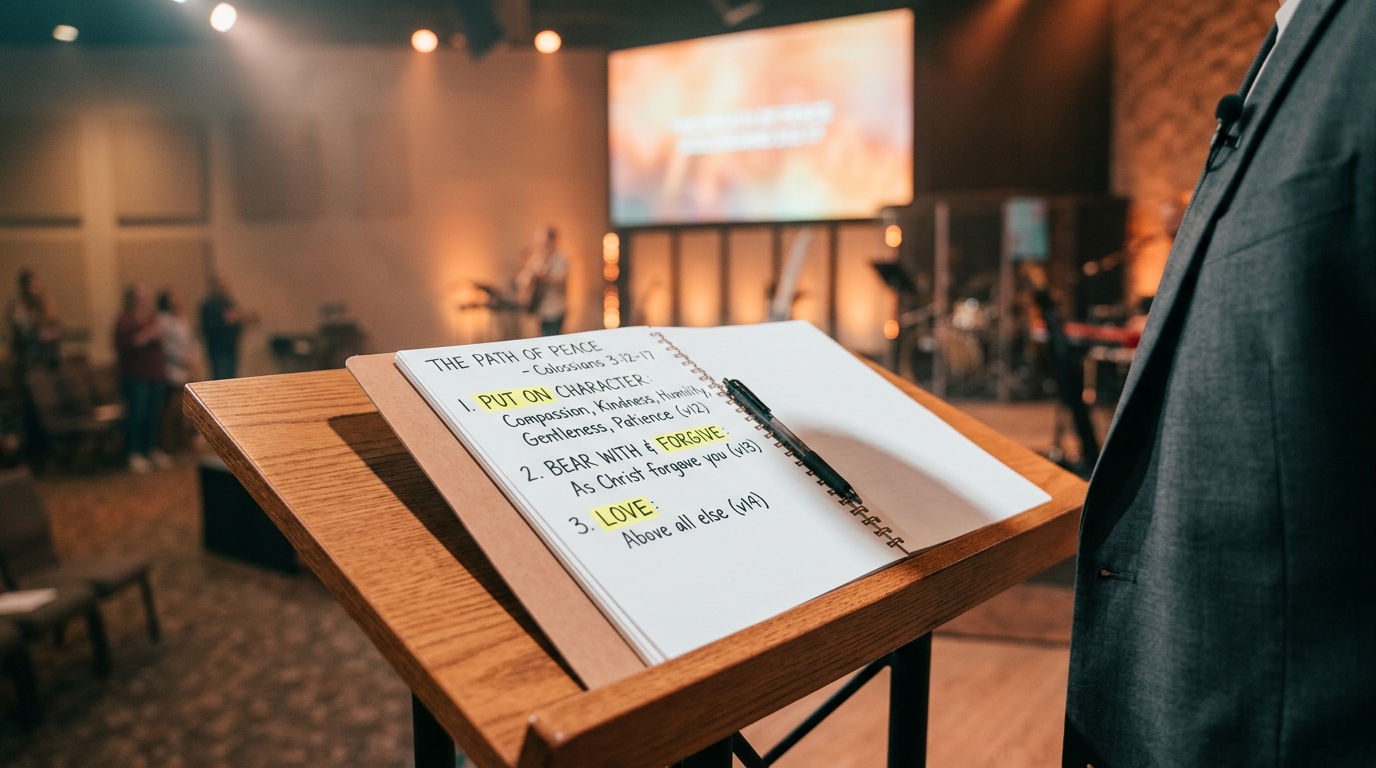
You've spent hours crafting the perfect sermon. Every transition is smooth, every illustration is precise, every theological point is sound. But when you step into the pulpit with your manuscript, something feels off. Your eyes are glued to the page. Your delivery feels stiff. The connection you felt while writing evaporates when you start reading.
Preaching with a manuscript doesn't have to feel like reading a term paper to your congregation. The best manuscript preachers sound conversational, maintain eye contact, and connect deeply—all while having every word carefully prepared. At Preach Better, we analyze thousands of sermons and see this pattern clearly: manuscript delivery isn't the problem. Poor manuscript technique is.
In this guide, you'll learn practical manuscript delivery techniques that let you preach with precision without sacrificing connection. Whether you're new to manuscript preaching or you've been doing it for years but feel stuck in a reading rut, these strategies will transform how you deliver prepared content.
Quick Answer: Effective manuscript preaching requires three core techniques: strategic eye contact patterns (look down for phrases, not sentences), vocal variety that matches conversational speech (varying pace and tone as if speaking spontaneously), and physical manuscript preparation (large fonts, strategic highlighting, wide margins). Pastors who master these techniques maintain 60-70% eye contact while reading, compared to 20-30% for untrained manuscript readers.
Key Takeaways
- Manuscript preparation matters as much as content — formatting, font size, and visual cues determine whether you can lift your eyes or stay buried in the page
- Eye contact patterns separate readers from preachers — looking up after phrases (not full sentences) creates natural rhythm while maintaining accuracy
- Vocal variety must be intentional — manuscript preachers who sound conversational practice inflection patterns, not just words
- Physical technique enables connection — manuscript placement, page-turning mechanics, and body positioning either facilitate or sabotage natural delivery
What Makes Manuscript Preaching Effective?
Effective manuscript preaching combines the precision of written communication with the warmth of conversational delivery. The goal isn't to hide the fact that you're using a manuscript—it's to use the manuscript as a tool that frees you to connect, not a barrier that separates you from your congregation.
Research on public speaking suggests that audiences respond more to delivery quality than preparation method. A well-delivered manuscript sermon outperforms a poorly delivered extemporaneous one every time. The difference lies in technique, not format.
The most effective manuscript preachers treat their written sermon as a script for performance, not a document to be read aloud. They understand that writing for the ear differs from writing for the eye. They use contractions. They include conversational asides. They write the way they actually speak, not the way academic papers are structured.
Consider this: when you have a meaningful conversation with a friend, you don't speak in perfectly formed paragraphs. You pause mid-thought. You emphasize certain words. You adjust your tone based on their reaction. Manuscript preaching at its best captures that same natural flow—it just happens to be carefully prepared in advance.
How to Prepare Your Manuscript for Natural Delivery
Your manuscript's physical format determines whether you can deliver it naturally. Most pastors fail at manuscript preaching not because they can't read well, but because their manuscript isn't designed for oral delivery.
Start with font size. If you're using 12-point Times New Roman, you're setting yourself up to stay buried in the page. Use 16-18 point font minimum. Your eyes need to capture full phrases in a single glance, then look up to deliver them. Small fonts force you to read word-by-word, which destroys natural rhythm.
Double or triple-space your lines. Dense text forces your eyes to work too hard to find your place when you look back down. Wide spacing lets you quickly relocate after making eye contact. Think of it like highway signs—you need to spot your location instantly, not search for it.
Use strategic highlighting or bolding for key phrases you want to emphasize. This serves two purposes: it reminds you where vocal emphasis belongs, and it creates visual landmarks that help you find your place quickly. When communication experts recommend vocal variety in manuscript delivery, they're talking about intentional emphasis—and visual cues make that possible.
Print on one side of the page only. Page-turning is already a mechanical challenge; don't compound it by forcing yourself to flip pages over. Slide finished pages to the side rather than flipping them. This creates smoother transitions and less visual disruption for your congregation.
Include margin notes for yourself: "slow down here," "pause," "look up," "smile." These reminders keep you from falling into monotone reading mode. They're coaching cues that interrupt autopilot delivery.
Why Eye Contact Patterns Matter More Than Eye Contact Percentage
Most advice about manuscript preaching focuses on "maintaining eye contact," but that's too vague to be useful. The real question is: what pattern of eye contact creates connection while maintaining accuracy?
The most effective technique is phrase-based eye contact. Look down and capture a complete phrase (4-8 words). Look up and deliver that phrase while making eye contact with a section of your congregation. Look back down for the next phrase. Repeat.
This differs fundamentally from sentence-based eye contact, where you read an entire sentence, then look up to deliver it from memory. That approach works for short sentences but breaks down with complex thoughts. You end up paraphrasing instead of delivering your carefully crafted language, which defeats the purpose of manuscript preaching.
It also differs from word-by-word reading, where your eyes never leave the page. That's not preaching—it's public reading, and your congregation can feel the difference.
Best practices in sermon delivery indicate that 60-70% eye contact is achievable with phrase-based technique. You're looking down frequently, but briefly. The rhythm becomes natural: glance, deliver, glance, deliver. Your congregation experiences connection, not interruption.
Practice this rhythm during your sermon preparation. Read a paragraph aloud using phrase-based eye contact. It will feel awkward at first. Your brain wants to either read everything or memorize everything. Train yourself to live in the middle—prepared precision with conversational delivery.
Common Manuscript Delivery Mistakes (and How to Fix Them)
The biggest mistake manuscript preachers make is treating their manuscript like a crutch instead of a tool. They apologize for using it, physically or verbally. They hunch over it. They grip the pulpit. They signal to their congregation: "I wish I didn't need this."
Instead, own your choice. Manuscript preaching is a legitimate delivery method used by some of history's most effective communicators. Your congregation doesn't need you to apologize for being prepared—they need you to deliver your preparation with confidence.
Another common mistake is failing to practice out loud. You can't evaluate manuscript delivery by reading silently. Your brain fills in inflection, pacing, and emphasis that won't naturally emerge when you're actually preaching. Practice aloud, multiple times, using the exact manuscript format you'll use on Sunday.
Many manuscript preachers also make the mistake of writing for the eye, not the ear. They use complex sentence structures that work on paper but sound convoluted when spoken. They include subordinate clauses and academic phrasing that would never appear in natural conversation.
Fix this by reading your manuscript aloud during the writing process. If a sentence feels awkward to say, rewrite it. Use contractions. Use shorter sentences. Write the way you actually talk, not the way you think sermons should sound.
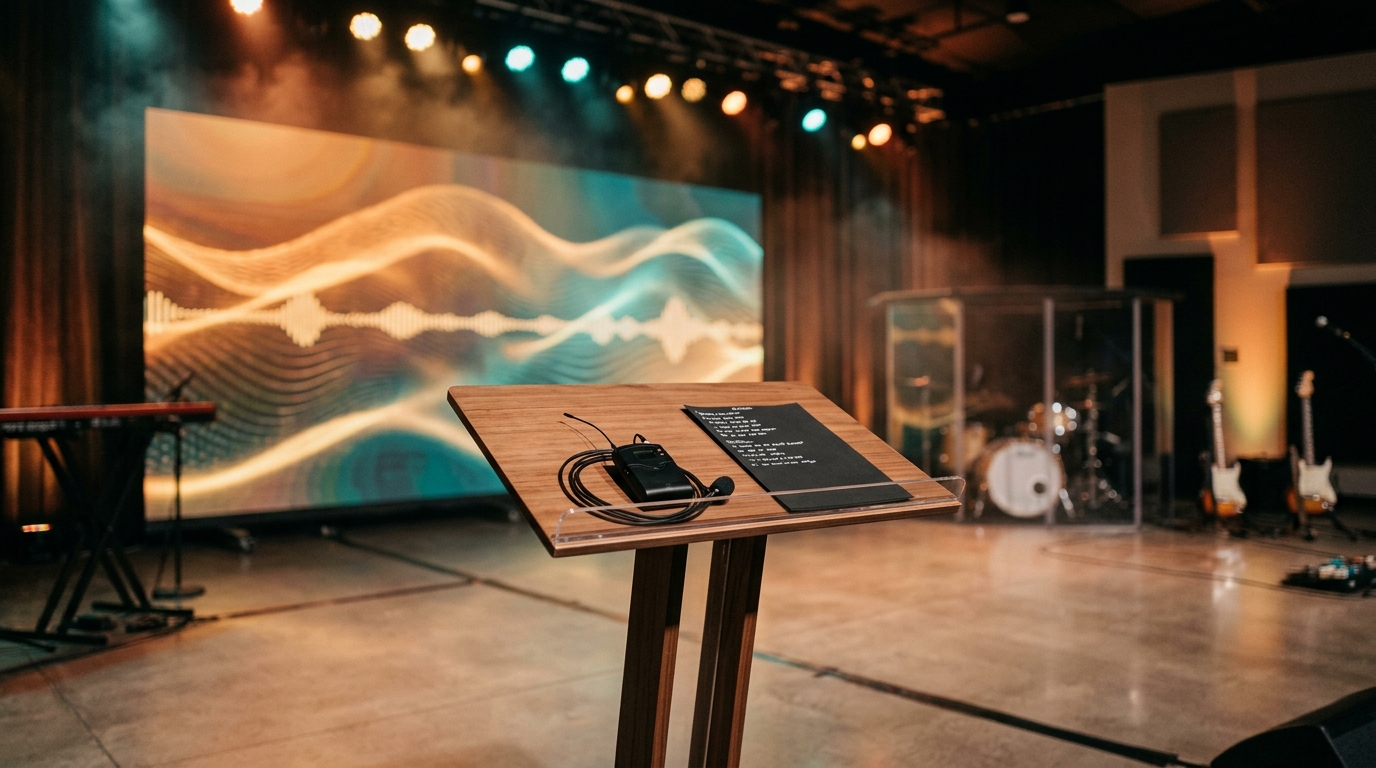
The final major mistake is poor manuscript placement. If your manuscript is flat on the pulpit, you're forcing yourself to look down at a steep angle, which breaks eye contact and creates poor posture. Use a slanted pulpit, a music stand, or a manuscript holder that positions your text at a 45-degree angle. This lets you glance down with minimal head movement, maintaining better connection with your congregation.
5 Manuscript Delivery Techniques That Create Conversational Preaching
1. The Phrase-Capture Method
Train your eyes to capture complete thought units, not individual words. A phrase like "God's grace is sufficient" should be absorbed in one glance, then delivered while looking at your congregation. This creates natural rhythm and prevents word-by-word plodding.
Practice by underlining natural phrase breaks in your manuscript. These become your visual targets—the chunks your eyes need to grab before looking up.
2. Strategic Memorization
You don't need to memorize your entire sermon, but memorizing key sections creates powerful moments of connection. Memorize your opening (first 2-3 minutes), your main transitions, and your closing. These are the moments when eye contact matters most.
When you can deliver these sections without looking down, your congregation experiences full engagement at the moments that matter most for retention and response.
3. Vocal Variety Rehearsal
Studies on audience retention show that vocal variety matters more than content complexity for keeping attention. Mark your manuscript with vocal cues: arrows for rising inflection, underlines for emphasis, brackets for slower pacing.
Then practice delivering those cues until they feel natural. Your goal is to sound like you're speaking spontaneously, even though every word is prepared.
4. The Page-Turn Pause
Don't try to hide page turns. Instead, use them as natural pause points. Finish a thought. Pause. Turn the page deliberately. Resume. This creates rhythm and gives your congregation micro-moments to process what you've said.
Rushing through page turns signals nervousness. Owning them signals confidence.
5. Physical Anchoring
Your body position affects your delivery. Stand with your weight balanced, not leaning on the pulpit. Keep your manuscript hand relaxed, not gripping. Use your free hand for natural gestures. Physical tension translates to vocal tension, which makes manuscript reading sound stiff.
Practice delivering your sermon while standing naturally, as if the manuscript weren't there. Then add the manuscript back in without changing your physical posture.
What to Look for When Evaluating Your Manuscript Delivery
When you review a recording of your sermon (and you should), watch for these specific markers of effective manuscript delivery:
Eye contact frequency and distribution. Are you looking up regularly? Are you making eye contact with different sections of your congregation, or just one spot? Effective manuscript preachers scan the room, not just the front row.
Vocal inflection variety. Does your voice have the same range and energy as when you're having a conversation? Or does it flatten into "reading voice"? If you sound like you're reading, your congregation will disengage—even if your content is excellent.
Pacing consistency. Manuscript preachers often speed up when they're nervous or slow down when they're concentrating on reading. Natural pacing varies based on content, not comfort level. Fast for urgency, slow for emphasis, moderate for explanation.
Physical tension indicators. Are you gripping the pulpit? Hunching over? These signal discomfort with manuscript delivery. Relaxed posture signals confidence.
Transition smoothness. The moments between sections reveal whether you're reading a document or preaching a message. Effective manuscript preachers use transitions to lift their eyes, pause, and reset before the next section.
Preach Better's analysis framework evaluates these exact elements across your entire sermon, providing specific feedback tied to transcript moments. Instead of wondering "Did I sound natural?" you get concrete data: "At 8:42, your pacing accelerated during the page turn, creating rushed delivery. At 15:20, you maintained eye contact through the entire illustration, creating strong connection."
How Manuscript Preaching Fits with the Four Pillars Framework
Manuscript delivery intersects with all four pillars of effective preaching: Clarity, Connection, Conviction, and Call to Action.
Clarity is manuscript preaching's natural strength. You've chosen every word carefully. Your logic flows. Your illustrations are precise. The challenge is delivering that clarity without sounding academic or distant.
Connection is where manuscript preachers often struggle. The manuscript can become a barrier between you and your congregation. But with proper technique—phrase-based eye contact, vocal variety, physical presence—manuscript delivery can create deep connection. Your congregation feels your preparation, not your distance.
Conviction in manuscript preaching comes from owning your words. When you believe what you've written and deliver it with confidence, your manuscript becomes a tool for emphasis, not a crutch for uncertainty. The best manuscript preachers sound more convinced, not less, because they've refined their message.
Call to Action benefits from manuscript precision. You know exactly what you're asking. You've crafted the invitation carefully. The danger is sounding scripted during the most crucial moment. This is why many effective manuscript preachers memorize their closing—they want full eye contact and complete freedom when they're calling for response.
Understanding how manuscript delivery affects each pillar helps you leverage its strengths and compensate for its challenges. Learn more about evaluating these elements in your preaching at https://preachbetter.app/pillars.
When to Choose Manuscript Preaching Over Other Methods
Manuscript preaching isn't the right choice for every sermon or every preacher, but it excels in specific situations.
Choose manuscript delivery when precision matters most. Complex theological topics, controversial subjects, or legally sensitive issues benefit from carefully worded content. You can't afford to misspeak or be misquoted—manuscript preaching eliminates that risk.
Manuscript delivery also works well for preachers who process thoughts through writing. If you think clearly on paper but struggle to organize extemporaneously, manuscript preaching lets you leverage your strength. Your best thinking makes it into the pulpit, not just what you can remember in the moment.
Some preaching contexts favor manuscript delivery. Formal settings, traditional liturgical environments, or congregations with academic expectations often respond well to carefully prepared manuscripts. The formality signals respect and seriousness.
However, manuscript preaching requires more practice time than other methods. If you're preaching multiple times per week or in highly interactive environments (like youth ministry), the time investment may not be sustainable. For more on choosing the right preparation method for your context, see Sermon Preparation Methods: Manuscript, Notes, or Memory?.
How to Practice Manuscript Delivery Before Sunday
Effective manuscript delivery requires specific practice, not just content preparation. Here's a practical rehearsal process:
Day 1-3: Write for the ear. As you draft your sermon, read each paragraph aloud. If it sounds written, revise it. Use contractions. Simplify complex sentences. Include conversational asides. Your manuscript should sound like you, not like a theology textbook.
Day 4: Format your manuscript. Large font. Wide spacing. Strategic highlighting. Margin notes. Print it exactly as you'll use it on Sunday. Don't wait until Saturday night to discover your font is too small.
Day 5: Practice phrase-based eye contact. Read through your entire sermon using the phrase-capture method. Don't worry about perfection—just establish the rhythm. Your goal is to feel comfortable looking down, capturing a phrase, and looking up to deliver it.
Day 6: Practice with vocal variety. Focus on inflection, pacing, and emphasis. Record yourself. Listen back. Do you sound conversational or monotone? Adjust your delivery, not just your content.
Day 7: Full dress rehearsal. Preach your sermon exactly as you will on Sunday. Same manuscript. Same standing position. Same physical movements. Time yourself. Identify rough spots. Make final adjustments.
This process takes time, which is why many pastors avoid manuscript preaching. But the payoff is significant: precision without distance, preparation without stiffness. For more on building a sustainable preparation routine, see Sermon Preparation Routine: Build a Weekly System That Actually Works.
Manuscript Delivery and Audience Engagement
One concern many pastors have about manuscript preaching is audience engagement. Won't people tune out if they see you reading?
According to homiletics research, audiences respond to delivery quality, not preparation method. A manuscript preacher who maintains eye contact, uses vocal variety, and delivers with conviction will engage more effectively than an extemporaneous preacher who rambles, loses their train of thought, or delivers without energy.
The key is making your manuscript delivery feel conversational, not scripted. This requires intentional technique:
-
Pause frequently. Silence creates space for processing. Manuscript preachers often rush because they're focused on getting through content. Resist that urge. Pause after key statements. Let your words land.
-
React to your congregation. Even with a manuscript, you can respond to visible reactions. If people laugh, acknowledge it. If you see confusion, add a clarifying sentence (even if it's not in your manuscript). Flexibility within structure creates authenticity.
-
Use your manuscript strategically. You don't have to read every word. If you know a section well, deliver it from memory. If you need precision, use the manuscript. This variation keeps your delivery dynamic.
-
Incorporate interactive elements. Ask rhetorical questions. Invite verbal responses. Use call-and-response. These techniques work with manuscript preaching—they just require planning. For more on this approach, see Sermon Call and Response: How to Use Congregation Participation Without Losing Control.
Engagement isn't about abandoning preparation—it's about delivering preparation in a way that invites participation.
Frequently Asked Questions
Is it okay to preach with a full manuscript, or should I try to memorize more?
Preaching with a full manuscript is completely legitimate and used by many effective communicators. The question isn't whether you should use a manuscript, but whether you can deliver it naturally. Focus on technique—phrase-based eye contact, vocal variety, physical presence—rather than memorization. Some preachers benefit from memorizing key sections (opening, closing, main transitions) while using the manuscript for the body, creating a hybrid approach that combines precision with freedom.
How can I maintain eye contact while reading my sermon?
Use phrase-based eye contact: look down and capture a complete phrase (4-8 words), look up and deliver that phrase while making eye contact, then look back down for the next phrase. This creates natural rhythm and allows 60-70% eye contact. Avoid trying to memorize full sentences, which leads to paraphrasing, or reading word-by-word, which eliminates connection. Practice this rhythm during sermon preparation until it feels automatic.
What font size and formatting should I use for my sermon manuscript?
Use 16-18 point font minimum (larger if your eyesight requires it), double or triple-spaced lines, and print on one side of the page only. Use strategic highlighting or bolding for emphasis points, and include wide margins for personal notes like "slow down" or "pause." Format your manuscript at a 45-degree angle using a slanted pulpit or stand, not flat on the pulpit surface. These formatting choices determine whether you can lift your eyes or stay buried in the page.
How do I avoid sounding like I'm just reading to my congregation?
Write for the ear, not the eye—use contractions, conversational language, and sentence structures that match how you actually speak. Practice vocal variety by marking inflection cues in your manuscript and rehearsing them until they sound natural. Use strategic pauses, especially at page turns and between sections. Memorize your opening, closing, and main transitions so you can deliver those sections with full eye contact. Record yourself practicing and listen for "reading voice" versus "conversational voice," then adjust your delivery accordingly.
Should I acknowledge that I'm using a manuscript, or try to hide it?
Own your choice rather than apologizing for it. Manuscript preaching is a legitimate method that prioritizes precision and careful preparation. Don't hunch over your manuscript or grip the pulpit—stand naturally and deliver with confidence. Most congregations don't object to manuscript use; they object to poor delivery. If you deliver your manuscript with eye contact, vocal variety, and genuine connection, your congregation will experience engagement, not distance. The manuscript is a tool, not a barrier—treat it that way.
How long does it take to get comfortable preaching with a manuscript?
Most pastors need 8-12 sermons to develop natural manuscript delivery technique. The first few attempts will feel mechanical as you consciously practice phrase-based eye contact and vocal variety. With repetition, these techniques become automatic, and you can focus on content and connection rather than mechanics. Consistent practice—including weekly dress rehearsals where you preach your full sermon aloud—accelerates this learning curve. Don't judge manuscript preaching based on your first attempt; evaluate it after you've developed the skill.
About Preach Better: Preach Better is a sermon delivery analysis platform that helps pastors get honest, specific feedback on their communication. Built around four pillars—Clarity, Connection, Conviction, and Call to Action—it provides coaching grounded in specific moments from your message, not vague generalities. For manuscript preachers, Preach Better identifies exactly when your delivery becomes stiff, when eye contact drops, and when vocal variety flattens, giving you concrete targets for improvement.
Bottom Line: Manuscript Delivery Is a Skill, Not a Limitation
Preaching with a manuscript doesn't limit your effectiveness—poor manuscript technique does. When you prepare your manuscript for oral delivery, practice phrase-based eye contact, and deliver with vocal variety and physical confidence, manuscript preaching becomes a powerful tool for precision and connection.
The pastors who excel at manuscript delivery treat it as a skill to develop, not a format to tolerate. They invest time in formatting, practice, and technique refinement. They understand that writing for the ear differs from writing for the eye. They own their choice rather than apologizing for it.
Your congregation doesn't need you to preach without a manuscript. They need you to preach with clarity, connection, conviction, and a clear call to action—and manuscript delivery, done well, delivers all four.
If you're ready to move beyond guessing whether your manuscript delivery is working, Preach Better provides the specific feedback you need. Upload your sermon audio, and you'll get detailed analysis of your eye contact patterns, vocal variety, pacing, and connection moments—tied to specific timestamps in your message. Because the best manuscript preachers don't just prepare well. They deliver well. And that's a skill you can measure, practice, and master.
Start improving your manuscript delivery today at https://preachbetter.app/get-started.