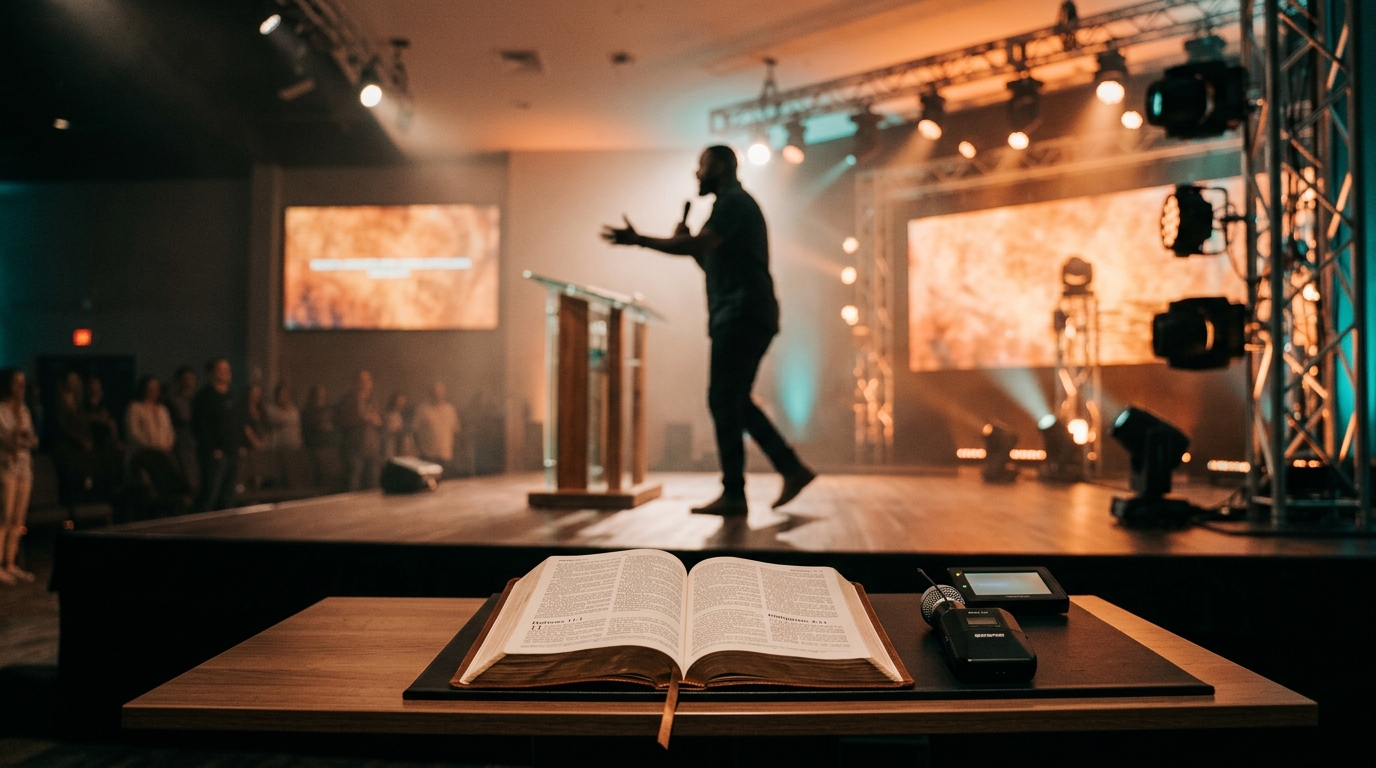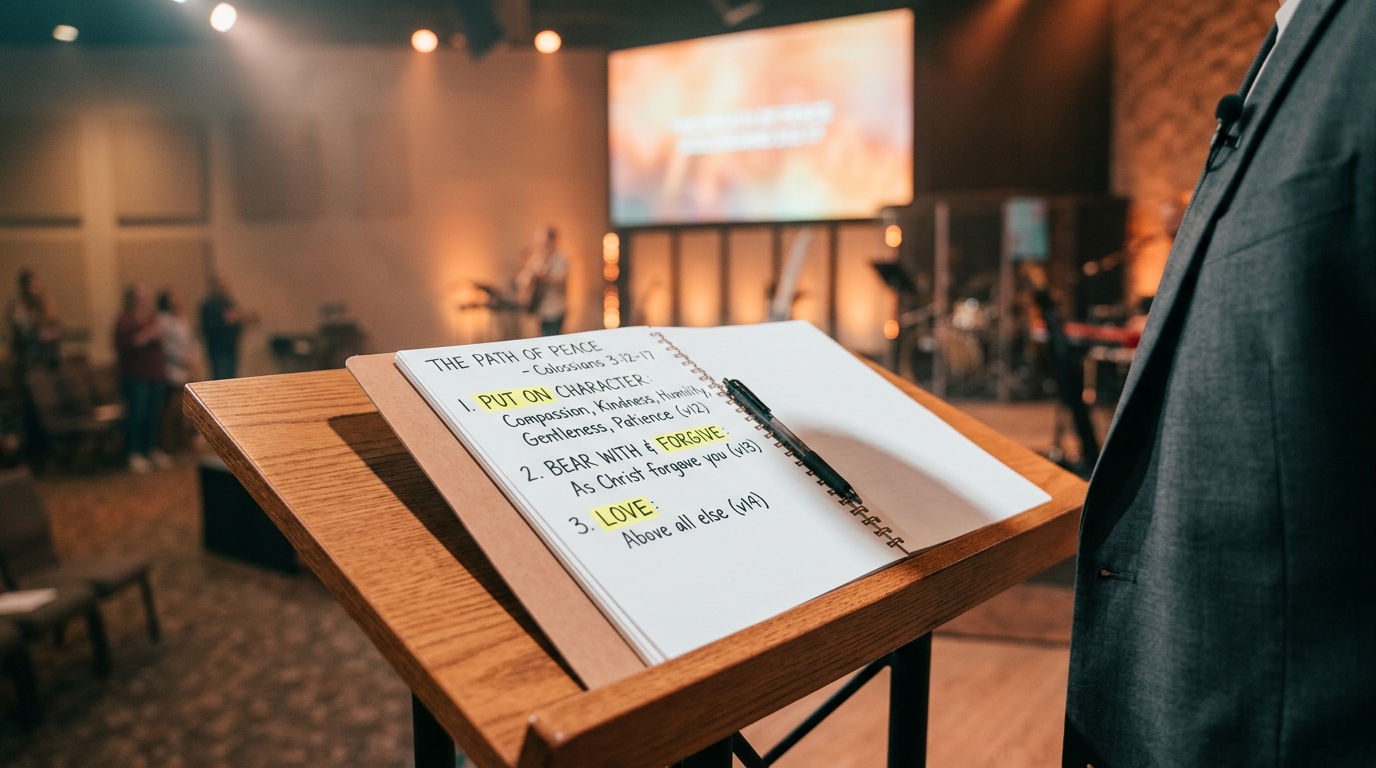
You've prepared a solid sermon. Your theology is sound, your illustrations are compelling, and your application is clear. But fifteen minutes in, you notice people checking their phones. By minute twenty-five, you've lost half the room. The problem isn't your content—it's your preaching rhythm.
Preaching rhythm is the pattern of speed, pause, emphasis, and vocal variation that carries your message from your mouth to your congregation's hearts. It's the difference between a sermon that feels like a conversation and one that feels like a lecture. Research on public speaking suggests that rhythm affects retention more than content quality—listeners remember messages delivered with varied cadence up to 40% better than those delivered in monotone.
For new pastors, finding your preaching rhythm can feel like learning to drive a manual transmission. You're focused on so many things—your notes, your theology, your body language—that the natural flow of your delivery gets lost. But rhythm isn't something you manufacture. It's something you discover and refine. This guide will show you how to identify your natural sermon cadence, recognize when you've lost it, and develop the vocal control that keeps your congregation engaged from opening prayer to final amen.
Quick Answer: Preaching rhythm is the natural pattern of speed, pauses, and vocal emphasis in your delivery. Most effective preachers vary their tempo every 45-90 seconds, using a base pace of 140-160 words per minute with intentional slowdowns to 100-120 wpm for key points and accelerations to 180-200 wpm for narrative sections. The key is variation, not speed.
Key Takeaways:
- Rhythm is discovered, not invented — your natural conversational cadence is your starting point, not someone else's preaching style
- Variation beats consistency — changing your tempo every 60-90 seconds keeps attention better than maintaining one "perfect" pace
- Pauses create rhythm — strategic silence is part of your cadence, not an interruption of it
- Energy follows rhythm — your vocal tempo directly affects perceived passion and conviction
What Makes Preaching Rhythm Different from Regular Speaking?
Preaching rhythm differs from conversational speech because it must sustain attention over 25-40 minutes while conveying complex ideas to a diverse audience. In normal conversation, you naturally adjust your pace based on immediate feedback—nods, questions, facial expressions. In preaching, that feedback loop is delayed or absent, so your rhythm must compensate.
Communication experts recommend thinking of sermon cadence as musical phrasing rather than metronome timing. A song doesn't maintain one tempo throughout—it builds, releases, emphasizes, and rests. Your preaching should do the same. The most engaging preachers shift their tempo based on content type: they slow for theological depth, accelerate through narrative, pause before application, and build intensity toward climactic moments.
Your base rhythm—the pace you return to between variations—should mirror your natural speaking voice in animated conversation. Record yourself talking with a friend about something you're passionate about. That's your baseline. Most pastors discover their conversational pace falls between 140-160 words per minute. Your preaching rhythm should orbit this center, varying 20-40 wpm in either direction based on content and emphasis.
How to Identify Your Natural Sermon Cadence
Your natural preaching rhythm already exists—you just need to isolate it from the nervous habits and borrowed styles that obscure it. Start by recording a sermon or teaching session where you felt particularly connected to your material. Don't listen to the content. Listen to the delivery. Notice where you naturally speed up (usually stories or familiar concepts) and where you slow down (complex ideas or emotional moments).
Best practices in sermon delivery indicate that your natural rhythm emerges most clearly in three contexts: when you're illustrating with personal stories, when you're responding to a question you're passionate about, and when you're teaching a concept you've mastered. These moments reveal your authentic vocal tempo because you're not thinking about delivery—you're focused on communication.
Pay attention to your breath patterns. Your natural rhythm aligns with your respiratory cycle. If you're constantly running out of air mid-sentence, you're fighting your natural cadence. If you're taking breaths in awkward places, you're probably mimicking someone else's rhythm instead of using your own. Your body knows how to pace speech for optimal oxygen exchange—trust it.
Create a "rhythm baseline" by transcribing three minutes of your most natural preaching and counting the words. Divide by three to get your words-per-minute average. This number is your home base. Effective preaching rhythm means varying from this baseline intentionally, not abandoning it entirely.
Why Monotone Rhythm Kills Engagement (Even with Great Content)
Monotone rhythm doesn't mean speaking in one pitch—it means maintaining one tempo. Studies on audience retention show that listeners begin to tune out after 90-120 seconds of unchanging vocal pace, regardless of content quality. Your brain interprets consistent rhythm as background noise, like a ceiling fan or highway traffic. Variation signals importance.
The problem for new pastors is that anxiety often flattens rhythm. When you're nervous, you default to one of two patterns: either racing through your material at 200+ wpm to "get it over with," or slowing to a cautious 100-120 wpm to avoid mistakes. Both create monotony because they eliminate variation. Your congregation doesn't need you to be fast or slow—they need you to be dynamic.
Monotone rhythm also undermines emotional connection. According to homiletics research, listeners gauge a speaker's conviction not by volume but by rhythmic variation. A pastor who maintains the same tempo while describing God's grace, human sin, and the church potluck sounds equally passionate (or dispassionate) about all three. Your rhythm communicates what matters to you.
The fix isn't to artificially inject "energy" by speaking faster or louder. It's to let your content dictate your cadence. Heavy theological concepts earn slower delivery. Narrative moments accelerate naturally. Application points benefit from measured, deliberate pacing. When your rhythm matches your content, engagement follows.
How to Vary Your Tempo Without Sounding Artificial
The key to natural tempo variation is anchoring changes to content shifts, not arbitrary timing. Every sermon contains natural rhythm markers: transitions between points, shifts from exposition to application, moves from Scripture to illustration. These are your tempo change opportunities.
Start with a simple framework: Slow for depth, accelerate for narrative, pause for emphasis, build for climax. When you're unpacking a complex theological concept, drop to 100-120 wpm. Let each phrase land before moving to the next. When you're telling a story, allow your natural narrative pace to emerge—usually 160-180 wpm. Before your main application point, insert a 2-3 second pause, then deliver the point at your baseline tempo with clear enunciation.
Practice tempo shifts in your sermon preparation. Mark your manuscript or notes with rhythm cues: "SLOW" for theological sections, "NATURAL" for transitions, "BUILD" for climactic moments, "PAUSE" before key applications. These aren't performance notes—they're reminders to let content shape cadence.
Avoid the "gear shift" effect where tempo changes feel abrupt. Transition gradually over 2-3 sentences. If you're moving from a fast-paced story to a slow theological point, use a transitional sentence at medium tempo: "Now, here's what that story reveals about God's character..." Then downshift into your slower, more deliberate exposition.
Record yourself practicing tempo variations with a single paragraph. Read it once at your baseline. Read it again, slowing the first sentence and accelerating the last. Read it a third time, inserting a pause mid-paragraph. Listen back. Which version feels most natural? That's your rhythm signature.
Common Preaching Rhythm Mistakes (and How to Fix Them)
The most common rhythm mistake new pastors make is the sprint finish—accelerating as the sermon progresses because they're anxious to reach the end or running out of time. This undermines your conclusion, which should be your most deliberate, measured section. If you find yourself speeding up in the final ten minutes, you're either over-prepared (too much content) or under-confident (rushing to escape).
Fix: Build a time cushion into your preparation. Plan for 25 minutes of content in a 30-minute slot. Mark your manuscript with time checks: "15 minutes," "20 minutes." If you hit these markers early, slow down. If you're behind, cut a section—don't accelerate.
The second mistake is rhythm mimicry—copying another preacher's cadence instead of developing your own. You've heard a communicator you admire, and you unconsciously adopt their tempo patterns. The problem is that borrowed rhythm always sounds forced because it doesn't match your natural vocal patterns or personality.
Fix: Study other preachers for principles, not patterns. Notice when they vary tempo (content shifts, emphasis points) but don't copy how they do it. Your rhythm should sound like you having an important conversation, not like you impersonating someone else.
The third mistake is pause anxiety—filling every potential silence with words because you're uncomfortable with quiet. This eliminates one of your most powerful rhythm tools. Strategic pauses aren't awkward gaps; they're essential punctuation that gives your congregation time to process and anticipate.
Fix: Practice pausing in low-stakes environments. In casual conversations, insert a 2-second pause before answering a question. In prayer, pause between petitions. Train yourself to experience silence as a communication tool, not a delivery failure. For more on this, see our guide on strategic pauses in preaching.
The fourth mistake is energy confusion—equating fast tempo with passion and slow tempo with boredom. Some of the most powerful preaching moments happen at 100 wpm with clear enunciation and strong eye contact. Speed doesn't equal conviction; intentionality does.
Fix: Separate tempo from intensity. You can deliver a slow-paced sentence with high energy through vocal emphasis, facial expression, and body language. Practice saying the same sentence at three different speeds with the same level of conviction. Record it. You'll hear that passion transcends pace.
What to Look For When Evaluating Your Preaching Rhythm
When reviewing a recorded sermon, listen for tempo variation frequency. Effective preachers shift their pace every 60-90 seconds. If you maintain the same tempo for three minutes or more, you've likely lost rhythmic engagement. Count how many times your speed changes in a ten-minute segment. Aim for 6-8 noticeable shifts.
Listen for pause placement and duration. Are your pauses strategic (before key points, after questions, during transitions) or random (mid-thought, awkward breaks)? Time your longest pause. If it's under 1.5 seconds, you're probably not pausing enough. If it's over 5 seconds without intentional dramatic effect, you may have lost your place.
Evaluate content-rhythm alignment. Does your tempo match your material? Theological exposition should be slower than narrative. Application should be measured and clear, not rushed. If you're racing through your main points and slowing down for tangential stories, your rhythm is working against your content.
Check for rhythm consistency across sermons. Record three different messages and compare tempo patterns. Do you always speed up in the same sections (introductions, conclusions)? Do you always slow down when reading Scripture? Patterns reveal habits. Some habits are good (slowing for Scripture shows reverence). Others need correction (always rushing conclusions).
Notice breath control. Are you running out of air mid-sentence? That's a sign you're speaking too fast for your lung capacity or taking breaths in unnatural places. Your rhythm should align with your respiratory cycle. If it doesn't, you're fighting your body's natural tempo.
For a comprehensive approach to evaluating all aspects of your delivery, including rhythm, check out how to evaluate sermon delivery using a structured self-assessment framework.
How Rhythm Connects to the Four Pillars of Sermon Delivery
Preaching rhythm isn't an isolated technique—it's integrated with every aspect of effective communication. At Preach Better, we evaluate sermons through four pillars: Clarity, Connection, Conviction, and Call to Action. Rhythm affects all four.
Clarity depends on rhythm because tempo determines comprehension. Complex ideas require slower delivery—120 wpm or less—to give listeners time to process. If you're racing through theological concepts at 180 wpm, you're prioritizing coverage over clarity. Rhythmic variation also aids clarity by signaling transitions: a pause before "Here's the second point" tells your congregation to shift mental gears.
Connection emerges when your rhythm feels conversational rather than performative. Listeners connect with preachers whose cadence mirrors natural speech patterns—varied, responsive, human. Monotone rhythm creates distance. Dynamic rhythm builds intimacy. When you slow down for a personal story, you're inviting your congregation into a moment. When you pause before a vulnerable admission, you're creating space for empathy.
Conviction is communicated through rhythmic emphasis. The moments you slow down signal importance. The points you repeat with varied tempo show passion. According to communication research, listeners judge a speaker's confidence not by volume but by vocal control—the ability to modulate pace intentionally rather than nervously. A pastor who can slow to 100 wpm for a weighty truth and accelerate to 180 wpm for a celebratory declaration demonstrates mastery, not just enthusiasm.
Call to Action requires deliberate rhythm. Your closing challenge should be your most measured, intentional section—not your fastest. If you rush through "So what do we do with this?" you communicate that application is an afterthought. If you slow down, pause strategically, and deliver your call with clear cadence, you signal that this is the point of everything that came before.
You can explore how these four pillars work together in our complete framework guide.
5 Exercises to Develop Better Preaching Rhythm
1. The Metronome Drill Set a metronome to 140 bpm (your likely baseline). Read a paragraph of your sermon manuscript in sync with the beat—one syllable per click. Then slow the metronome to 100 bpm and read the same paragraph. Then increase to 180 bpm. This trains your ear to recognize different tempos and your voice to shift between them intentionally.
2. The Conversation Recording Record yourself in an animated conversation about something you care deeply about (not sermon-related). Transcribe three minutes and count words per minute. This is your authentic rhythm. Now record yourself preaching and compare. If there's a 40+ wpm difference, you're not bringing your natural cadence to the pulpit.
3. The Content-Based Tempo Map Take a completed sermon manuscript. Color-code sections: blue for theological depth (slow), green for narrative (natural/fast), yellow for application (measured), red for climax (building intensity). Practice reading with tempo shifts at each color change. This trains you to let content dictate cadence.
4. The Pause Timer Practice inserting pauses of specific durations. Set a timer and practice 1-second, 2-second, and 3-second pauses. Learn what each feels like so you can deploy them intentionally. A 1-second pause is a breath. A 2-second pause is emphasis. A 3-second pause is dramatic weight. Most new pastors underestimate pause duration by 50%.
5. The Rhythm Transcription Choose a preacher whose rhythm you admire. Transcribe five minutes of their sermon and mark tempo shifts. Don't copy their style—analyze their strategy. When do they slow down? When do they speed up? What content triggers each shift? Apply the principles to your own material in your own voice.
For more on developing your unique preaching voice, see our guide on how new pastors can find their voice without copying others.
How Preaching Rhythm Affects Perceived Sermon Length
Your congregation's experience of sermon length is determined more by rhythm than by actual duration. A 35-minute sermon with strong rhythmic variation feels shorter than a 25-minute sermon delivered in monotone. Studies on audience retention show that listeners perceive time as passing faster when they experience regular novelty—and tempo changes create that novelty.
This is why the same congregation that complains about "long sermons" will sit through a 45-minute message from a guest speaker without checking their watches. The difference isn't content or charisma—it's rhythmic engagement. When your cadence varies every 60-90 seconds, your listeners' brains stay alert, anticipating the next shift. When your tempo flatlines, their attention drifts and time drags.
The practical application: if you're struggling with sermon length, don't just cut content—increase rhythmic variation. A well-paced 30-minute sermon will feel more engaging than a rushed 20-minute sermon. Mark your manuscript with tempo cues. Practice shifting speeds. Insert strategic pauses. Your congregation will experience the same content as shorter and more compelling.
Rhythm also affects retention. Messages delivered with varied cadence are remembered better because tempo changes create mental bookmarks. When you slow down for a key point, that shift in pace helps your congregation file the information as important. When you pause before application, that silence creates anticipation that aids memory formation.
For more on managing sermon length and pacing, see our research-backed guide on ideal sermon length and our article on sermon pacing.
Frequently Asked Questions
What is the ideal speaking pace for preaching? There's no single ideal pace—effective preaching rhythm varies between 100-180 words per minute depending on content. Your baseline should be 140-160 wpm (your natural conversational pace), with intentional slowdowns to 100-120 wpm for complex theology and accelerations to 160-180 wpm for narrative sections. The key is variation, not maintaining one "perfect" speed.
How do I know if I'm speaking too fast in my sermon? You're speaking too fast if you're consistently running out of breath mid-sentence, if listeners frequently ask you to repeat points after the service, or if you finish your prepared material significantly earlier than expected. Record yourself and count words per minute—if you're consistently above 180 wpm, you're likely too fast for optimal comprehension.
Should I use the same preaching rhythm for every sermon? No. Your baseline tempo should be consistent (your natural conversational pace), but your rhythmic variations should match your content. A sermon on the joy of salvation will have different tempo patterns than a sermon on suffering. Let your material dictate your cadence—theology slows you down, narrative speeds you up, application requires measured delivery.
How can I practice varying my preaching tempo without sounding artificial? Anchor tempo changes to content shifts rather than arbitrary timing. Slow down when unpacking complex ideas, accelerate during stories, pause before key applications. Practice with a manuscript color-coded by content type (theology, narrative, application) and read each section at its appropriate pace. Record yourself and listen—natural variation follows content, artificial variation follows a formula.
What's the difference between preaching rhythm and vocal variety? Preaching rhythm refers specifically to the tempo and pacing of your delivery—how fast or slow you speak and how often you vary that speed. Vocal variety is broader, including pitch changes, volume modulation, and tonal shifts. Both are essential, but rhythm is the foundation. You can have vocal variety without good rhythm, but you can't have engaging delivery without rhythmic variation. For more on vocal variety, see our guide on vocal variety in preaching.
How long should pauses be in preaching? Most effective pauses in preaching range from 1.5 to 3 seconds. A 1-second pause is a breath break. A 2-second pause creates emphasis. A 3-second pause builds dramatic tension. New pastors typically underestimate pause duration—what feels like 3 seconds to you is often only 1.5 seconds to your listeners. Practice with a timer to calibrate your internal sense of pause length.
About Preach Better: Preach Better is a sermon delivery analysis platform that helps pastors get honest, specific feedback on their communication. Built around four pillars—Clarity, Connection, Conviction, and Call to Action—it provides coaching grounded in specific moments from your message, not vague generalities. Our rhythm analysis identifies exactly where your tempo works and where it needs adjustment, with timestamp-specific feedback you can immediately apply.
Bottom Line: Rhythm Is Your Congregation's Guide
Your preaching rhythm isn't a performance technique—it's a navigation system. It tells your congregation when to lean in (you're slowing down for something important), when to follow along (you're maintaining steady pace through familiar territory), and when to anticipate (you're pausing before something significant). Without rhythmic variation, even the best content feels monotonous.
The good news for new pastors: you don't need to manufacture rhythm. You need to discover and refine the natural cadence already present in your animated conversation. Record yourself. Count your words per minute. Notice when you naturally speed up and slow down. Then bring that authentic variation to the pulpit, anchoring tempo shifts to content changes rather than nervous habits.
Start with one rhythm goal per sermon: "I'll slow down for my theological points" or "I'll pause for two full seconds before my main application." Master one element before adding another. Over time, rhythmic variation becomes instinctive—you won't think about tempo any more than you think about breathing.
Your congregation won't consciously notice your rhythm when it's working well. They'll just stay engaged, remember more, and feel like your sermon was "just the right length." That's the power of preaching rhythm—it's invisible when it's right and obvious when it's wrong.
Ready to hear exactly where your rhythm is working and where it needs refinement? Preach Better analyzes your sermon delivery and provides timestamp-specific feedback on tempo, pacing, and rhythmic variation—the kind of detailed coaching that helps you improve week over week, not year over year.