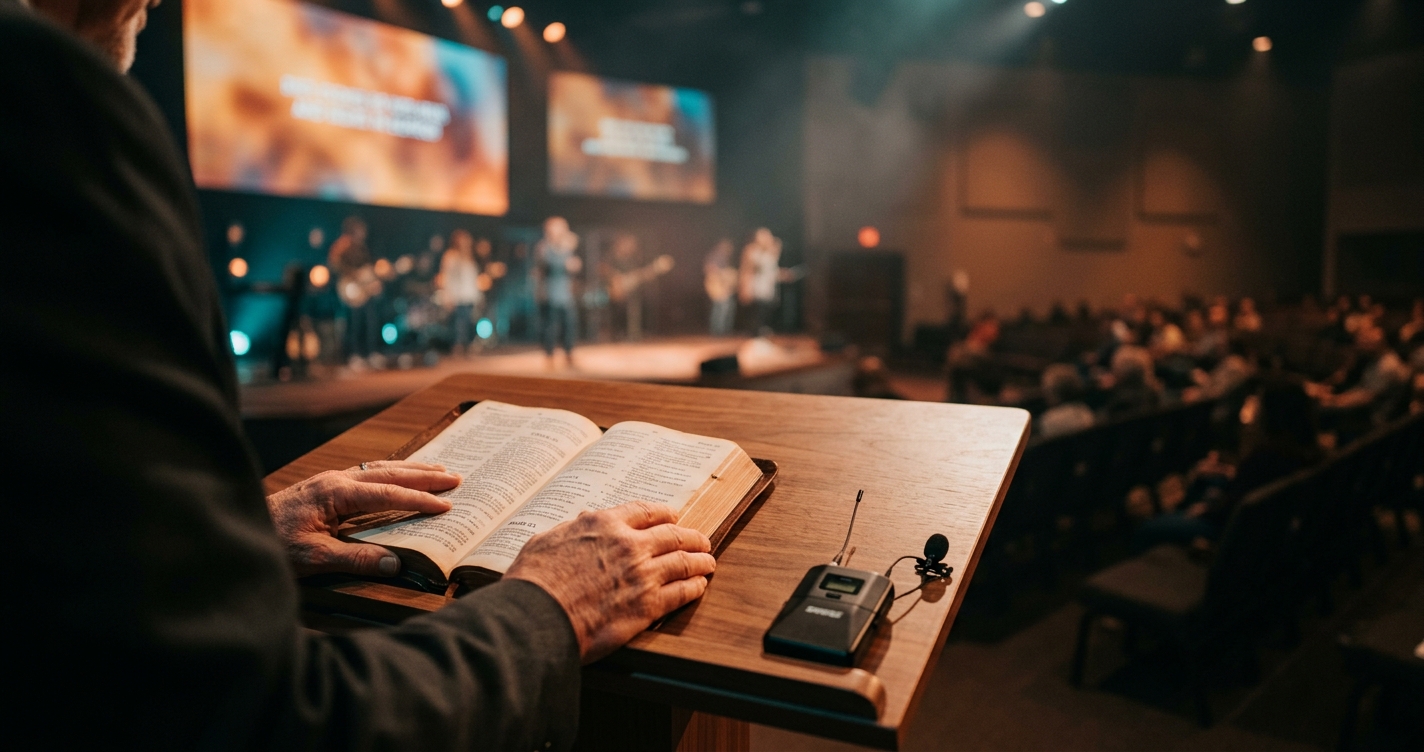

You've been called to preach. The weight of that calling sits heavy on your shoulders every Saturday night as you stare at your sermon notes, wondering if you sound too much like the podcast pastor you've been studying or not enough like the mentor who shaped your theology. The truth? Your congregation doesn't need a carbon copy of someone else's voice. They need yours.
The pressure to perform perfectly in your first months of new pastor preaching can make you reach for someone else's delivery style like a security blanket. But the pastors who connect most deeply with their congregations aren't the ones who master imitation—they're the ones who discover their authentic voice and refine it with intention. At Preach Better, we've analyzed thousands of sermons and consistently see that authenticity paired with skill creates far more impact than polished mimicry ever could.
This guide will walk you through developing your preaching style without losing yourself in the process, delivering first sermons with confidence, and building communication skills that grow stronger with every message you preach.
Quick Answer: New pastor preaching success comes from developing your authentic voice rather than imitating others. Focus on three foundations: know your natural communication strengths, study effective techniques without copying delivery styles, and get specific feedback on your actual performance. Most new preachers improve fastest when they identify 2-3 core areas to refine rather than trying to fix everything at once.
Key Takeaways
- Your authentic voice is your greatest asset — congregations connect with genuine communication, not polished performances that feel borrowed
- First sermon tips focus on preparation and presence — thorough preparation creates confidence, and confidence creates connection with your audience
- Developing preaching style takes intentional practice — record yourself, analyze specific moments, and refine one skill at a time rather than overhauling everything
- Feedback systems accelerate growth — without honest evaluation of your delivery, you'll repeat the same patterns for years without knowing what's working or what's not
What Makes New Pastor Preaching Different from Experienced Preaching?
New pastor preaching carries unique challenges that experienced preachers often forget. You're simultaneously learning your congregation's culture, establishing credibility, developing theological depth, and refining communication skills—all while delivering a message every single week. The cognitive load is immense.
The primary difference isn't skill level; it's self-awareness. Experienced preachers know their verbal tics, their pacing tendencies, their default sermon structures. They've preached enough messages to recognize when they're losing the room or when a story landed perfectly. New preachers lack this internal calibration. You don't yet know if that long pause felt awkward or powerful, whether your illustration clarified or confused, or if your closing actually moved people toward action.
Communication experts recommend building external feedback systems early in your ministry rather than relying solely on internal intuition. Your gut will develop over time, but in these first months and years, you need objective data about what's actually happening when you preach. This is why many new pastors benefit from sermon delivery analysis tools that point to specific moments—"At 12:34, you used seven filler words in thirty seconds"—rather than vague encouragement like "great job today."
The second difference is permission. Experienced preachers have earned the trust to experiment, to try a new structure, to preach without notes occasionally. New pastors often feel they must prove themselves first. But here's the reality: your congregation wants you to succeed. They're rooting for you. They'll extend far more grace than you imagine if you're authentic and improving rather than perfect and static.
How to Develop Your Preaching Style Without Copying Others
Developing preaching style begins with inventory, not imitation. Before you can find your voice, you need to know what your natural communication patterns actually are. Record your next three sermons—not to critique yourself harshly, but to observe objectively. Listen for:
- Your natural pacing: Do you speak quickly when excited? Slow down during emotional moments? Rush through transitions?
- Your energy patterns: Where does your voice naturally rise and fall? When do you sound most engaged?
- Your default structure: Do you naturally move from story to principle? From problem to solution? From Scripture to application?
- Your verbal habits: What phrases do you repeat? What filler words appear under pressure?
This inventory reveals your baseline. Now you can make intentional choices about what to keep, what to refine, and what to eliminate. A pastor who naturally tells stories shouldn't force himself into a three-point outline structure just because his seminary professor preferred it. A pastor whose energy peaks during application shouldn't bury the call to action in the final sixty seconds.
Study other preachers for technique, not for personality. When you listen to a podcast sermon, ask: "What specific communication choice made that moment effective?" Not: "How can I sound like that?" Notice how a preacher uses a strategic pause before a key statement. Observe how another builds tension through pacing. Identify how someone transitions smoothly between points. These are transferable skills, not personality traits.
The pastors who develop the strongest preaching styles are those who view their favorite preachers as coaches teaching specific techniques rather than as models to replicate wholesale. You can learn Tim Keller's approach to handling objections without adopting his cadence. You can study Beth Moore's storytelling structure without mimicking her delivery style. According to homiletics research, preachers who consciously separate technique from personality develop authentic voices 40% faster than those who attempt full-style imitation.
What Should New Pastors Focus on in Their First Sermon?
Your first sermon as a new pastor carries symbolic weight, but it doesn't need to carry the burden of perfection. Focus on three core elements: clarity, connection, and confidence. Everything else is secondary.
Clarity means your congregation understands your main point. Not three points, not five applications—one clear, memorable idea they can articulate to someone else on Monday morning. Studies on audience retention show that listeners remember one central concept far better than multiple subpoints, especially when hearing a new voice for the first time. Choose a passage you know deeply, develop one strong thesis, and structure everything around that single idea.
Connection means your congregation sees you as a real person, not a performance. Share one brief, genuine story from your own life that relates to the text. Make eye contact with different sections of the room. Use language that sounds like how you actually talk, not like how you think a pastor should sound. Your congregation is deciding whether they can trust you, and trust begins with authenticity. They need to see the person behind the pulpit, not a polished persona.
Confidence comes from preparation, not from pretending you're not nervous. Prepare thoroughly—outline, practice aloud at least three times, time yourself, anticipate transitions. Then acknowledge the nerves internally and preach anyway. Confidence isn't the absence of anxiety; it's the decision to communicate your message despite the anxiety. Research on public speaking suggests that audiences respond more positively to speakers who are prepared and slightly nervous than to speakers who appear overconfident but underprepared.
Avoid these common first sermon mistakes: trying to establish your theological credentials by overloading with Greek and Hebrew, attempting to address every church issue in one message, or preaching significantly longer than the church's normal sermon length. Your first sermon should feel like an invitation to a conversation that will continue for years, not like a comprehensive statement of everything you believe.
How to Get Honest Feedback on Your New Pastor Preaching
The preaching feedback problem affects new pastors more acutely than anyone else. Your congregation wants to encourage you. Your leadership team wants to support you. Your spouse wants to protect you. Everyone defaults to "good job" because honesty feels risky when you're still building trust.
But generic encouragement doesn't help you grow. You need specific, actionable feedback tied to actual moments in your message. The question isn't whether you did a "good job"—the question is what specific communication choices helped or hindered your message's impact.
Create a feedback system with three components. First, identify 2-3 trusted individuals who will give you honest, specific observations. Frame the request clearly: "I'm not asking if you liked it. I'm asking what you noticed. Did I rush the ending? Did the story in the middle connect to the main point? When did you feel most engaged?" Give them permission to be constructively critical.
Second, record every sermon and review it yourself within 48 hours. Watch or listen for one specific element each time—not everything at once. Week one, focus only on pacing. Week two, listen for filler words. Week three, evaluate your transitions. This focused approach prevents overwhelm and creates measurable progress.
Third, consider using a sermon delivery analysis tool like Preach Better that provides objective feedback grounded in specific moments from your transcript. Instead of wondering whether you used too many filler words, you'll see exactly where they appeared and how frequently. Instead of guessing whether your pacing felt rushed, you'll get data on your words-per-minute during different sermon sections. This kind of specific feedback accelerates growth because you're working with facts, not feelings.
The pastors who improve fastest are those who build feedback systems early and treat them as essential to their development, not as optional luxuries they'll add "when they have time." You can read more about why honest evaluation is rare and what to do about it in our guide on the preaching feedback problem.
What Are the Most Common New Preacher Mistakes (and How to Fix Them)?
New preachers make predictable mistakes, which means they're also predictably fixable. The most common error is over-preparation of content and under-preparation of delivery. You spend fifteen hours crafting the perfect outline, finding the perfect illustrations, and writing the perfect transitions—then you stand up to preach and realize you've barely thought about how you'll actually communicate all that material.
Fix this by shifting your preparation ratio. Spend 60% of your time on content development and 40% on delivery practice. Practice aloud, in the actual space if possible, with your notes in the format you'll use. Time yourself. Record yourself. Adjust based on what you hear. Your congregation will forgive a less-than-perfect outline if your delivery is clear and engaging. They won't forgive a brilliant outline they can't follow because you rushed through it or mumbled through transitions.
The second mistake is trying to cover too much ground. New pastors often feel pressure to prove their biblical knowledge, address multiple needs, and provide comprehensive teaching—all in one message. The result is a sermon that touches on eight ideas but lands on none of them. Best practices in sermon delivery indicate that depth on one concept creates more transformation than breadth across many concepts.
Fix this by ruthlessly editing. Choose one main idea. Develop it thoroughly. Illustrate it clearly. Apply it specifically. Cut everything else, no matter how good it is. Save those other ideas for future messages. Your congregation needs clarity more than they need comprehensiveness.
The third mistake is neglecting the call to action. New preachers often spend 95% of the sermon explaining what the text means and 5% (if that) helping people know what to do with it. The sermon ends with a vague "let's apply this to our lives" rather than a specific, actionable next step. Communication experts recommend spending at least 20% of your sermon time on clear, concrete application that tells people exactly what to do differently this week.
Fix this by planning your call to action first, before you outline the rest of the sermon. Ask: "What's the one thing I want them to do because of this message?" Then structure everything to move toward that action. For more on this, see our framework on the four sermon delivery pillars, which includes Conviction and Call to Action as essential elements.
How Long Does It Take to Develop Your Preaching Voice?
Developing preaching style isn't a destination you arrive at; it's a process you engage with throughout your entire ministry. That said, most pastors report feeling significantly more comfortable and authentic in the pulpit after approximately 50-75 sermons—roughly one to two years of weekly preaching.
The timeline accelerates dramatically when you practice with intention rather than just accumulating repetitions. A pastor who preaches 100 sermons without reviewing them, getting feedback, or analyzing specific moments will improve slowly through trial and error. A pastor who preaches 50 sermons while actively seeking feedback, studying their own delivery, and refining specific skills will often surpass the first pastor's growth.
Think of it like learning any complex skill. You don't become a great guitarist by playing the same songs the same way for years. You become great by identifying specific techniques to improve, practicing them deliberately, and getting feedback from someone who can hear what you can't. The same principle applies to preaching.
Your voice will continue to evolve throughout your ministry as you grow in theological depth, life experience, and communication skill. The preacher you are at year five will sound different from the preacher you are at year one—and that's exactly as it should be. The goal isn't to lock in a style and never change; the goal is to develop a foundation of authentic communication that grows stronger and more refined over time.
Expect to feel awkward and uncertain in your first 10-15 sermons. Expect to start finding your rhythm around sermon 25-30. Expect to feel genuinely comfortable and confident somewhere between sermon 50 and 75. And expect to continue learning and improving for the rest of your ministry. The best preachers never stop growing.
What Role Does Personality Play in Developing Your Preaching Style?
Your personality isn't a limitation to overcome; it's a foundation to build on. Introverted pastors don't need to become extroverted performers. High-energy pastors don't need to adopt a calm, measured delivery. The most effective preaching happens when your natural personality is channeled through refined communication skills, not suppressed in favor of some idealized "preacher personality."
If you're naturally analytical, lean into that. Your congregation needs clear, logical progression through complex ideas. If you're naturally relational, use that. Your congregation needs to feel personally connected to the message. If you're naturally passionate, embrace that. Your congregation needs to feel the weight and urgency of what you're teaching. According to homiletics research, congregations respond most positively to preachers who communicate in ways that align with their authentic personality rather than adopting a persona that feels forced.
The key is understanding which aspects of your personality serve your message and which might hinder it. An introverted pastor's thoughtful pacing can create space for reflection—or it can feel distant if there's no warmth. An extroverted pastor's energy can engage the room—or it can feel overwhelming if there's no variation. A detail-oriented pastor's precision can bring clarity—or it can feel tedious if there's no narrative arc.
Develop self-awareness about your natural tendencies, then make intentional choices about when to lean into them and when to balance them. This isn't about changing who you are; it's about becoming the most effective communicator you can be while remaining authentically yourself. You can learn more about evaluating your natural communication patterns in our self-assessment guide for new pastors.
How to Balance Preparation and Spontaneity in New Pastor Preaching
New pastors often swing between two extremes: over-scripting every word out of fear of forgetting something important, or under-preparing in an attempt to sound spontaneous and Spirit-led. Neither extreme serves your congregation well.
The most effective approach is structured spontaneity—thorough preparation that creates freedom rather than restriction. Prepare your content comprehensively: know your main point, your supporting points, your key illustrations, your transitions, and your call to action. Practice your delivery enough that the flow feels natural. Then step into the pulpit with the freedom to adjust in the moment based on what you sense the room needs.
This might mean extending a story that's clearly connecting, even if it wasn't planned. It might mean cutting an illustration that suddenly feels redundant. It might mean pausing longer than you rehearsed because you sense the weight of a particular truth settling on the congregation. Preparation creates the foundation that makes these spontaneous adjustments possible without derailing your entire message.
Think of it like jazz improvisation. Jazz musicians don't walk on stage and make up random notes. They've mastered their scales, studied chord progressions, practiced their instrument for thousands of hours—and that mastery creates the freedom to improvise beautifully within structure. Your sermon preparation works the same way. The better prepared you are, the more freedom you have to respond to the moment.
Avoid the trap of equating spontaneity with spirituality. The Holy Spirit works just as powerfully through careful preparation as through in-the-moment inspiration. In fact, studies on public speaking suggest that speakers who prepare thoroughly are better able to notice and respond to audience cues than speakers who are mentally scrambling to remember what comes next. Preparation doesn't limit the Spirit; it creates space for you to be fully present to what God is doing in the room.
Frequently Asked Questions
How many times should I practice my first sermon before preaching it?
Practice your first sermon aloud at least five times before you preach it. The first run-through will feel awkward and clunky—that's normal. By the third practice, you'll start to find your rhythm. By the fifth, you'll have internalized the flow enough to focus on delivery rather than just remembering what comes next. Time yourself during practice to ensure you're within your target length, and adjust accordingly.
Should new pastors preach with notes or try to memorize their sermons?
Use whatever method allows you to be most present with your congregation while maintaining clarity. Most new pastors benefit from detailed notes or a full manuscript initially, then gradually reduce their reliance on notes as they gain confidence. The goal isn't to prove you can preach without notes; the goal is to communicate clearly and connect authentically. If notes help you do that, use them without apology.
How can I stop comparing my preaching to more experienced pastors?
Comparison is natural but rarely helpful. Reframe it by asking different questions. Instead of "Why don't I sound like them?" ask "What specific technique are they using that I could learn?" Instead of "Will I ever be that good?" ask "What's one area I can improve this week?" Focus on your own growth trajectory rather than someone else's current position. Remember that every experienced preacher was once exactly where you are now.
What should I do if I completely lose my place during a sermon?
Pause, take a breath, and acknowledge it simply: "Let me find my place here." Your congregation will extend grace. Look at your notes, find where you were, and continue. Don't apologize profusely or make it a bigger moment than it needs to be. Experienced preachers lose their place occasionally too—the difference is they recover quickly and move forward rather than dwelling on the mistake.
How do I know if my preaching style is connecting with my congregation?
Look for engagement indicators during the message: eye contact, nodding, note-taking, visible emotional responses. After the message, listen for specific feedback rather than generic compliments. When people reference particular moments or illustrations from your sermon in conversation, that's a strong sign of connection. Most importantly, watch for changed behavior over time—that's the ultimate measure of whether your preaching is landing.
Should I address my nervousness with the congregation or just push through it?
Brief, honest acknowledgment can actually build connection: "I'm grateful to be here with you, even though I'll admit I'm a bit nervous." But don't dwell on it or make your nervousness the focus. Acknowledge it, then move into your message with confidence. Your congregation wants you to succeed and will appreciate your authenticity without needing you to narrate your anxiety throughout the entire sermon.
About Preach Better: Preach Better is a sermon delivery analysis platform that helps pastors get honest, specific feedback on their communication. Built around four pillars—Clarity, Connection, Conviction, and Call to Action—it provides coaching grounded in specific moments from your message, not vague generalities. For new pastors developing their preaching voice, Preach Better offers the objective feedback that's often hardest to find in those crucial first years of ministry.
Bottom Line: Your Voice Matters More Than You Think
Your congregation doesn't need you to sound like the podcast pastor with a million downloads or the conference speaker who fills arenas. They need you to communicate God's word with clarity, authenticity, and growing skill. That happens when you commit to developing your preaching style with intention—studying effective techniques, getting specific feedback, and refining your delivery one sermon at a time.
The pastors who make the greatest impact aren't the ones who started with the most natural talent. They're the ones who combined their authentic voice with deliberate practice and honest evaluation. Your first sermon won't be your best sermon, and that's exactly as it should be. You're not aiming for perfection; you're aiming for faithful communication that grows stronger with every message you preach.
Start where you are. Record your next sermon. Identify one specific area to improve. Get feedback from someone who will tell you the truth. And remember that every experienced preacher you admire started exactly where you are now—uncertain, nervous, and learning. The difference is they kept preaching, kept learning, and kept growing. You can too.
If you're ready to move beyond generic encouragement and get specific feedback on your sermon delivery, explore how Preach Better can help you identify exactly what's working and what needs refinement in your preaching. Because every message matters—especially when you're just beginning to find your voice.