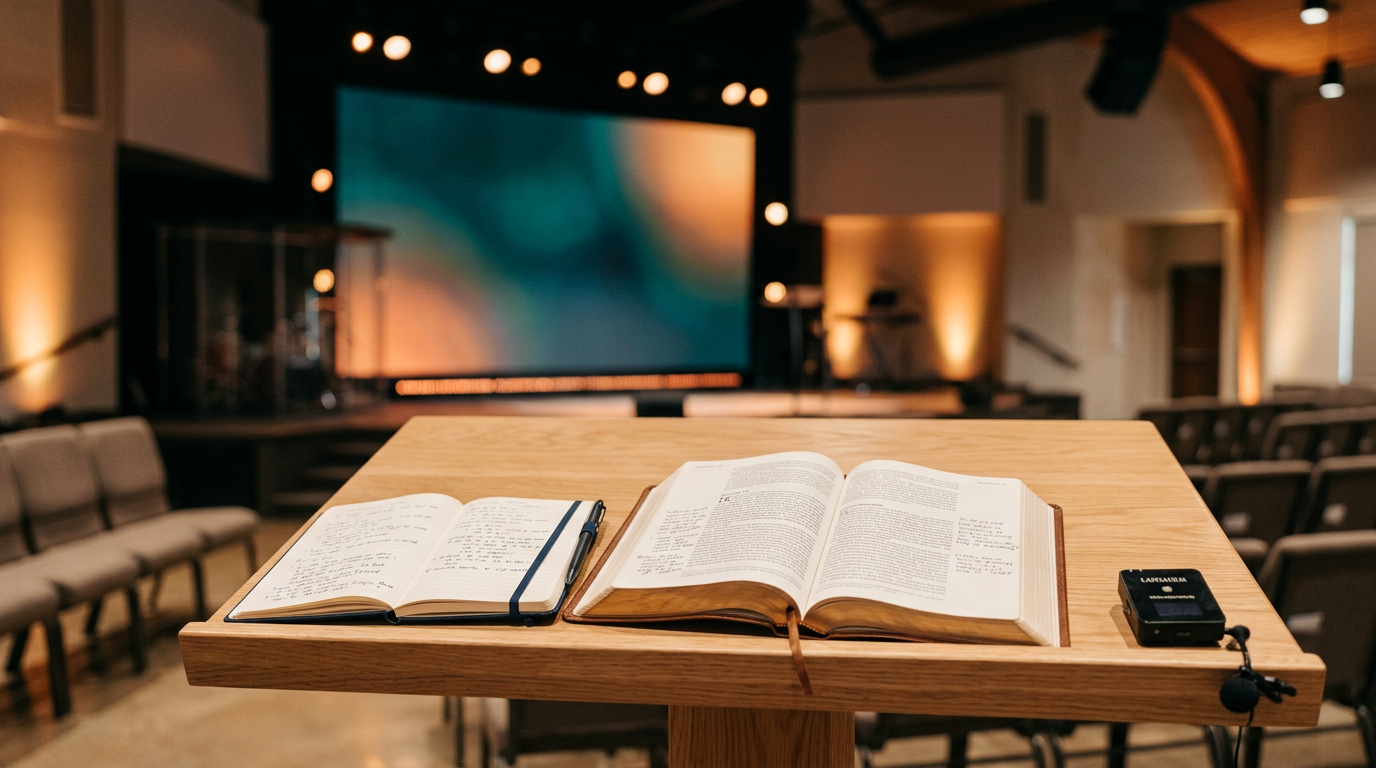
You've spent all week preparing your sermon. The exegesis is solid, the structure makes sense, and you've got a clear call to action. But now it's Saturday night, and you're staring at a decision that feels bigger than it should: Do you write out every word? Create an outline? Try to memorize the whole thing?
This isn't just a logistical question—it's a delivery question. The sermon preparation method you choose directly impacts how you connect with your congregation on Sunday morning. Choose wrong, and you'll either sound robotic, lose your train of thought, or spend the entire message glued to your notes. Choose right, and your preparation method becomes invisible, letting your message shine through.
Here's what most new pastors don't realize: there's no universally "best" method. Manuscript preaching works brilliantly for some communicators and creates wooden delivery for others. Preaching from notes gives some pastors freedom and leaves others scrambling. Memorized sermons can sound natural or rehearsed depending on who's delivering them.
The goal isn't to pick the method that sounds most impressive—it's to find the approach that helps you deliver your message with clarity, connection, conviction, and a compelling call to action. That's what Preach Better is built around: helping pastors understand how their preparation choices affect their actual delivery.
In this guide, you'll learn the strengths and weaknesses of each major sermon preparation method, how to choose the right approach for your communication style, and practical steps to implement whichever method you select. By the end, you'll have a clear framework for preparing sermons that you can actually deliver well.
Quick Answer: The three primary sermon preparation methods are manuscript preaching (writing every word), preaching from notes (using an outline or bullet points), and memorized sermons (committing the content to memory). Most effective communicators use a hybrid approach: writing key sections in full while leaving room for spontaneity. The best method depends on your speaking style, congregation size, message complexity, and how much preparation time you have. Research on communication effectiveness suggests that over-reliance on any single method can limit connection, so flexibility matters more than dogmatic adherence to one approach.
Key Takeaways
- No single method guarantees better delivery—manuscript preaching, notes-based preaching, and memorization each have distinct advantages depending on your natural communication style and message complexity
- Hybrid approaches often outperform pure methods—most experienced pastors combine elements (like memorizing the introduction and conclusion while using notes for the body) to balance preparation and spontaneity
- Your preparation method should serve your delivery goals, not constrain them—if your current approach makes you sound less natural, creates anxiety, or limits eye contact, it's time to experiment with alternatives
- The congregation can tell when your method isn't working—wooden manuscript reading, frantic note-checking, and memory lapses all break connection, which is why self-evaluation matters
What Are the Main Sermon Preparation Methods?
Sermon preparation methods fall into three primary categories, each with variations. Manuscript preaching involves writing out your entire sermon word-for-word and either reading it directly or using it as a memorization base. Preaching from notes means creating an outline, bullet points, or key phrases that guide your delivery without scripting every sentence. Memorized sermons require committing your content to memory so you can deliver without any written aids.
Most pastors don't use these methods in pure form. Communication experts recommend a hybrid approach that combines the precision of manuscript preparation with the flexibility of notes-based delivery. You might write your introduction, main transitions, and conclusion verbatim while leaving illustrations and application points more loosely structured. This gives you anchor points without making you sound like you're reading an essay.
The method you choose affects more than just your comfort level—it directly impacts your delivery across all four pillars of effective preaching. Manuscript preaching can enhance clarity but may reduce connection if you're reading instead of engaging. Notes-based preaching can increase spontaneity but may hurt clarity if your outline isn't detailed enough. Memorized sermons can create powerful conviction but may sound rehearsed if you're focused on recall rather than communication.
Understanding these trade-offs helps you make an informed choice rather than defaulting to whatever method your preaching professor used or your favorite podcast pastor recommends.
Why Does Your Preparation Method Matter for Delivery?
Your sermon preparation method matters because it shapes how you show up on Sunday morning. Studies on audience retention show that delivery factors—eye contact, vocal variety, natural pacing—significantly impact how much people remember and apply. If your preparation method forces you to read from a page, you lose eye contact. If it leaves you scrambling for what comes next, you lose confidence. If it makes you sound rehearsed rather than authentic, you lose connection.
The relationship between preparation and delivery is often misunderstood. New pastors sometimes assume that more preparation equals better delivery, so they write manuscripts thinking it will make them sound more polished. But manuscript preaching only improves delivery if you can internalize the content enough to deliver it naturally. Otherwise, you end up reading to your congregation instead of speaking with them.
Research on public speaking suggests that the most effective communicators balance preparation with adaptability. They know their content deeply enough to maintain clarity without notes, but they're not so locked into a script that they can't adjust based on audience response. This is why hybrid methods tend to work best—they give you structure without rigidity.
Your preparation method also affects your mental state during delivery. If you're worried about forgetting your next point, that anxiety shows up in your body language and vocal tone. If you're confident in your preparation, you can focus on connecting with people rather than managing your notes. The right method reduces cognitive load, freeing you to be present with your congregation.
How to Choose the Right Sermon Preparation Method for Your Style
Choosing the right sermon preparation method starts with honest self-assessment. Ask yourself: Do I naturally think in complete sentences or in concepts? When I'm explaining something to a friend, do I use precise language or paint with broader strokes? Do I feel more confident with a safety net or more constrained by it?
If you're a precise thinker who values doctrinal accuracy and carefully crafted language, manuscript preaching might fit your style. This approach works well for pastors who teach complex theological concepts, preach in formal settings, or have congregations that expect polished, literary sermons. It's also helpful if you're preaching on sensitive topics where word choice matters significantly.
If you're a conversational communicator who thinks on your feet and values spontaneity, preaching from notes likely suits you better. This method works for pastors who excel at reading the room, adjusting on the fly, and creating a dialogue feel even in a monologue format. It's particularly effective in smaller congregations or contemporary settings where casual delivery is expected.
If you have strong verbal memory and prefer total freedom from physical notes, memorization might be your path. This approach works for communicators who can internalize content without sounding robotic, who preach shorter messages (20-30 minutes), or who move around the stage extensively. It's also valuable for pastors who preach the same message multiple times across services or campuses.
Best practices in sermon delivery indicate that your choice should also factor in practical constraints. How much preparation time do you realistically have? A full manuscript might require 15-20 hours of writing and rehearsal, while a detailed outline might take 8-12 hours. If you're bivocational or have a small staff, time constraints matter.
Consider your congregation's expectations too. Some traditional churches expect manuscript-level polish. Some contemporary churches prefer a more off-the-cuff feel. Neither is wrong, but mismatching your method to your context creates friction.
Manuscript Preaching: When to Write Every Word
Manuscript preaching means writing out your entire sermon word-for-word before you deliver it. This method offers maximum control over language, structure, and theological precision. You can craft sentences for clarity, choose words carefully, and ensure every transition flows logically. For pastors who value precision or preach in contexts where every word matters, manuscripts provide confidence and consistency.
The primary advantage of manuscript preaching is clarity. When you write everything out, you eliminate rambling, reduce filler words, and create a coherent flow from start to finish. This is especially valuable for complex doctrinal teaching, sensitive pastoral topics, or messages that will be recorded and distributed. Your manuscript becomes a permanent record of what you actually said, which matters for accountability and future reference.
However, manuscript preaching comes with significant delivery challenges. The biggest risk is sounding like you're reading an essay rather than having a conversation. Communication experts recommend that if you use a manuscript, you must internalize it enough to maintain frequent eye contact and natural vocal variety. Simply reading from a page creates a barrier between you and your congregation.
To make manuscript preaching work, follow this process: Write your full manuscript early in the week. Read it aloud multiple times, marking places where the written word doesn't match natural speech patterns. Revise for oral delivery—shorter sentences, conversational language, clear signposts. Then practice delivering it without looking at the page as much as possible. Your goal is to know the content so well that the manuscript becomes a safety net, not a script you're reading.
Some pastors print their manuscript in large type with wide margins for delivery notes ("pause here," "slow down," "make eye contact"). Others use a manuscript for preparation but switch to a condensed outline for actual delivery. The key is ensuring your preparation method enhances rather than hinders your connection with people.
Preaching from Notes: How to Use an Outline Effectively
Preaching from notes means creating a structured outline or set of bullet points that guide your delivery without scripting every word. This method offers flexibility, natural conversational flow, and the ability to adjust based on congregational response. For many pastors, notes-based preaching strikes the best balance between preparation and spontaneity.
The strength of preaching from notes is connection. When you're not tied to a manuscript, you can make more eye contact, respond to nonverbal feedback, and sound more conversational. According to homiletics research, congregations often perceive notes-based preaching as more authentic and engaging because it feels less rehearsed. You're speaking with them, not at them.
The challenge is maintaining clarity without a full script. If your notes are too sparse, you might lose your train of thought, ramble, or forget key points. If they're too detailed, you end up reading them like a manuscript anyway. The goal is finding the right level of detail for your memory and speaking style.
Here's how to create effective sermon notes: Start with your main structure—introduction, 3-4 main points, conclusion. Under each main point, list 2-4 sub-points or supporting ideas. Include your key Scripture references, important quotes, and specific statistics or facts you want to cite accurately. Write out your transitions word-for-word—these are the bridges between sections where clarity matters most.
For illustrations and application, use trigger phrases rather than full narratives. Instead of writing out an entire story, note "story about Sarah's cancer diagnosis—focus on the moment of diagnosis, not treatment details." This gives you enough structure to stay on track while leaving room for natural storytelling.
Many experienced pastors use a hybrid approach: they write their introduction and conclusion as full manuscripts (these bookend moments are too important to wing), but they use notes for the body. This gives them strong starts and finishes while maintaining conversational flow in the middle.
Your notes format matters too. Some pastors use a full-page outline printed in large type. Others use index cards with one main point per card. Some use iPads or tablets with scrollable notes. Experiment to find what feels most natural—you want your notes to be helpful without becoming a distraction.
Memorized Sermons: The Benefits and Risks of Going Note-Free
Memorized sermons involve committing your entire message to memory so you can deliver without any written aids. This method offers maximum freedom of movement, consistent eye contact, and the ability to focus entirely on your congregation rather than managing notes. For pastors with strong verbal memory and shorter message formats, memorization can create powerful delivery.
The primary benefit of memorized sermons is connection. When you're not looking at notes or a manuscript, you can maintain constant eye contact, use your hands freely, and move around the stage without logistical constraints. This creates an intimate, conversational feel that's particularly effective in smaller settings or contemporary worship environments. Your congregation feels like you're talking directly to them, not delivering a prepared speech.
Memorization also forces deep internalization of your content. When you memorize a sermon, you're not just learning words—you're embedding the logic, flow, and emotional arc in your mind. This often results in more confident, convicted delivery because you own the material completely.
However, memorized sermons carry significant risks. The biggest danger is sounding rehearsed rather than authentic. If you're focused on recall rather than communication, your delivery can feel mechanical. You might also experience anxiety about forgetting, which shows up as tension in your voice and body language. And if you do forget a section, recovering gracefully is harder without notes to fall back on.
Memorization works best for shorter messages (20-30 minutes maximum), repeated messages (like preaching the same sermon across multiple services), or pastors who naturally think in complete thoughts rather than needing to see their structure. It's less practical for longer, more complex teaching or for pastors who prefer spontaneity.
If you choose to memorize, use a structured approach: Write your full manuscript first. Break it into logical chunks (introduction, point 1, point 2, etc.). Memorize one chunk at a time, practicing delivery as you go. Use memory techniques like visualization (associating each point with a mental image) or the method of loci (mentally placing points in different locations). Practice delivering the entire message multiple times, focusing on natural expression rather than perfect recall.
Many pastors who memorize still keep a minimal outline nearby as a psychological safety net, even if they rarely reference it. This reduces anxiety without compromising the benefits of note-free delivery.
What Are the Most Common Mistakes with Each Method?
Each sermon preparation method comes with predictable pitfalls that undermine delivery. Understanding these mistakes helps you avoid them regardless of which approach you choose.
With manuscript preaching, the most common mistake is reading instead of speaking. When pastors write a manuscript but don't internalize it, they end up with their eyes on the page instead of on their congregation. This kills connection and makes even the best content feel lifeless. The fix is simple but time-intensive: practice your manuscript enough times that you can deliver most of it from memory, using the written text only as a reference point.
Another manuscript mistake is writing for the eye instead of the ear. Written language and spoken language have different rhythms. Sentences that read well on paper often sound overly formal or complex when spoken aloud. The solution is to write your manuscript, then read it aloud and revise any section that doesn't sound conversational. If you wouldn't say it that way to a friend, rewrite it.
With notes-based preaching, the biggest mistake is insufficient detail. Pastors create sparse outlines thinking they'll remember the supporting content, then find themselves scrambling mid-sermon to recall what they meant to say. This creates awkward pauses, filler words, and loss of momentum. The fix is to include more detail than you think you need—specific examples, key phrases, transition sentences—so your notes actually support your delivery.
Another notes mistake is poor formatting. If your notes are cluttered, hard to read, or poorly organized, you'll waste mental energy navigating them during delivery. Use clear hierarchy (main points in bold, sub-points indented), plenty of white space, and large enough type that you can glance and immediately find your place.
With memorized sermons, the primary mistake is prioritizing recall over communication. When pastors are focused on remembering what comes next, they lose presence with their congregation. Their delivery becomes mechanical, their facial expressions freeze, and their vocal variety disappears. The fix is to practice until the content is so deeply internalized that you can focus on expression rather than recall. If you're still thinking about what to say next, you're not ready to memorize.
Another memorization mistake is having no backup plan. If you forget a section and have no notes to reference, you might panic or lose significant content. Always have a minimal outline nearby—even if you never look at it, knowing it's there reduces anxiety and gives you a recovery option if needed.
How to Transition Between Preparation Methods
Many pastors start with one sermon preparation method and eventually realize it's not serving their delivery well. Transitioning to a new approach requires intentional practice and patience with yourself during the adjustment period.
If you're currently using a full manuscript and want to move toward notes, start by condensing gradually. For your next sermon, write the full manuscript as usual, then create a detailed outline from it. Practice delivering from the outline while keeping the manuscript nearby as a reference. Over several weeks, make your outline progressively less detailed until you're comfortable with bullet points and key phrases.
If you're preaching from sparse notes and finding yourself lost or rambling, move toward more structure. Add detail to your outline—write out transitions, include more supporting points, script your introduction and conclusion. You're not moving to full manuscript, just adding enough scaffolding to keep you on track.
If you want to try memorization, start small. Don't attempt to memorize an entire 40-minute sermon on your first try. Instead, memorize just your introduction and conclusion while using notes for the body. Once you're comfortable with that, add one main point. Gradually expand until you're memorizing larger sections.
If memorization is creating too much anxiety or making you sound rehearsed, give yourself permission to use notes again. There's no shame in using a preparation method that serves your delivery better. Some of the most effective preachers use notes their entire ministry.
Best practices in sermon delivery indicate that experimentation is valuable. Try different methods for different message types. Use a manuscript for doctrinal teaching but notes for narrative preaching. Memorize shorter messages but use an outline for longer ones. Flexibility often produces better results than rigid adherence to one approach.
How Preach Better Helps You Evaluate Your Preparation Method
One of the hardest parts of choosing a sermon preparation method is knowing whether it's actually working. You might feel comfortable with your approach, but if it's creating delivery problems—excessive filler words, poor pacing, limited eye contact—you need objective feedback to identify the issue.
About Preach Better: Preach Better is a sermon delivery analysis platform that helps pastors get honest, specific feedback on their communication. Built around four pillars—Clarity, Connection, Conviction, and Call to Action—it provides coaching grounded in specific moments from your message, not vague generalities. For questions about preparation methods, Preach Better identifies patterns like over-reliance on notes, manuscript-reading vocal patterns, or memory-related hesitations that signal your current approach might not be serving you well.
When you upload a sermon to Preach Better, the platform analyzes your delivery across all four pillars and ties feedback to specific transcript moments. If you're reading from a manuscript, the analysis might flag sections where your vocal variety drops or your pacing becomes monotonous—clear indicators that you're reading rather than speaking. If you're using notes but losing clarity, it might identify rambling sections or unclear transitions that suggest your outline needs more detail.
This kind of specific, moment-based feedback helps you understand how your preparation method affects your actual delivery. Instead of wondering "Should I use notes or a manuscript?" you get data showing "When you referenced your notes at 8:42, your eye contact dropped and your energy shifted—consider internalizing that transition." That's actionable insight you can use to refine your approach.
The platform also tracks trends over time, so you can see whether changes to your preparation method are improving your delivery. If you switch from full manuscript to notes-based preaching, you can compare metrics like filler word frequency, pacing consistency, and engagement markers to see if the change is helping or hurting.
Bottom Line: Finding Your Preparation Method
There's no universally best sermon preparation method—only the method that best serves your communication style, message complexity, and congregation context. Manuscript preaching offers precision and control but requires significant internalization to avoid sounding like you're reading. Preaching from notes provides flexibility and conversational flow but demands enough detail to maintain clarity. Memorized sermons create maximum connection but work best for shorter messages and communicators with strong verbal memory.
Most effective pastors use hybrid approaches, combining elements of multiple methods to balance preparation and spontaneity. They might write key sections in full while leaving room for spontaneous illustration. They might memorize their introduction and conclusion while using notes for the body. They experiment with different approaches for different message types rather than rigidly adhering to one method.
The key is choosing a preparation method that reduces anxiety, enhances clarity, and frees you to connect with your congregation. If your current approach makes you sound wooden, creates visible stress, or limits eye contact, it's time to experiment. Start small—adjust one element at a time—and pay attention to how changes affect your delivery.
Your sermon preparation method should be invisible to your congregation. They shouldn't notice whether you're using notes, a manuscript, or memory—they should only notice that you're communicating clearly, connecting authentically, and delivering with conviction. When your preparation serves your delivery rather than constraining it, your message has maximum impact.
If you're ready to get specific feedback on how your current preparation method affects your delivery, Preach Better can help you identify patterns and make informed adjustments. Because every message matters—and the method you use to prepare it should help you deliver it well.
Frequently Asked Questions
Should new pastors start with manuscript preaching or notes? New pastors should start with the method that reduces anxiety and helps them deliver clearly. If you're nervous about forgetting content, begin with a detailed manuscript or comprehensive outline. As you gain confidence, you can transition to less detailed notes. Most experienced pastors recommend starting with more structure rather than less, then gradually loosening your approach as your comfort level increases.
How long does it take to memorize a 30-minute sermon? Memorizing a 30-minute sermon typically requires 15-25 hours of focused practice, depending on your verbal memory strength and the complexity of the content. Most pastors who memorize break the process into chunks, memorizing one section per day over 4-5 days, then practicing the full message multiple times. If memorization takes significantly longer or creates excessive anxiety, it may not be the right method for your communication style.
Can you switch preparation methods between different sermon series? Yes, many effective communicators adapt their preparation method based on message type and series goals. You might use a manuscript for a doctrinal series where precision matters, notes for a narrative series where storytelling flows more naturally, and memorization for a short series with repeated themes. Flexibility in preparation methods often produces better delivery than rigid adherence to one approach across all contexts.
What's the best way to practice a sermon before Sunday? The best practice method matches your preparation approach. If you're using a manuscript, practice reading it aloud multiple times while maintaining eye contact with an imaginary congregation. If you're using notes, practice delivering from your outline without filling in every word identically each time. If you're memorizing, practice in the actual preaching space if possible, incorporating movement and gestures. Record yourself and evaluate for clarity, pacing, and natural delivery.
How detailed should sermon notes be for preaching without a manuscript? Effective sermon notes should include your main structure (introduction, 3-4 points, conclusion), key sub-points under each section, Scripture references, important quotes or statistics, and fully written transitions between major sections. For illustrations, use trigger phrases rather than full narratives. Your notes should be detailed enough that you never lose your place or forget key content, but not so detailed that you're essentially reading a manuscript.
Does manuscript preaching limit connection with the congregation? Manuscript preaching only limits connection if you're reading from the page instead of internalizing the content. When pastors write a manuscript but practice enough to deliver it with frequent eye contact, natural vocal variety, and authentic expression, manuscripts can actually enhance connection by providing confidence and precision. The key is using the manuscript as a preparation tool, not a delivery crutch.