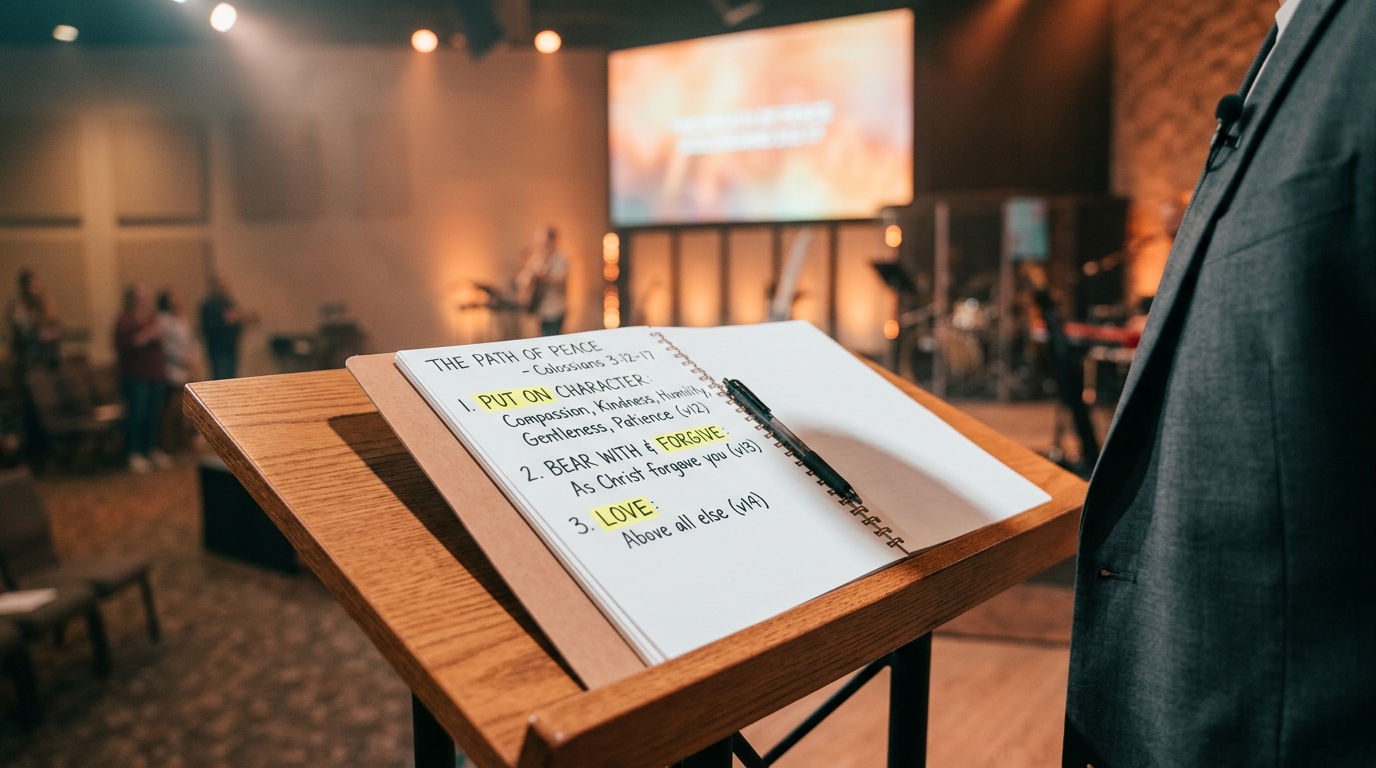

You're fifteen minutes into your sermon when you realize you just skipped an entire section. Or you blank on a key Scripture reference. Or you mispronounce a name you've said correctly a hundred times in practice. Your heart races. Your face flushes. And for a split second, you're convinced everyone in the room just watched you fail.
Here's the truth every seasoned pastor knows but rarely talks about: sermon mistakes aren't the exception—they're part of the process. The difference between a shaken preacher and a confident one isn't the absence of errors. It's knowing how to recover when things go sideways.
This guide will show you exactly what to do when you make a mistake in the pulpit, how to turn preaching blunders into moments of connection, and why your congregation cares far less about your errors than you think they do. You'll learn practical recovery techniques you can use this Sunday, and you'll discover why the pastors you admire aren't mistake-free—they're just better at handling them.
Quick Answer: When you make a sermon mistake, acknowledge it briefly if necessary, correct it naturally, and move forward without dwelling on it. Most errors go unnoticed by your congregation, and those that are noticed are quickly forgotten if you don't fixate on them. The key to sermon mistakes recovery is maintaining your composure and continuing with confidence, treating the error as a minor detour rather than a derailment.
Key Takeaways
- Most sermon mistakes are invisible to your congregation — what feels catastrophic to you often goes completely unnoticed by listeners focused on the message, not the messenger
- Recovery technique matters more than the mistake itself — a smooth, confident recovery actually builds credibility, while over-apologizing or freezing draws unnecessary attention to minor errors
- Your congregation wants you to succeed — they're on your side, not waiting for you to fail, which means they're more forgiving and less critical than the voice in your head
- Practice-based preparation reduces mistake frequency — rehearsing your sermon out loud multiple times creates muscle memory that helps you navigate errors without panic
What Counts as a Sermon Mistake (And What Doesn't)
Not every stumble is a mistake that needs recovery. Understanding the difference between actual errors and normal communication variance will save you from unnecessary anxiety and over-correction.
A genuine sermon mistake is something that creates confusion, miscommunicates truth, or disrupts the flow of your message in a way that requires correction. This includes: citing the wrong Scripture reference and building a point on it, stating incorrect information as fact, losing your place for more than a few seconds, or saying something that directly contradicts your intended meaning.
What doesn't count: slight mispronunciations that don't change meaning, minor word substitutions that preserve your point, brief pauses while you gather your thoughts, or deviating slightly from your planned wording. These are normal features of live communication, not mistakes requiring recovery.
The distinction matters because new pastors often treat normal speech patterns as errors, which leads to constant self-correction and apology. This actually undermines your delivery more than the original "mistake" ever would. Research on public speaking suggests that audiences don't notice most of the small imperfections speakers obsess over—they're focused on understanding your message, not grading your performance.
If you find yourself constantly stopping to correct minor variations from your notes, you're not recovering from mistakes—you're creating them. Save your recovery techniques for actual errors that impact understanding or accuracy.
Why Do Sermon Mistakes Feel So Catastrophic?
The emotional weight of a sermon mistake far exceeds its actual impact, and understanding why helps you respond more effectively when errors occur.
Preaching combines three high-pressure elements: public performance, spiritual authority, and personal vulnerability. When you make a mistake, you're not just stumbling over words—you're experiencing a threat to your credibility as a spiritual leader in front of people who trust you. That's why a simple word mix-up can trigger the same stress response as a genuine crisis.
Communication experts recommend distinguishing between perceived stakes and actual stakes. The perceived stakes of a sermon mistake feel enormous: "Everyone thinks I'm incompetent. I've lost their trust. They're questioning my calling." The actual stakes are usually minimal: "I said the wrong verse number and corrected it. Three people noticed. None of them care."
New pastors are especially vulnerable to catastrophic thinking about mistakes because you lack the experiential evidence that errors are survivable. You haven't yet preached through dozens of mistakes and watched your congregation show up the next week unchanged. Every error feels like it could be the one that undermines everything.
The spotlight effect compounds this. Studies on audience retention show that listeners remember your main points and overall message trajectory, not your verbal missteps. But because you're hyper-aware of your own performance, you assume everyone else is equally focused on your errors. They're not. They're thinking about their own lives, connecting your message to their circumstances, or mentally planning lunch.
This psychological reality is actually good news for sermon mistakes recovery: the mistake feels worse to you than it is, which means your recovery doesn't need to be as elaborate as your anxiety suggests.
How to Recover from Common Sermon Mistakes in Real-Time
When you make a mistake mid-sermon, your recovery technique should match the error type. Here's how to handle the most common preaching blunders without derailing your message.
Lost your place: Pause naturally, glance at your notes, and resume with a brief transition phrase. "Let me come back to this point..." or "As I was saying..." works perfectly. Don't apologize or explain—just reconnect and continue. If you need more than a few seconds, acknowledge it: "Give me just a moment to find where we were." Your congregation will wait. They've been lost before too.
Wrong Scripture reference: Correct it immediately and specifically. "Actually, that's John 3:16, not John 4." Then move on. Don't dwell on how you mixed it up or apologize repeatedly. The correction itself is sufficient. If you've already built a point on the wrong reference, acknowledge the error, provide the correct reference, and confirm your point still stands (or adjust it if needed).
Mispronounced a name or word: If it's a minor mispronunciation that doesn't change meaning, keep going. If it's significant (especially biblical names or theological terms), correct it once: "Ephesians—not Ephesus." No need to explain or apologize. If you're genuinely unsure of the correct pronunciation, own it: "I'm not certain of the pronunciation, but the point is..." Humility beats fake confidence.
Said something you didn't mean: Stop, correct, and clarify. "Let me restate that—what I meant to say is..." Be direct about the correction so no one leaves with the wrong information. This is one situation where a brief explanation helps: "That came out backwards. What I'm trying to say is..."
Forgot a key point: If you're mid-sermon and realize you skipped something important, you have two options. If it's essential to what you're currently saying, acknowledge it: "Before I go further, I need to back up to something I missed." Then insert the point and reconnect. If it's not essential to your current flow, make a note and circle back at a natural transition point: "Earlier I mentioned X, but I want to add something important about that..."
Technical failure: Sound cuts out, slides won't advance, or your mic dies. Stay calm, use humor if appropriate ("Well, that's one way to get your attention"), and adapt. Speak louder if needed, describe what was on the slide, or pause briefly while the issue is resolved. Your congregation understands technology fails—they just need to see you're not flustered by it.
The common thread in all these recoveries: brevity, confidence, and forward momentum. Acknowledge if necessary, correct if needed, and move on. The mistake is a moment, not a monument.
The One Recovery Technique That Always Works
Among all the specific strategies for handling different types of errors, one approach consistently outperforms the others: confident continuation.
Confident continuation means you acknowledge the mistake (if necessary), make the correction (if needed), and then proceed with your message as if nothing significant happened. You don't apologize excessively, explain what went wrong, or reference the error again later. You treat it as a minor detour and keep driving.
This works because your congregation takes emotional cues from you. If you signal that something is a big deal—through repeated apologies, visible frustration, or dwelling on the error—they'll perceive it as a big deal. If you signal that it's a small thing—through calm correction and immediate forward movement—they'll barely register it.
According to homiletics research, audiences are remarkably forgiving of mistakes when the speaker maintains composure. They interpret your confidence as competence, even when you've just made an error. Conversely, excessive apology or visible anxiety after a mistake actually damages credibility more than the mistake itself.
Here's what confident continuation looks like in practice: You cite the wrong verse. You pause, correct it ("That's Colossians 3, not Ephesians 3"), and immediately continue your point without changing your tone or energy level. You don't say "I'm sorry" or "I always mix those up" or "Let me start over." You correct and continue.
This technique requires practice because it goes against your instinct to over-explain or apologize. Your anxiety wants to make sure everyone knows you know you made a mistake. But your congregation doesn't need that reassurance—they need you to lead them through the message without getting stuck on minor errors.
The pastors you admire who seem unshakeable in the pulpit aren't mistake-free. They've just mastered confident continuation. They've trained themselves to treat errors as commas, not periods.
What to Do After the Sermon Ends
Your sermon mistakes recovery doesn't end when you walk off the platform. How you process errors afterward determines whether they become learning opportunities or sources of ongoing anxiety.
First, resist the urge to immediately apologize to everyone. If someone approaches you about a specific error that affected their understanding, address it directly: "You're right, I misstated that. Here's what I should have said." But don't seek out people to confess every minor stumble. Most of them didn't notice, and bringing it up creates a problem that didn't exist.
Second, do a calm post-sermon review. Wait at least a few hours after preaching—your immediate post-sermon emotions aren't reliable guides to what actually happened. Then review objectively: What mistakes did I make? Which ones actually mattered? How did I recover? What would I do differently?
This review should focus on patterns, not isolated incidents. One mispronunciation isn't a pattern. Consistently losing your place might indicate you need a better notes system. Frequently citing wrong references might mean you need to verify citations during preparation, not just rehearsal.
Third, use tools that give you objective feedback. Preach Better analyzes your sermon delivery across four key pillars—Clarity, Connection, Conviction, and Call to Action—and provides specific feedback tied to actual moments in your message. Instead of relying on your anxiety-driven memory of what went wrong, you get concrete data on what worked and what needs improvement. This shifts your focus from catastrophizing about mistakes to systematically improving your delivery.
Fourth, talk to a trusted mentor or peer about significant errors, but frame the conversation around learning, not confession. "I stumbled over this section—what's your approach when that happens?" is more productive than "I can't believe I messed up so badly."
Finally, give yourself permission to move on. One sermon doesn't define your ministry. The mistakes you made last Sunday don't determine your effectiveness next Sunday. Best practices in sermon delivery indicate that improvement comes from consistent practice and reflection, not from dwelling on past errors.
If you find yourself replaying mistakes days later, that's not helpful reflection—that's rumination. Acknowledge what you learned, identify one specific change for next time, and release it.
Common Sermon Mistakes That Actually Build Connection
Some mistakes, when handled well, actually strengthen your relationship with your congregation rather than undermining it. Understanding which errors fall into this category helps you see mistakes as potential opportunities, not just problems to fix.
Authentic vulnerability moments—when you genuinely forget something, admit uncertainty, or acknowledge you're struggling to articulate a complex idea—humanize you. Your congregation doesn't need you to be perfect; they need you to be real. When you say, "I'm having trouble finding the right words for this, but let me try again," you're modeling the kind of honest struggle with truth that they experience in their own spiritual lives.
Minor technical fumbles that you handle with grace and humor show emotional intelligence. When the slides fail and you quip, "Looks like we're going old school today," you demonstrate the kind of unshakeable peace under pressure that your congregation wants to emulate. Your recovery becomes a better sermon illustration than whatever was on the slide.
Correcting yourself when you realize you've overstated something or been unclear models intellectual honesty. "Actually, let me be more precise about that..." shows you care more about truth than about appearing flawless. This builds trust.
The key distinction: these mistakes build connection when your recovery is authentic and forward-focused. If you turn a simple stumble into a five-minute apology tour, you've lost the benefit. If you acknowledge it naturally and keep moving, you've gained credibility.
This doesn't mean you should intentionally make mistakes for connection purposes—that's manipulation, and congregations can sense it. But it does mean you can stop viewing every error as a credibility crisis. Some mistakes, handled well, actually make you more relatable and trustworthy.
How to Prevent the Most Common Sermon Mistakes
While you can't eliminate all errors, you can significantly reduce the frequency of common preaching blunders through strategic preparation and practice.
Verify every citation during preparation. Don't trust your memory for Scripture references, quotes, or statistics. Look them up, write them down correctly, and double-check before Sunday. This prevents the most credibility-damaging type of mistake: stating wrong information as fact.
Rehearse out loud multiple times. Silent reading doesn't prepare your mouth and brain for the physical act of speaking. Rehearse your sermon at least three times out loud, ideally in the space where you'll preach. This creates muscle memory that helps you navigate transitions smoothly and reduces the likelihood of losing your place.
Use a notes system that works for you. If you're constantly losing your place, your notes might be the problem, not your memory. Experiment with different formats—full manuscript, detailed outline, minimal bullet points—until you find what helps you stay oriented without being tied to the page. For more on this, see our guide on sermon preparation methods.
Mark difficult pronunciations phonetically. If your sermon includes names, places, or terms you're unsure about, write the phonetic pronunciation in your notes. This prevents the mid-sermon panic of encountering a word you can't say confidently.
Build in natural pause points. Plan moments in your sermon where you'll intentionally pause—after a key question, before a major transition, following a story. These planned pauses give you micro-moments to reorient if needed, and they prevent the rushed, breathless delivery that increases mistake frequency.
Eliminate unnecessary complexity. If a sentence is hard to say in rehearsal, it'll be harder on Sunday. Simplify complex phrases, break up long sentences, and choose words you can say confidently. Clarity beats eloquence every time. Our article on filler words in sermons explores how simplification improves overall delivery.
Manage your pre-sermon routine. Fatigue, dehydration, and anxiety all increase mistake frequency. Get adequate sleep Saturday night, stay hydrated Sunday morning, and develop a pre-sermon routine that calms your nerves rather than heightening them. Physical preparation matters as much as content preparation.
Prevention doesn't mean perfection. You'll still make mistakes. But these strategies reduce the frequency of preventable errors, which means you'll spend less mental energy on recovery and more on actually communicating your message.
When to Address a Mistake After the Fact
Most sermon mistakes don't require follow-up after the service ends. But some do. Knowing when to address an error publicly and when to let it go is an important pastoral judgment call.
Address it publicly if: you stated incorrect information that could lead people astray theologically or practically, you misattributed a quote or story in a way that matters, you said something potentially offensive or hurtful that you didn't mean, or you made a factual error that significantly impacts the message's credibility.
In these cases, a brief correction in the next service, via email, or on social media is appropriate: "Last week I incorrectly stated [X]. The accurate information is [Y]. I apologize for the confusion." Keep it factual and brief. Don't over-explain or dramatize.
Don't address it publicly if: it was a minor mispronunciation or word substitution that didn't change meaning, you briefly lost your place but recovered smoothly, you had a technical glitch that everyone witnessed and understood, or you made a small error that you corrected in the moment.
Publicly addressing minor mistakes that most people didn't notice actually creates problems. It signals insecurity, draws attention to errors people had forgotten, and trains your congregation to scrutinize your delivery for flaws.
The test: Would correcting this mistake serve my congregation's spiritual growth and understanding, or would it primarily serve my need to be seen as accurate? If it's the latter, let it go.
For significant errors, address them promptly and directly. For minor ones, learn from them privately and move forward. Your congregation needs your leadership more than they need your perfectionism.
Frequently Asked Questions
How do I stop replaying sermon mistakes in my head days later?
Rumination about past mistakes is a thought pattern, not a reflection practice. When you catch yourself replaying an error, acknowledge the thought ("I'm ruminating again"), identify one specific lesson you learned, and redirect your attention to preparing for the next sermon. If the pattern persists, it may indicate broader anxiety that would benefit from conversation with a mentor or counselor.
Should I apologize to my congregation if I make a major mistake during a sermon?
Apologize briefly if the mistake created confusion or could mislead people, but keep it focused and forward-moving: "I misstated that—here's the correction." Avoid lengthy apologies that center your feelings rather than their understanding. If the mistake requires more explanation, address it after the service individually with those who ask, rather than derailing the sermon with an extended apology.
What if I completely blank and can't remember what I was going to say next?
Pause, take a breath, and glance at your notes. If you need more than a few seconds, acknowledge it calmly: "Give me a moment to gather my thoughts." Your congregation will wait—they've experienced mental blanks too. If you truly can't recover the point, transition to your next section: "Let me come at this from a different angle." Confidence in your recovery matters more than perfect recall.
How can I tell if a mistake actually affected my congregation or if I'm just overthinking it?
If people approach you after the service asking for clarification about something you said, the mistake likely affected understanding. If no one mentions it and you're the only one thinking about it days later, you're overthinking. Most mistakes that feel catastrophic to you go completely unnoticed by your congregation, who are focused on the message's overall impact, not your delivery mechanics.
Is it better to acknowledge mistakes immediately or just keep going as if nothing happened?
Acknowledge mistakes that create confusion or miscommunicate important information—wrong Scripture references, factual errors, or statements that contradict your intended meaning. Don't acknowledge minor stumbles like slight mispronunciations, brief pauses, or word substitutions that preserve your point. Over-acknowledgment draws unnecessary attention to normal speech patterns and undermines your delivery more than the original "mistake" would.
How do experienced pastors seem so calm when they make mistakes during sermons?
Experienced pastors have made hundreds of mistakes and watched their congregations show up the next week unchanged. They've learned through repetition that most errors are survivable and forgettable. They've also developed confident continuation as a practiced skill—they've trained themselves to correct briefly and move forward without dwelling on errors. This composure comes from experience, not from being mistake-free.
About Preach Better: Preach Better is a sermon delivery analysis platform that helps pastors get honest, specific feedback on their communication. Built around four pillars—Clarity, Connection, Conviction, and Call to Action—it provides coaching grounded in specific moments from your message, not vague generalities. Instead of relying on your anxiety-driven memory of what went wrong, you get objective data on your delivery patterns, including how you handle transitions, maintain energy, and recover from unexpected moments.
Bottom Line: Your Mistakes Don't Define Your Ministry
Here's what matters about sermon mistakes recovery: the error itself is almost never as significant as your response to it. Your congregation isn't waiting for you to fail, and they're far more forgiving than the critical voice in your head.
The pastors you admire aren't mistake-free—they've just learned to treat errors as minor detours rather than disasters. They correct when necessary, continue with confidence, and refuse to let one stumble define an entire message. You can develop the same skill through practice and perspective.
Every sermon is an opportunity to improve, and every mistake is data for that improvement. The question isn't whether you'll make errors—you will. The question is whether you'll let those errors paralyze you or propel you toward better communication.
This Sunday, when something goes wrong (and something probably will), remember: acknowledge if necessary, correct if needed, and keep moving forward. Your congregation needs your message more than they need your perfection. And the confidence you build through recovering well will serve your preaching far more than the anxiety you feel trying to avoid every possible mistake.
Want to see exactly where your delivery is strong and where it needs work—without relying on your own anxiety-driven assessment? Preach Better gives you objective feedback tied to specific moments in your sermon, so you can focus on systematic improvement rather than catastrophizing about mistakes.