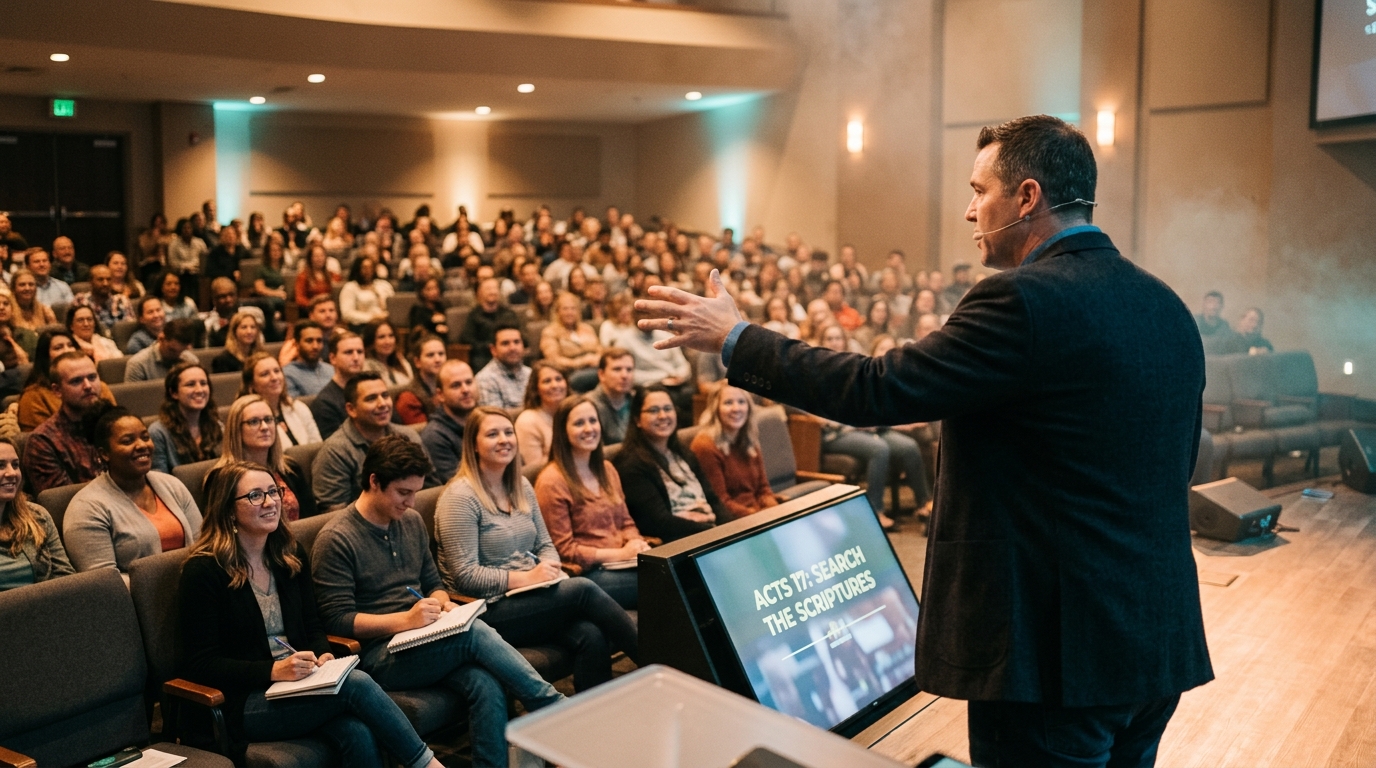

You know that moment when you look up from your notes and catch someone's eye in the third row? For just a second, you see them lean in. They nod. They're with you. Then you look back down at your manuscript, and when you glance up again thirty seconds later, they're checking their phone.
Eye contact in preaching isn't just a delivery technique—it's the difference between talking at people and talking with them. It's how you turn a room full of individuals into a congregation experiencing something together. And if you're like most pastors, you know it matters, but you're not sure you're doing it well.
The truth is, most of us weren't trained in visual engagement. We learned exegesis, homiletics, and theology. We practiced writing sermons, not delivering them. So we end up defaulting to what feels safe: reading our notes, glancing at the back wall, or scanning the room so quickly that we never actually connect with anyone. Meanwhile, our people are sitting there wondering if we even see them.
In this post, you'll learn why sermon eye contact is one of the most powerful tools in your communication toolkit, what's actually happening when you make (or avoid) eye contact, and specific strategies to improve your visual engagement without losing your train of thought or abandoning your preparation.
Quick Answer: Effective eye contact in preaching means holding visual connection with individual audience members for 3-5 seconds at a time, distributed evenly across the room, while maintaining your message flow. Research on public speaking suggests that sustained eye contact (not quick glances) builds trust, increases retention, and signals confidence—making your sermon feel more like a conversation than a lecture.
Key Takeaways
- Eye contact builds trust faster than words—your congregation evaluates your credibility and authenticity through visual connection before they fully process your content
- The 3-5 second rule creates real connection—quick glances feel impersonal, while sustained eye contact (3-5 seconds per person) signals genuine engagement and helps your audience feel seen
- Visual engagement is trainable—improving sermon eye contact doesn't require abandoning your notes or memorizing your message; it requires strategic preparation and intentional practice patterns
- Distribution matters more than duration—connecting with every section of your room (front, back, left, right, center) creates inclusive engagement that keeps your entire congregation attentive
Why Does Eye Contact in Preaching Matter So Much?
Eye contact is the primary nonverbal signal of connection in human communication. When you look directly at someone, you're saying, "I see you. This message is for you. We're in this moment together." When you avoid eye contact, you're unintentionally communicating the opposite: "I'm not sure about this. I'm reading something I prepared. You're an audience, not a person."
Communication experts recommend that effective speakers maintain eye contact 60-70% of the time during a presentation. But here's what most pastors don't realize: it's not about the total percentage—it's about the quality of the connection. Three seconds of genuine eye contact with one person does more for audience engagement than thirty seconds of scanning the room without actually landing on anyone.
Consider what happens neurologically when you make eye contact. Studies on audience retention show that direct visual connection activates the social engagement system in your listeners' brains. They shift from passive reception to active participation. Their mirror neurons fire, creating empathy and connection. They're more likely to remember what you say, more likely to feel moved by it, and more likely to act on it.
Here's the pastoral reality: your people are evaluating whether you believe what you're saying, whether you care about them personally, and whether this message is relevant to their lives. They make those judgments largely through eye contact. A pastor who consistently looks down, reads from a manuscript, or stares at the back wall signals uncertainty, disconnection, or disinterest—even if that's not what they feel at all.
What Makes Sermon Eye Contact Effective (And What Doesn't)?
Effective sermon eye contact isn't about staring people down or never looking at your notes. It's about creating patterns of visual engagement that feel natural, personal, and inclusive. The difference between good and poor eye contact often comes down to three factors: duration, distribution, and intention.
Duration is how long you hold eye contact with an individual person. Quick glances (less than 2 seconds) feel impersonal and scanning. Your audience registers that you looked near them, but not at them. The sweet spot is 3-5 seconds per person—long enough to complete a full thought or sentence while maintaining connection, but not so long that it becomes uncomfortable or awkward.
Distribution is how you spread your visual attention across the room. Many pastors unconsciously favor one section—usually the front center, where the most engaged people sit. But when you only connect with 30% of your room, the other 70% feels invisible. Effective distribution means intentionally connecting with every section: front, back, left, right, center, and balcony (if you have one).
Intention is the difference between looking at people and looking through them. You can technically make eye contact while your mind is three sentences ahead, focused on what you're about to say next. Your audience can tell. Intentional eye contact means you're present in the moment, aware of the person you're connecting with, and genuinely communicating to them, not just near them.
Here's what ineffective sermon eye contact looks like in practice: You glance up from your notes every 10-15 seconds, scan the room quickly, then look back down. You focus on the front two rows because that's where you can see faces clearly. You avoid eye contact with people you know are struggling or critical because it feels uncomfortable. You stare at the back wall or the tech booth when you're trying to remember what comes next.
Effective eye contact looks different: You look up from your notes and hold eye contact with one person for a complete thought (3-5 seconds). Then you naturally transition to someone in a different section of the room for your next thought. You include people in the back, on the sides, and in the balcony. You make eye contact during your most important points, not just during transitions. You use your notes as a reference, not a script, so you can maintain visual connection for longer stretches.
How to Improve Your Eye Contact Without Losing Your Place
The biggest fear pastors have about improving eye contact is losing their train of thought. You look up, connect with someone, and suddenly you can't remember what comes next. So you default back to reading your notes, and the cycle continues. The solution isn't to memorize your sermon—it's to prepare differently.
Start with your sermon structure. If you're reading a manuscript word-for-word, you'll always struggle with eye contact because you can't afford to look away for more than a second or two. Instead, prepare with a detailed outline that captures your main points, key phrases, and transitions, but gives you freedom to speak conversationally. This doesn't mean less preparation—it means different preparation. You're memorizing the flow and the key ideas, not the exact wording.
Use visual anchors in your notes. Highlight or bold the phrases that help you remember where you are in your message. These are your "breadcrumbs"—when you glance down, you can quickly find your place without reading full sentences. Many pastors use different colors for different sections, or they use large fonts and extra spacing so their notes are easier to scan.
Practice the 3-5 second rule. When you rehearse your sermon, practice looking up from your notes and maintaining eye contact with an imaginary person for one complete sentence or thought. Count to yourself: "One Mississippi, two Mississippi, three Mississippi." Then look down, find your next point, look up, and repeat. This trains your brain to hold the thought long enough to deliver it with connection.
Start with your strongest sections. You don't have to improve eye contact in every part of your sermon at once. Identify the 2-3 moments where connection matters most—usually your opening, your main points, and your call to action. Focus on maintaining strong eye contact in those sections first. As you get more comfortable, expand to other parts of your message.
Use strategic pauses. When you need to glance at your notes, pause first. Finish your sentence, let the thought land, then look down while your audience processes what you just said. This feels natural and intentional, not like you lost your place. When you look back up, you're ready to deliver your next point with full eye contact. (For more on this technique, see our guide on strategic pauses in preaching.)
Record yourself and watch for patterns. Most pastors are shocked when they see their own eye contact patterns on video. You might think you're connecting with the whole room, but the recording shows you're only looking at the front left section. You might think you're holding eye contact, but you're actually scanning every 1-2 seconds. Video doesn't lie, and it's the fastest way to identify what needs to change.
Common Eye Contact Mistakes Pastors Make (And How to Fix Them)
Even pastors who know eye contact matters often fall into predictable patterns that undermine their effectiveness. Here are the most common mistakes and their solutions.
Mistake #1: The Quick Scan. You look up from your notes and scan the room in a sweeping motion, making brief eye contact with no one in particular. This feels like you're checking to see if people are still awake, not like you're connecting with them. Fix: Force yourself to land on one person and hold for 3-5 seconds before moving to the next person. It will feel uncomfortably long at first—that's how you know you're doing it right.
Mistake #2: The Front Row Focus. You make great eye contact with the first two rows and ignore everyone else. This creates a VIP section and makes the rest of your congregation feel like extras in someone else's experience. Fix: Divide your room into six sections (front left, front center, front right, back left, back center, back right) and intentionally connect with at least one person in each section during every major point of your sermon.
Mistake #3: The Back Wall Stare. When you're trying to remember what comes next or deliver a difficult point, you stare at the back wall or the ceiling. This signals uncertainty and disconnection. Fix: If you need to think, look down at your notes or pause and look at a neutral spot on the floor. Then look back up and re-establish eye contact before continuing.
Mistake #4: The Avoidance Pattern. You unconsciously avoid eye contact with certain people—critics, people you know are going through hard times, or anyone who looks disengaged. This creates invisible walls and makes those people feel even more disconnected. Fix: Intentionally include people who make you uncomfortable. You don't have to hold eye contact longer with them, but don't skip them entirely.
Mistake #5: The Manuscript Trap. You've written a beautiful sermon, and you're determined to deliver it exactly as written. So you spend 80% of your time looking down, reading. Your content is strong, but your delivery feels flat. Fix: Transition to a detailed outline or use a manuscript with large fonts and heavy spacing. Give yourself permission to paraphrase in the moment. Your congregation would rather have 90% of your content delivered with connection than 100% of your content read without it.
What to Look For When Evaluating Your Sermon Eye Contact
If you want to improve your visual engagement, you need to know what to measure. Here are the specific indicators of effective eye contact in preaching, and how to assess yourself.
Connection Duration: Time how long you hold eye contact with individual people. Are you hitting the 3-5 second range, or are you scanning every 1-2 seconds? Record a sermon and count. If your average is under 2 seconds, you're not connecting—you're glancing.
Room Coverage: Map out where you're looking. Are you connecting with every section of your room, or are you favoring certain areas? A simple test: have someone sit in different sections during your rehearsal and ask them afterward if they felt included. If people in the back or on the sides feel invisible, you have a distribution problem.
Eye Contact Percentage: What percentage of your sermon are you maintaining eye contact versus looking at your notes? Communication experts recommend 60-70% eye contact for maximum engagement. If you're under 50%, your notes are competing with your people for attention.
Moment Alignment: Are you making eye contact during your most important moments? You should have strong, sustained eye contact during your opening hook, your main points, your stories, and your call to action. If you're looking down during those moments, you're undermining your own message.
Natural Flow: Does your eye contact feel natural and conversational, or does it feel forced and mechanical? If you're thinking about eye contact while you're preaching, you're probably overdoing it. The goal is for visual engagement to become automatic, not a technique you're consciously executing.
Best practices in sermon delivery indicate that effective eye contact should feel invisible to your audience. They shouldn't notice you're "doing" eye contact—they should just feel connected to you. If people comment on your eye contact after a sermon, it might mean you're overdoing it or making it feel unnatural.
How Eye Contact Connects to the Four Pillars of Sermon Delivery
At Preach Better, we evaluate sermon delivery through four pillars: Clarity, Connection, Conviction, and Call to Action. Eye contact plays a critical role in each one.
Clarity is about making your message easy to follow and understand. Eye contact enhances clarity because it helps you gauge whether your audience is tracking with you. When you maintain visual connection, you can see confusion on faces, notice when people check out, and adjust in real time. Pastors who never look up miss these cues and keep plowing forward even when their congregation is lost.
Connection is about building trust and rapport with your audience. Eye contact is the primary tool for connection. It's how you signal, "I'm not just delivering information—I'm talking to you." According to homiletics research, congregations rate pastors who maintain strong eye contact as more trustworthy, more authentic, and more relatable than pastors who read their notes, even when the content is identical.
Conviction is about delivering your message with confidence and authority. Eye contact signals conviction. When you look people in the eye and declare truth, you're communicating, "I believe this. I stake my credibility on this." When you avoid eye contact during your most important points, you unintentionally communicate uncertainty or doubt, even if you feel completely confident internally.
Call to Action is about moving people from hearing to doing. Eye contact during your closing is especially critical because it personalizes the invitation. Instead of a general "someone should do this," sustained eye contact makes it feel like "you should do this." It's the difference between a sermon that ends with polite applause and a sermon that ends with people taking real steps.
For a deeper look at how these four pillars work together, see our complete guide to the Four Sermon Delivery Pillars.
Practical Exercises to Build Your Eye Contact Skills
Improving eye contact in preaching isn't about trying harder on Sunday morning—it's about building new habits during the week. Here are specific exercises you can practice.
Exercise 1: The 3-Second Hold. During casual conversations this week, practice holding eye contact for 3 full seconds before looking away. This trains your brain to be comfortable with sustained visual connection. Most people look away after 1-2 seconds out of habit, so this will feel long at first.
Exercise 2: The Six-Section Drill. When you rehearse your sermon, divide your empty room into six sections. Deliver each major point to a different section, holding eye contact with an imaginary person in that section for the entire point. This builds the muscle memory of distributing your attention.
Exercise 3: The Manuscript Reduction. Take your full manuscript and reduce it to an outline with only your main points and key phrases. Practice delivering the sermon from the outline, allowing yourself to paraphrase. Time how long you can maintain eye contact in each section. Your goal is to increase that duration each time you practice.
Exercise 4: The Video Review. Record yourself preaching (or rehearsing) and watch it with the sound off. Just observe your eye contact patterns. Where are you looking? How long are you holding eye contact? Are you connecting with the whole room or just one section? Make notes on what you see, then practice again with specific corrections.
Exercise 5: The Feedback Loop. Ask 3-4 trusted people to sit in different sections of your room and give you specific feedback on eye contact after your sermon. Did they feel included? Did you connect with their section? Was the eye contact natural or forced? Use their input to identify blind spots you can't see on video.
Frequently Asked Questions
How do I maintain eye contact when I'm reading Scripture?
You don't need to maintain constant eye contact during Scripture reading, but you should still include moments of visual connection. Read a verse or two, then look up and let the words land while making eye contact with your congregation. This signals that the Scripture isn't just text you're reading—it's truth you're proclaiming together. Many effective preachers read a phrase, look up and repeat it while making eye contact, then look back down for the next phrase.
What if eye contact makes me too nervous to focus on my message?
Start small. Don't try to overhaul your entire delivery at once. Pick one section of your sermon—maybe your opening or your first main point—and focus on strong eye contact just in that section. As you get more comfortable, expand to other sections. Also, practice eye contact in lower-stakes environments first: staff meetings, small group teaching, casual conversations. The more comfortable you become with sustained eye contact in general, the easier it will be during preaching.
Should I make eye contact with people I know are going through hard times?
Yes, but with sensitivity. Avoiding eye contact with someone who's struggling can make them feel invisible or judged. Instead, include them naturally in your visual engagement, but don't single them out with prolonged staring. A 3-5 second connection that says "I see you" is pastoral and appropriate. If you're preaching on a topic directly related to their situation, it's okay to acknowledge them with a compassionate glance, but don't make them feel like the sermon is about them specifically.
How do I improve eye contact when I preach from a manuscript?
The best solution is to transition away from reading a manuscript word-for-word. But if you're not ready for that, try these adjustments: use a large font (18-20 point), add extra line spacing, bold your key phrases, and practice your sermon enough that you can deliver full sentences from memory after glancing at your notes. The goal is to reduce your dependence on the manuscript so you can look up more often and for longer stretches. For more on preparation methods, see our guide on sermon preparation methods.
What's the difference between eye contact and staring?
Eye contact feels natural and conversational; staring feels intense and uncomfortable. The key difference is duration and context. Eye contact lasts 3-5 seconds per person and moves naturally from person to person as you deliver your message. Staring is when you lock eyes with one person for 10+ seconds without breaking connection, or when you make eye contact without any warmth or expression. If your eye contact feels robotic or forced, you're probably overdoing it. Aim for the same natural rhythm you'd use in a one-on-one conversation.
How can I tell if my eye contact is improving?
Look for these indicators: people are more engaged during your sermons (fewer phones out, more nodding, more attentive postures), you feel more connected to your congregation while you're preaching, you're able to read the room better and adjust in real time, and you're spending less time looking at your notes. You can also ask for specific feedback from trusted people or use a tool like Preach Better to track your delivery patterns over time and see measurable improvement in your connection metrics.
About Preach Better: Preach Better is a sermon delivery analysis platform that helps pastors get honest, specific feedback on their communication. Built around four pillars—Clarity, Connection, Conviction, and Call to Action—it provides coaching grounded in specific moments from your message, not vague generalities. When it comes to eye contact, Preach Better identifies patterns in your visual engagement and offers concrete strategies to improve connection with your congregation.
The Bottom Line: Eye Contact Is About Seeing and Being Seen
Here's what you need to remember: eye contact in preaching isn't a performance technique—it's a pastoral practice. It's how you communicate to your people that you see them, that this message is for them, and that you're in this together. When you improve your sermon eye contact, you're not just becoming a better communicator. You're becoming a more present, more connected shepherd.
The good news is that visual engagement is completely trainable. You don't need to be naturally charismatic or abandon your preparation style. You just need to be intentional about building new habits: holding eye contact for 3-5 seconds at a time, distributing your attention across the whole room, and preparing your sermon in a way that frees you to look up more often.
Start with one section of your next sermon. Focus on strong eye contact during your opening or your first main point. Notice how it changes the feel of the room. Then expand from there. Over time, sustained visual engagement will become automatic, and your congregation will feel the difference—even if they can't articulate exactly what changed.
If you want specific, actionable feedback on your eye contact patterns and other aspects of your sermon delivery, Preach Better can help. Upload your sermon audio, and you'll get a detailed coaching report that identifies exactly where your visual engagement is strong and where it needs work—tied to specific moments in your message, not vague generalities. Because every message matters, and the way you deliver it matters just as much as what you say.