
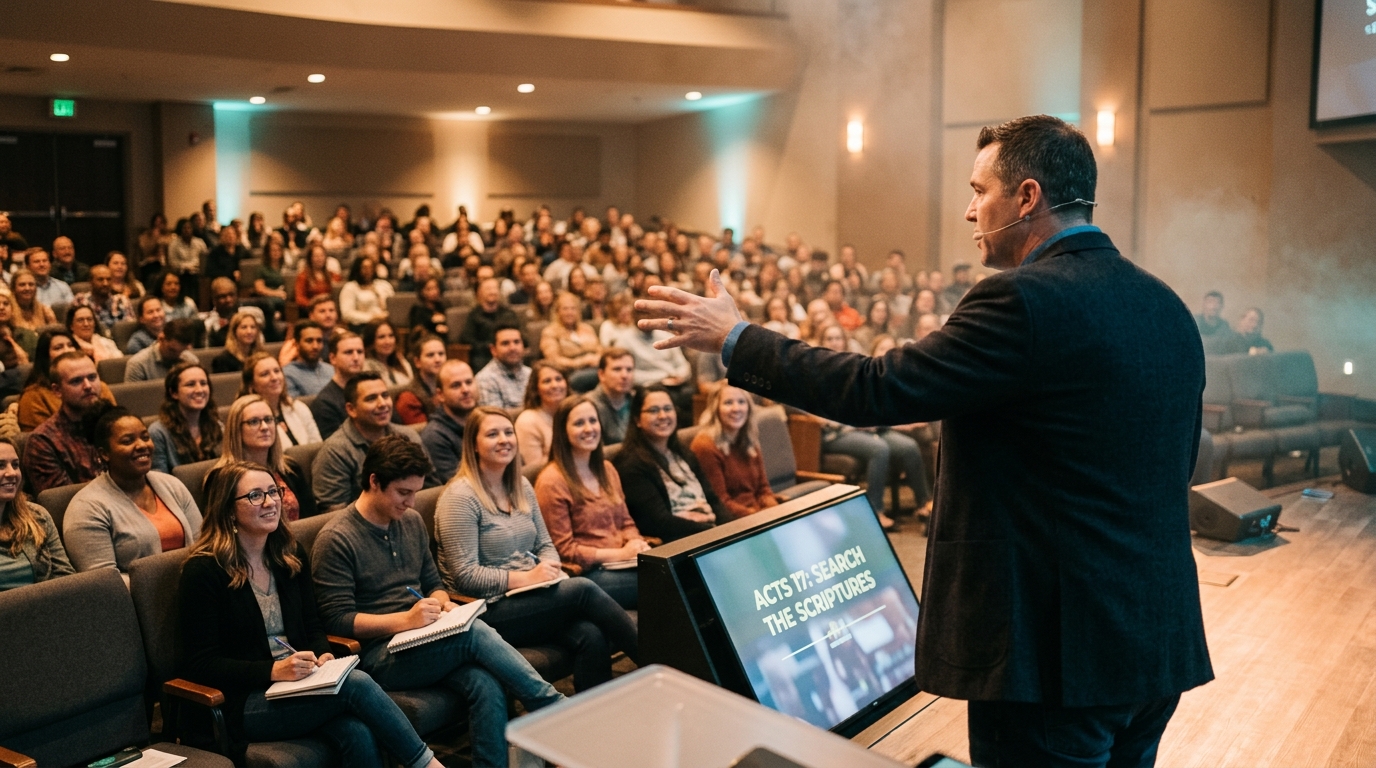
You've probably felt it — that moment mid-sermon when you realize you're talking at people, not with them. The room feels passive. Eyes glaze over. You're working hard, but the connection isn't there. Traditional monologue preaching has its place, but what if your message could feel more like a conversation than a lecture?
That's where dialogical preaching comes in. It's not about abandoning structure or turning Sunday morning into a free-for-all discussion. It's about creating space for genuine two-way engagement — where your congregation participates actively in the learning process, not just receives information passively. Research on adult learning shows that participatory methods increase retention by up to 75% compared to passive listening alone.
Dialogical preaching doesn't mean you lose control of your message. It means you invite your congregation into the discovery process in strategic, intentional ways. In this guide, you'll learn what dialogical preaching actually looks like, when to use it, and how to implement interactive techniques without derailing your sermon or creating awkward silence.
Quick Answer: Dialogical preaching is a sermon delivery method that incorporates two-way communication between preacher and congregation through strategic questions, responses, and participatory elements. Unlike pure monologue, it engages listeners as active participants in the learning process, typically increasing retention by 50-75% while maintaining the preacher's authority and message structure.
Key Takeaways
- Dialogical preaching increases retention — Interactive elements can boost message retention by 50-75% compared to monologue-only delivery
- It's structured participation, not chaos — Effective dialogical preaching uses planned interaction points that support (not derail) your main message
- Question types matter more than frequency — Rhetorical, reflective, and direct questions serve different purposes and create different levels of engagement
- Cultural context determines effectiveness — Some congregations embrace participation immediately; others need gradual introduction and permission to respond
What Is Dialogical Preaching (And What It's Not)?
Dialogical preaching is a sermon delivery approach that intentionally creates space for congregation participation and response during the message. Instead of a one-way information transfer from preacher to listener, it establishes a conversational dynamic where the congregation actively engages with the content through questions, responses, reflections, or brief discussions.
This doesn't mean you're conducting a Bible study or facilitating a small group discussion from the pulpit. You're still the primary communicator with a prepared message and clear direction. The difference is that you're inviting strategic moments of interaction that deepen engagement and processing.
Dialogical preaching is not simply asking rhetorical questions and answering them yourself. It's not call-and-response where you train your congregation to shout back predictable phrases. And it's definitely not opening the floor for random comments that derail your message. True dialogical preaching maintains your authority and message structure while creating genuine opportunities for cognitive and emotional engagement.
Communication experts recommend dialogical methods particularly for teaching complex concepts or addressing topics where listeners need to process personal application. When you're explaining a difficult theological concept, working through a controversial passage, or calling people to specific life change, interactive elements help people move from passive hearing to active integration.
The goal isn't just engagement for engagement's sake. It's creating conditions where your congregation processes truth more deeply, remembers it more clearly, and applies it more specifically than they would through passive listening alone.
Why Does Dialogical Preaching Work Better for Some Messages?
Dialogical preaching works because it aligns with how adults actually learn and process new information. Studies on audience retention show that people remember approximately 10% of what they hear, 20% of what they read, but 70-90% of what they discuss and apply. When you create space for interaction, you're moving people from the lowest retention category to the highest.
Beyond retention, dialogical methods address the attention problem every preacher faces. The average adult attention span for passive listening is 10-18 minutes. After that, engagement drops significantly. Interactive elements reset attention by changing the dynamic — suddenly listeners aren't just receiving, they're participating. This cognitive shift re-engages focus and extends the effective attention window.
Dialogical preaching also creates emotional connection that pure monologue can't match. When you ask a question and pause for people to genuinely consider their answer (even if they don't speak it aloud), you're creating a moment of personal reflection. That internal dialogue — "How would I answer that? What does this mean for me?" — is where transformation begins. You're not just delivering content; you're facilitating discovery.
Certain message types benefit especially from dialogical approaches. When you're teaching practical application, working through doubt or difficult questions, addressing cultural issues, or calling people to decision, interaction helps people personalize the message. A sermon on prayer becomes more powerful when you pause and say, "Think about the last time you really prayed. Not just said grace, but actually talked to God. What was happening in your life?" That moment of reflection does work that ten more minutes of explanation can't accomplish.
The method also builds trust. When you demonstrate that you're willing to engage questions, acknowledge complexity, and invite honest processing, you signal that faith isn't about blind acceptance — it's about genuine wrestling with truth. That permission to think critically actually strengthens conviction rather than weakening it.
How to Structure Dialogical Elements Without Losing Your Message
The biggest fear pastors have about interactive preaching is losing control — that one question will derail the entire sermon or create awkward silence that kills momentum. The solution isn't avoiding interaction; it's structuring it intentionally.
Start by identifying 3-5 strategic interaction points in your sermon outline. These aren't random moments — they're places where engagement serves a specific purpose. Common interaction points include:
- After introducing the problem — "Before we look at what Scripture says, think about how you'd answer this question..."
- Before revealing the solution — "What do you think Jesus is about to say here? Turn to the person next to you and share your guess."
- During application — "On a scale of 1-10, how well are you doing in this area? Just think about it — you don't have to share."
- Before the conclusion — "What's one thing you need to do differently this week based on what we've talked about?"
- After a challenging truth — "I know that's hard to hear. What questions does that raise for you?"
Each interaction point should have a clear boundary. Specify what you're asking for: "Just think about it," "Turn to one person," "Raise your hand if...," "Write this down." The clearer your instruction, the more confident people feel participating.
Time-box your interactive moments. A 30-second pause for reflection works. A 60-90 second turn-and-share creates energy without losing momentum. A 2-3 minute small group discussion can work if you're intentional about transitioning back. Anything longer risks losing people who finish early or creating side conversations that compete with your message.
Use transitional phrases that signal you're moving from interaction back to teaching: "Alright, let's come back together," "Here's what Scripture actually says about that," "Now that you've thought about it, let me show you..." These phrases reclaim attention and re-establish your authority without feeling abrupt.
The key is that every interactive element should serve your main point, not distract from it. If you can't explain how a question or activity reinforces your central idea, cut it. Dialogical preaching isn't about adding interaction for its own sake — it's about using participation strategically to deepen the impact of your message.
What Are the Different Types of Dialogical Techniques?
Not all interaction is created equal. Different techniques create different levels of engagement and serve different purposes. Understanding the spectrum helps you choose the right tool for each moment.
Rhetorical questions with extended pause are the entry point to dialogical preaching. You ask a question, but instead of immediately answering it yourself, you pause 5-10 seconds and let people actually think. This is more interactive than it sounds — you're creating space for internal dialogue. Example: "When was the last time you felt truly known by someone?" [Pause. Let them think.] "That feeling — that's what God offers."
Direct questions with visible response invite people to physically indicate their answer. "Raise your hand if you've ever felt like giving up on prayer." "Stand up if you've experienced God's provision in a tangible way this month." These create community and normalize honesty. They also give you real-time feedback about where your congregation is.
Turn-and-share prompts create peer interaction. "Turn to someone near you and share one thing you're grateful for this week." "Tell the person next to you what question this passage raises for you." This works especially well for application or reflection — it's less intimidating than speaking to the whole room, but more engaging than just thinking silently.
Call-and-response patterns work when you're building energy or reinforcing a key phrase. "When I say 'God is,' you say 'faithful.' God is..." "Faithful!" This technique has deep roots in Black church tradition and creates communal affirmation. Use it sparingly for emphasis, not as a crutch.
Open-ended questions with volunteer responses are higher risk but higher reward. "What do you think Jesus meant by that? Anyone want to share?" This requires a congregation that's comfortable speaking up and a preacher who can gracefully redirect if someone goes off track. It works best in smaller settings or churches with strong participatory culture.
Guided reflection with note-taking invites people to write their response. "I want you to write down one area where you need to trust God more. You don't have to share it — this is between you and God." This creates personal engagement without requiring public vulnerability.
Best practices in sermon delivery indicate that variety matters more than frequency. Using the same technique repeatedly becomes predictable and loses impact. Mixing methods — a rhetorical question here, a turn-and-share there, a moment of silent reflection later — keeps people engaged without feeling gimmicky.
Common Dialogical Preaching Mistakes (And How to Fix Them)
The most common mistake is asking questions you don't actually want answered. You say, "What do you think about that?" but your tone and pacing make it clear you're about to answer it yourself. This trains your congregation to ignore your questions because they know you're not really asking. Fix: If you ask a question, pause. Count to five in your head. Let the silence do its work. If you want verbal responses, explicitly invite them: "I really want to hear from you — what comes to mind?"
Another mistake is creating interaction without clear instructions. You say, "Talk about this," but people don't know if they should turn to one person, their whole row, or just think silently. The result is awkward confusion. Fix: Be specific. "Turn to one person near you." "Just think about this — you don't need to share." "Raise your hand if this applies to you." Clarity creates confidence.
Many pastors also misjudge timing. They ask people to discuss something, then cut them off after 20 seconds right when conversation is starting. Or they let discussion run three minutes and lose momentum. Fix: Time your interactive moments during sermon prep. Practice them. Know what 60 seconds of turn-and-share actually feels like. Give clear time boundaries: "You've got about a minute — make it count."
Some preachers use dialogical techniques to avoid doing the hard work of clear teaching. They ask questions instead of making points, hoping the congregation will arrive at the truth themselves. This abdicates your teaching responsibility. Fix: Use interaction to deepen understanding of truth you're teaching, not to replace teaching altogether. You're the shepherd — lead clearly, but invite participation in the journey.
The opposite mistake is over-controlling the interaction. You ask for responses but only validate the "right" answers, shutting down honest questions or different perspectives. This kills trust and makes future participation feel risky. Fix: When someone shares, honor their contribution even if it's not what you expected. "That's a great observation — let me build on that," or "I hear you — that's a question a lot of people have. Here's what I'd say..."
Finally, many pastors give up on dialogical preaching after one awkward attempt. The first time you ask your congregation to turn and share, you might get silence or hesitation. That's normal, especially in churches without a participatory culture. Fix: Start small. Build gradually. Give your congregation permission and practice. The more consistently you create space for interaction, the more comfortable people become engaging.
How to Introduce Dialogical Preaching to a Traditional Congregation
If your church is used to monologue preaching, you can't flip a switch and suddenly start running a town hall meeting from the pulpit. Cultural change requires intentionality and patience.
Start with low-risk interaction. Before you ask people to share out loud, begin with rhetorical questions with extended pauses. Then move to "think about this" prompts. Then try "raise your hand if..." questions. Each step normalizes participation without requiring vulnerability. You're training your congregation that when you ask a question, you actually mean it.
Explain what you're doing and why. Early in your sermon, say something like: "Today I'm going to ask you some questions, and I actually want you to think about your answers. I'm not just asking rhetorically — I want you to engage with this truth personally." That permission and explanation reduces anxiety and increases participation.
Model the behavior you want. If you ask people to turn and share, turn to someone on the front row and demonstrate. If you want people to write something down, pull out your own notebook and write. Your congregation will follow your lead.
Celebrate participation when it happens. If someone raises their hand or shares a response, affirm them: "Thank you for that," "I appreciate your honesty," "That's exactly the kind of thinking I'm asking for." Positive reinforcement encourages others to engage next time.
Be patient with silence. The first time you ask your congregation to reflect on a question, you might get uncomfortable quiet. Don't panic and fill it immediately. Let the silence do its work. Count to ten. People need time to shift from passive listening to active thinking.
Consider starting dialogical elements in less formal settings first. Try interactive teaching in a Bible study, small group, or midweek service before bringing it to Sunday morning. This lets you practice the techniques and build congregational comfort in a lower-stakes environment.
According to homiletics research, congregations adapt to new preaching styles over 6-8 weeks of consistent exposure. Don't judge the effectiveness of dialogical preaching based on your first attempt. Commit to incorporating interactive elements regularly for two months, then evaluate. You'll likely see engagement increase significantly as people learn the new pattern.
What to Look For When Evaluating Your Dialogical Preaching
How do you know if your interactive elements are working? Look for both immediate engagement signals and longer-term impact indicators.
During the sermon, watch for participation rates. When you ask people to raise hands, turn and share, or reflect silently, what percentage actually do it? In a healthy dialogical sermon, you should see 60-80% visible participation in low-risk activities (like raising hands) and 40-60% in higher-risk ones (like turn-and-share). If numbers are lower, your congregation may need more permission, clearer instructions, or gradual introduction to the technique.
Pay attention to energy shifts. Effective dialogical moments create a noticeable change in room energy — you can feel attention re-engage. If your interactive elements create awkwardness or confusion instead, something's off. Either the timing is wrong, the instructions are unclear, or the congregation isn't ready for that level of participation.
Listen to the quality of turn-and-share conversations. When you give people 60-90 seconds to discuss, do you hear engaged conversation or awkward small talk? Are people actually talking about what you asked, or are they chatting about lunch plans? The content of their interaction tells you whether your prompt was clear and compelling.
After the sermon, track retention and application. Do people remember your main points better when you used dialogical techniques versus pure monologue? Do they reference specific interactive moments in follow-up conversations? "That question you asked about prayer really stuck with me" is a sign the technique worked.
Ask for direct feedback from trusted leaders. "How did the interactive elements feel today? Too much? Not enough? Awkward or helpful?" Their perspective can reveal blind spots you can't see from the pulpit.
Evaluate your own comfort level. Are you rushing through interactive moments because you're anxious, or are you settling into them with confidence? Your ease with the technique directly impacts its effectiveness. If you're uncomfortable, your congregation will be too.
Preach Better's analysis framework can help you evaluate dialogical elements objectively. When you upload your sermon, the platform identifies moments where you asked questions, created pauses, or shifted energy — and shows you whether those moments enhanced or disrupted your message flow. You'll see data on pacing changes around interactive elements, helping you calibrate timing and frequency for maximum impact. It's coaching grounded in specific moments from your actual delivery, not generic advice about "being more interactive."
Frequently Asked Questions
How often should I use dialogical preaching techniques in a single sermon? Most effective dialogical sermons include 3-5 strategic interaction points in a 30-40 minute message. More than that risks feeling gimmicky or fragmented. Less than that doesn't create enough engagement shift to justify the approach. The key is quality over quantity — each interactive moment should serve a clear purpose in your message structure.
What if no one responds when I ask for participation? Silence doesn't always mean failure. If you asked for internal reflection ("think about this"), silence is exactly what you want. If you asked for visible response and got nothing, it likely means your congregation needs more permission or practice. Start with lower-risk techniques (rhetorical questions with pauses) and build gradually. Also check your instructions — unclear prompts create hesitation.
Can dialogical preaching work in large church settings? Absolutely. Turn-and-share works at any size because people interact with their immediate neighbors, not the whole room. Direct questions with visible response (raising hands, standing) can create powerful corporate moments in large venues. What doesn't scale well is open-ended questions with individual verbal responses — save those for smaller settings or use them very selectively with wireless mics.
How do I handle someone who gives a wrong or off-topic answer during interaction? Thank them for sharing, then redirect gracefully: "I appreciate that perspective — let me build on it this way..." or "That's an interesting thought. Here's what Scripture specifically says about it..." Never embarrass someone for participating, even if their answer misses the mark. Your goal is to maintain safety for future participation while keeping your message on track.
Is dialogical preaching appropriate for every sermon topic? No. Some messages — particularly prophetic preaching, urgent calls to repentance, or complex theological exposition — work better as monologue. Dialogical techniques excel when you're teaching practical application, working through doubt, addressing controversial topics, or helping people personalize truth. Match your method to your message goal.
How do I transition back to teaching after an interactive moment without losing momentum? Use clear transitional phrases: "Alright, let's come back together," "Now that you've thought about it, here's what Scripture says," "Based on those conversations, let me show you..." These signals reclaim attention and re-establish your teaching authority. Pause briefly after the transition to let side conversations finish, then continue with energy and clarity.
About Preach Better: Preach Better is a sermon delivery analysis platform that helps pastors get honest, specific feedback on their communication. Built around four pillars — Clarity, Connection, Conviction, and Call to Action — it provides coaching grounded in specific moments from your message, not vague generalities. When you're experimenting with dialogical techniques, Preach Better shows you exactly how those interactive moments affected your pacing, energy, and overall message flow.
Bottom Line: Dialogical Preaching Done Right
Dialogical preaching isn't about abandoning your role as teacher or turning Sunday morning into a free-for-all discussion. It's about strategically inviting your congregation into the discovery process through intentional interaction that deepens engagement, increases retention, and personalizes application.
The most effective dialogical preachers use 3-5 well-placed interactive moments per sermon, chosen specifically to serve their main message. They give clear instructions, honor participation, and transition smoothly back to teaching. They start with low-risk techniques and build congregational comfort gradually. And they evaluate effectiveness based on both immediate engagement and long-term retention.
Your congregation is capable of more than passive listening. When you create space for them to think, reflect, discuss, and respond, you're not just delivering a message — you're facilitating transformation. That's the kind of preaching that sticks long after Sunday ends.
If you're ready to see how your interactive elements are actually landing, upload your next sermon to Preach Better. You'll get specific feedback on your dialogical techniques — what's working, what's not, and how to refine your approach for even greater impact. Because every conversation matters, especially the ones that happen in your sermon.