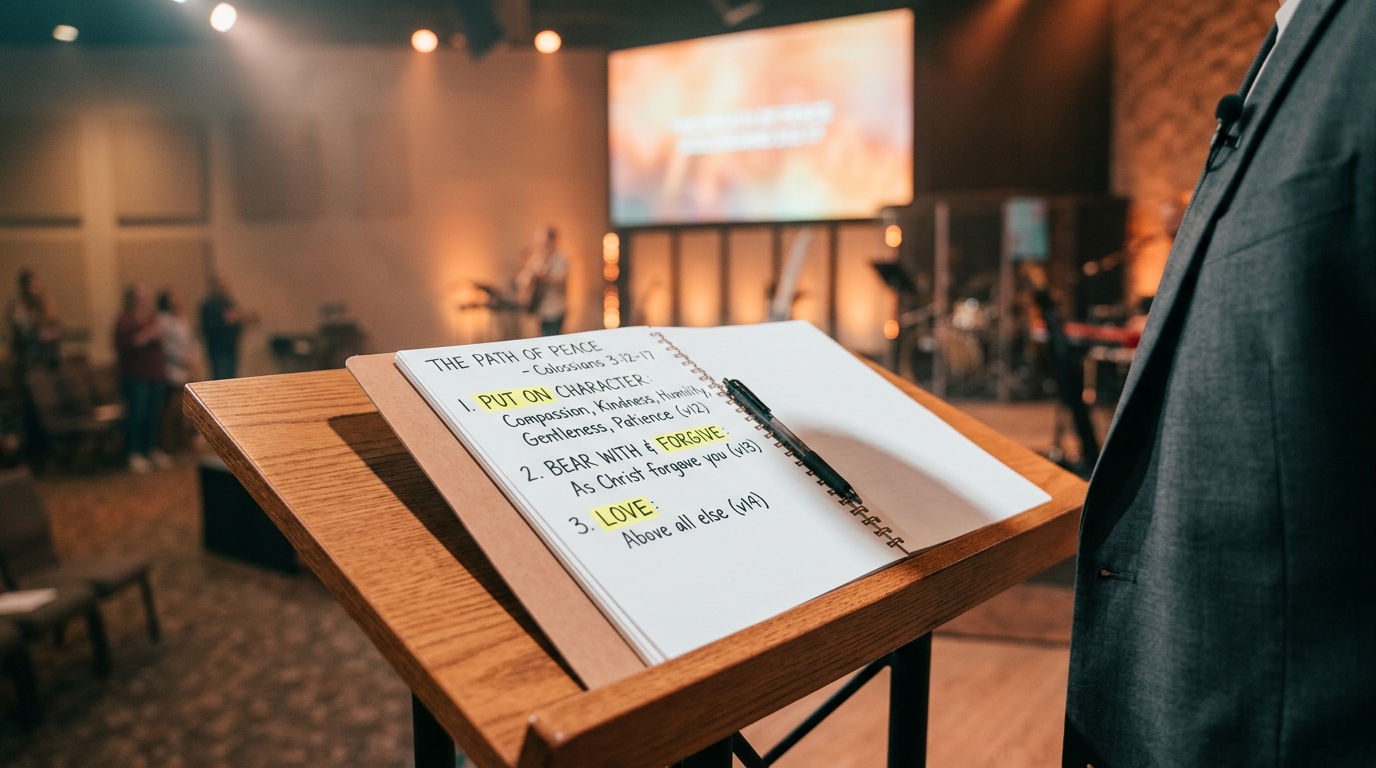

You've been there. Standing before your congregation, manuscript prepared, theology sound, but something's missing. Your words are true, but they're landing flat. You can feel it—the disconnect between what you know in your head and what your congregation is experiencing in the room.
The missing ingredient isn't better research or tighter structure. It's conviction. And here's the challenge: conviction in preaching isn't something you can manufacture with louder volume or more dramatic gestures. It's the alignment between your belief, your preparation, and your delivery that creates authentic, compelling communication. When pastors at Preach Better review their sermon analysis, one of the most common gaps they discover isn't in their content—it's in how conviction translates (or doesn't) through their delivery.
This guide will show you how to identify what's blocking your conviction, how to cultivate it authentically, and how to let it shape your delivery without resorting to performance tactics that feel forced.
Quick Answer: Conviction in preaching is the authentic alignment between your belief in the message and how you communicate it. It's expressed through vocal confidence, intentional pacing, purposeful pauses, and body language that reinforces rather than contradicts your words. Pastors develop conviction through deep preparation, personal wrestling with the text, and delivery practices that let their genuine belief show through without manufactured emotion.
Key Takeaways
- Conviction isn't volume—it's the congruence between what you believe and how you communicate it, often expressed more powerfully through strategic pauses than shouting
- Preparation depth directly impacts delivery confidence—pastors who wrestle personally with the text before crafting the sermon naturally preach with more authority
- Your body language either reinforces or undermines your conviction—misaligned gestures, nervous habits, and defensive postures signal uncertainty even when your words are strong
- Authentic conviction connects deeper than manufactured passion—congregations can distinguish between genuine belief and performance, and they respond to authenticity
What Is Conviction in Preaching (And What It's Not)?
Conviction in preaching is the visible and audible evidence that you believe what you're saying matters. It's not enthusiasm, though enthusiasm can be part of it. It's not volume, though conviction may occasionally be loud. It's the integration of belief and delivery—when your voice, body, and words all communicate the same level of certainty and importance.
Communication experts recommend distinguishing between conviction and its common counterfeits. Manufactured passion—raising your voice at predetermined moments, using dramatic pauses you've scripted without feeling them—reads as performance. Your congregation has watched enough TED Talks and consumed enough media to recognize when emotion is genuine versus produced. True conviction emerges when you've personally grappled with the truth you're presenting and your delivery naturally reflects that wrestling.
Conviction shows up in specific, measurable ways: vocal inflection that emphasizes key truths without straining, eye contact that holds rather than scans, pauses that let weight settle instead of rushing to fill silence, and body language that opens toward the congregation rather than retreating behind the pulpit. When these elements align with your content, conviction isn't something you're trying to project—it's simply what happens when you believe your message and communicate it clearly.
Why Does Conviction Matter More Than Content Quality?
You can preach a theologically sound, exegetically rigorous sermon and still lose your congregation if conviction is absent. Research on public speaking suggests that audiences make judgments about a speaker's credibility and authority within the first 30 seconds—long before they've processed the content. What they're reading isn't your outline; it's your confidence in what you're about to say.
Conviction functions as the permission structure for your congregation to engage. When you communicate with certainty—not arrogance, but settled belief—you signal that this message is worth their attention. Conversely, when your delivery communicates hesitation, uncertainty, or disconnection from your own words, you're asking your congregation to believe something you don't appear to believe yourself.
This is particularly critical in an era of information overload. Your congregation has access to countless podcast sermons, YouTube preachers, and written resources. What they can't get from a recording is the conviction of their pastor who knows them, loves them, and believes this specific message matters for this specific moment. Your conviction isn't just about the universal truth of Scripture—it's about your belief that this truth, presented this way, to these people, right now, has the power to change lives. That specificity of conviction is irreplaceable.
How Does Preparation Depth Impact Preaching Conviction?
The most common conviction problem isn't a delivery issue—it's a preparation issue. Pastors who rush through sermon prep, relying on commentaries without personal text engagement, or who finalize their message Saturday night, consistently struggle with confident delivery. You can't communicate conviction you haven't developed.
Deep preparation means wrestling with the text before you craft the sermon. It means asking hard questions, sitting with tensions, and letting the passage challenge you before you challenge your congregation. When you've personally encountered the truth you're presenting—when it's disrupted your thinking, convicted your own heart, or reshaped your perspective—that encounter shows up in your delivery. You're not just reporting information; you're sharing a discovery.
Studies on audience retention show that speakers who demonstrate personal investment in their material hold attention 40% longer than those who present the same content with detachment. For preachers, this translates directly: the sermon you've lived with all week, that you've prayed through and let reshape you, will naturally carry more conviction than the one you assembled from borrowed insights the night before. Your congregation can hear the difference between "here's what the text says" and "here's what the text has done to me this week."
What Are the Vocal Markers of Conviction?
Conviction has a sound. It's not one specific tone or volume—it's the alignment between your voice and your meaning. When you believe what you're saying, your vocal delivery naturally emphasizes key words, varies in pace to match content weight, and uses strategic pauses to let important truths land.
The most reliable vocal marker of conviction is intentional inflection. Pastors who read their manuscripts with flat, even tone—regardless of whether they're describing judgment or grace, problem or solution—communicate that all content has equal weight. Conviction requires vocal dynamics: rising inflection for questions that deserve consideration, falling inflection for statements of certainty, emphasis on words that carry theological or practical weight.
Volume is the most misunderstood aspect of conviction. Many pastors equate passion with loudness, but communication experts recommend the opposite: conviction is often most powerful when delivered at moderate volume with clear articulation. Shouting can signal desperation or performance; steady, clear delivery at conversational volume signals confidence. Save increased volume for moments of genuine climax, and your congregation will recognize those moments as significant rather than performative. The pastors who master strategic pauses in preaching often communicate more conviction in silence than others do with increased volume.
How to Eliminate Delivery Habits That Undermine Conviction
Your conviction can be genuine, but if your delivery habits contradict it, your congregation will trust what they see and hear over what you intend. Nervous habits, defensive body language, and vocal uncertainty patterns all signal that you're not fully confident in your message—even when you are.
The most common conviction-killers are filler words and hedging language. "Um," "uh," "you know," "kind of," "sort of," "maybe," "I think"—these verbal tics communicate uncertainty. When you say "I think God might be calling us to consider possibly making a change," you've buried your conviction under six layers of qualification. The truth you're presenting deserves declarative language: "God is calling us to change." If you're not certain enough to say it clearly, you're not ready to preach it. Many pastors benefit from learning how to eliminate filler words in sermons as a foundational step toward more confident delivery.
Body language either reinforces or undermines your words. Crossed arms, hands in pockets, gripping the pulpit, retreating behind the lectern, avoiding eye contact—all signal defensiveness or uncertainty. Conviction requires open posture: hands visible and gesturing naturally, body oriented toward the congregation, eye contact that connects with individuals rather than scanning over heads. If your message is "God is for you," but your body language says "I'm protecting myself from you," the congregation will believe your body.
Vocal patterns also matter. Upspeak—ending declarative sentences with rising inflection as if they're questions—undermines authority. Rushing through key statements without pause signals nervousness. Dropping volume at the end of sentences makes your conclusions literally inaudible. These aren't minor stylistic choices; they're conviction signals your congregation is reading constantly.
What Role Does Authenticity Play in Convicted Preaching?
Authenticity and conviction aren't the same thing, but they're inseparable. You can be authentic without conviction (genuine but uncertain), and you can project conviction without authenticity (confident but fake). Powerful preaching requires both: genuine belief communicated with confidence.
The authenticity challenge for experienced pastors is avoiding the performance trap. After years of preaching, you know what works—which stories get laughs, which phrases land, which sermon structures keep attention. The temptation is to rely on these proven patterns even when they don't emerge naturally from the text or your genuine engagement with it. Your congregation can sense when you're running a play versus when you're genuinely moved by what you're saying.
According to homiletics research, congregations consistently rate "authentic" as more important than "polished" when evaluating preaching effectiveness. They'd rather hear a pastor who's genuinely wrestling with a text, even if the delivery is rough, than one who's performing a smooth but disconnected message. This doesn't mean preparation doesn't matter—it means your preparation should deepen your authenticity, not replace it with performance.
Authentic conviction also means acknowledging when you're uncertain. If a text is difficult, say so. If you're still working through implications, admit it. If the application challenges you personally, let that show. This kind of vulnerability doesn't undermine conviction—it demonstrates that your conviction is about the authority of Scripture, not your own certainty about every detail. Your congregation will trust a pastor who says "this passage is difficult, and here's what I believe it means" more than one who glosses over complexity with false confidence.
How to Develop Conviction When You're Preaching Difficult Texts
Not every text fires you up. Some Sundays you're preaching genealogies, judgment passages, or doctrinal content that feels more like obligation than inspiration. How do you develop conviction when the text doesn't naturally excite you?
The answer is finding the why beneath the what. Every biblical text exists for a reason. Every genealogy connects to the larger redemptive story. Every judgment passage reveals something about God's character and humanity's need. Every doctrinal truth has practical implications for how your congregation lives Monday through Saturday. Your job isn't to manufacture enthusiasm for content you don't care about—it's to dig until you discover why this text matters, then let that discovery fuel your conviction.
Start by asking: What would my congregation miss if they never heard this text? What problem does it solve? What truth does it clarify? What behavior does it correct? What hope does it offer? When you can answer those questions specifically, you've found your conviction anchor. You're not preaching a difficult text because it's next in the lectionary—you're preaching it because your congregation needs this specific truth for their specific lives.
Best practices in sermon delivery indicate that conviction also grows through repetition and refinement. Practice your sermon out loud multiple times before Sunday. Each time through, you'll discover which phrases feel natural, which points need stronger emphasis, which transitions need smoothing. This isn't about memorization—it's about internalization. By the time you preach, the content should feel like yours, not like something you're reading or reciting. That ownership translates directly to conviction.
How Does Conviction Connect to the Four Pillars Framework?
Conviction isn't a standalone element—it's woven through all four pillars of effective sermon delivery. Understanding how conviction intersects with Clarity, Connection, Conviction, and Call to Action helps you develop it systematically rather than hoping it shows up spontaneously.
In the Clarity pillar, conviction means believing your message is clear enough to act on. If you're uncertain whether your congregation understands, that uncertainty shows in your delivery. Conviction requires you to craft clear statements, define terms, and structure content logically—then deliver it with confidence that you've done the work to make it understandable.
In the Connection pillar, conviction means believing your message matters to your specific congregation. Generic applications delivered with high energy still lack conviction if they don't connect to real lives. Conviction requires knowing your people well enough to make your message specific, then delivering it with the confidence that comes from relevance.
In the Conviction pillar itself, this is where your belief in the message's truth and importance becomes most visible. Your vocal emphasis, body language, pacing, and pauses all communicate whether you believe this message has the power to change lives. This is where the alignment between preparation depth and delivery confidence becomes most critical.
In the Call to Action pillar, conviction means believing your congregation can and should respond. Weak calls to action—"maybe consider thinking about possibly trying to pray more"—signal that you don't really believe change is possible. Conviction requires clear, specific, actionable next steps delivered with the confidence that obedience is both possible and necessary.
What Are the Most Common Conviction Mistakes Pastors Make?
Even experienced pastors fall into conviction traps that undermine their effectiveness. Recognizing these patterns helps you avoid them.
The first mistake is confusing conviction with intensity. Some pastors believe that preaching louder, faster, or more dramatically equals more conviction. But intensity without substance reads as performance. Your congregation can distinguish between a pastor who's genuinely moved by truth and one who's working to generate emotion. Authentic conviction often shows up in quieter moments—a strategic pause before a key statement, steady eye contact during a challenging truth, or a simple declarative sentence delivered with calm certainty.
The second mistake is apologizing for your message. Phrases like "I know this is hard to hear" or "I'm sorry if this offends anyone" or "I don't mean to be harsh, but..." all undermine conviction before you've even made your point. If the text says something difficult, say it clearly and let it stand. Your congregation doesn't need you to soften Scripture—they need you to deliver it with conviction that it's true and necessary.
The third mistake is inconsistent conviction. Some pastors preach the gospel with fire but deliver practical application with hesitation. Others are confident in doctrine but uncertain in personal stories. Conviction should be consistent throughout your message. Every point deserves the same level of belief and confident delivery, or you're signaling to your congregation which parts really matter and which are filler.
The fourth mistake is neglecting feedback. You can't evaluate your own conviction accurately without external input. Recording your sermons and reviewing them, or using tools like Preach Better to get specific feedback on delivery patterns, helps you identify conviction gaps you can't feel while preaching. Many pastors discover they're most convicted during preparation but lose that conviction in delivery due to nervous habits they weren't aware of.
How to Practice Conviction Before Sunday
Conviction isn't something you turn on when you step into the pulpit—it's something you develop throughout the week. Practical preparation practices build the foundation for confident delivery.
First, preach your sermon out loud multiple times before Sunday. Not in your head, not reading silently—out loud, standing, as if your congregation is present. Each time through, pay attention to which sections feel natural and which feel forced. The forced sections need more work, either in content or in your own belief about why they matter.
Second, identify your conviction anchors—the 3-4 core truths in your message that you believe most deeply. These are your non-negotiables, the statements you'd defend in any conversation. Practice delivering these specific statements with full conviction: clear voice, steady pace, direct eye contact (even if you're practicing alone). When you know your anchors, you can navigate the rest of your sermon with confidence because you know where you're headed.
Third, eliminate manuscript dependence for key moments. You don't need to memorize your entire sermon, but your most convicted statements should be internalized enough that you can deliver them without reading. Looking up from your notes for your most important truths signals to your congregation that these moments matter most.
Fourth, practice your pauses. Conviction isn't just about what you say—it's about giving your congregation space to receive it. After your key statements, practice pausing for 2-3 seconds. It will feel longer than it is, but that pause communicates confidence. You're not rushing to the next point because you believe what you just said deserves time to land.
How to Recover Conviction When You've Lost It Mid-Sermon
Even with thorough preparation, you'll occasionally lose conviction mid-sermon. Maybe you stumbled over a section, lost your place, or suddenly questioned whether your point is landing. How do you recover without derailing your message?
The first rule: don't apologize or draw attention to the moment. Saying "sorry, I lost my place" or "that didn't come out right" amplifies the problem and undermines whatever conviction you had. Your congregation likely didn't notice the stumble as much as you did. Keep moving.
The second strategy: return to your conviction anchors. If you've lost confidence in where you are, jump to the next core truth you believe deeply. You can always circle back to fill in details, but getting back to solid ground restores your confidence and your congregation's trust.
The third approach: use a strategic pause. If you're feeling uncertain, stop talking. Take a breath. Make eye contact with your congregation. A 2-3 second pause feels like recovery time to you, but to your congregation it looks like emphasis. They'll interpret your pause as conviction—you're letting an important truth settle—rather than uncertainty.
The fourth option: engage your congregation directly. Ask a rhetorical question, reference something specific to your church context, or acknowledge the weight of what you're saying. This shifts you from performance mode to conversation mode, which often restores natural conviction because you're no longer trying to execute a script—you're communicating truth to real people.
Frequently Asked Questions
How can I preach with conviction when I'm naturally introverted or soft-spoken?
Conviction isn't about personality type or volume—it's about alignment between belief and delivery. Introverted pastors often communicate conviction more effectively than extroverts because their measured, thoughtful delivery signals depth rather than performance. Focus on clear articulation, intentional pauses, and steady eye contact. Your conviction will show through consistency and authenticity, not through adopting an extroverted preaching style that doesn't fit who you are.
What's the difference between conviction and being dogmatic or arrogant?
Conviction is confidence in the truth of Scripture and its relevance to your congregation. Arrogance is confidence in your own interpretation or superiority. Convicted preaching acknowledges the authority of the text while remaining humble about your role as messenger. You can say "God's Word is clear on this" with conviction while also saying "I'm still learning what this means for my own life" with humility. The difference is whether your confidence is in the message or in yourself.
How do I develop conviction for texts I personally struggle with or disagree with?
First, don't preach what you don't believe. If you fundamentally disagree with a text's meaning, more study is needed before you preach it. But if you believe the text is true but struggle with its implications, let that struggle show. Conviction doesn't require you to have everything figured out—it requires you to believe the text is authoritative even when it challenges you. Preaching "this text is difficult, and here's why I believe we must submit to it anyway" demonstrates deeper conviction than pretending it's easy.
Should I show emotion when preaching, or does that undermine conviction?
Emotion and conviction aren't opposites—they're often companions. If a text moves you to tears, let that show. If a truth excites you, let your energy reflect it. The question isn't whether to show emotion, but whether your emotion is genuine or manufactured. Congregations trust authentic emotion that emerges naturally from the content. They're skeptical of emotion that feels produced for effect. Let your genuine response to the text show through, whatever that response is.
How can I tell if my conviction is coming through to my congregation?
The most reliable indicator is engagement. When you preach with conviction, your congregation leans in, maintains eye contact, and responds with attention rather than distraction. Post-sermon conversations will reference specific statements you made with conviction rather than general impressions. You can also record your sermons and review them, or use sermon analysis tools like Preach Better to get specific feedback on delivery patterns that either reinforce or undermine conviction. External feedback reveals conviction gaps you can't feel while preaching.
What if I'm preaching someone else's sermon or using a sermon series resource?
Using prepared resources doesn't automatically undermine conviction, but it requires extra work to make the content yours. You must wrestle with the text and application personally, not just deliver someone else's insights. Adapt the content to your congregation's specific context, add your own illustrations and applications, and practice until the delivery feels natural rather than borrowed. If you can't internalize the message enough to preach it with conviction, it's not ready for your congregation—even if it's a great sermon for someone else.
About Preach Better: Preach Better is a sermon delivery analysis platform that helps pastors get honest, specific feedback on their communication. Built around four pillars—Clarity, Connection, Conviction, and Call to Action—it provides coaching grounded in specific moments from your message, not vague generalities. For pastors working to strengthen their conviction, Preach Better identifies delivery patterns that undermine confidence and provides actionable coaching to align your belief with your delivery.
Bottom Line: Conviction Is Cultivated, Not Manufactured
Conviction in preaching isn't a performance technique you add to your delivery—it's the natural result of deep preparation, genuine belief, and aligned communication. When you've wrestled with the text personally, when you believe your message matters to your specific congregation, and when your vocal delivery and body language reinforce rather than contradict your words, conviction shows up naturally.
The pastors who preach with the most conviction aren't necessarily the loudest or most dramatic. They're the ones who've done the work to believe their message deeply, who've practiced their delivery until it feels natural, and who've eliminated the habits that undermine their confidence. They understand that conviction is about congruence—when what you believe, what you say, and how you say it all align, your congregation feels it.
Your congregation needs to hear truth delivered with conviction. Not manufactured passion, not borrowed intensity, but your genuine belief that this message, for these people, at this moment, has the power to change lives. That kind of conviction is worth cultivating, and it starts with your next sermon preparation session.