You've prepared a solid message. Your outline is clear, your illustrations land, your theology is sound. But fifteen minutes in, you notice a few people checking their phones. Others are staring at your hands instead of listening to your words.
The problem isn't your content. It's your sermon gestures.
Most pastors don't realize that hand movements can either amplify a message or completely undermine it. After analyzing thousands of sermons at Preach Better, we've identified patterns that separate distracting gestures from powerful ones. The difference isn't about being more animated or more reserved—it's about intentionality.
In this guide, you'll learn the seven most common gesture mistakes experienced pastors make, why they happen, and specific techniques to fix them before your next message.
Quick Answer: The most common sermon gesture mistakes include repetitive hand movements (the "washing machine" effect), mismatched gestures that contradict your words, pocket hiding that signals discomfort, and excessive pointing that feels accusatory. Effective preaching gestures should be purposeful, varied, and aligned with your message's emotional tone—typically using open palm gestures for invitation, controlled movements for emphasis, and strategic stillness for weight.
Key Takeaways
- Repetitive gestures create visual noise that trains your congregation to tune out your nonverbal communication entirely
- Gesture-word misalignment (saying "three points" while holding up two fingers) undermines your credibility more than you realize
- Strategic stillness amplifies emphasis better than constant motion—knowing when NOT to gesture is as important as the gestures themselves
- Open palm positioning communicates invitation and authenticity, while closed fists and excessive pointing create psychological barriers
What Makes Sermon Gestures Effective (Or Distracting)?
Effective sermon gestures work because they align with how the human brain processes communication. Research on public speaking suggests that audiences assign meaning to nonverbal cues faster than they process verbal content—your hands communicate before your words do.
A distracting gesture is one that draws attention to itself rather than reinforcing your message. The "fig leaf" position (hands clasped in front of your body) signals discomfort. The "T-Rex" stance (elbows pinned to your sides with only forearms moving) looks mechanical. The "traffic cop" (constant directional pointing) feels aggressive.
Effective preaching gestures, by contrast, are invisible in the best sense—they enhance meaning without calling attention to themselves. When you describe something expanding, your hands naturally move outward. When you emphasize a critical point, your gesture becomes more controlled and deliberate. When you invite response, your palms open toward the congregation.
The key distinction: effective gestures emerge from your message's content and emotional tone. Distracting gestures are habitual patterns disconnected from what you're actually saying.
Why Hand Movements in Preaching Matter More Than You Think
Your congregation processes your sermon gestures whether they're consciously aware of it or not. Communication experts recommend that speakers maintain congruence between verbal and nonverbal messages—when these channels conflict, audiences trust the nonverbal signal.
This creates a credibility problem for preachers. If you're preaching about God's expansive grace while your hands remain locked in a tight, protective position, your body contradicts your theology. If you're calling people to bold action while your gestures are timid and uncertain, your nonverbal communication undermines your verbal call.
Beyond credibility, gestures directly impact retention. Studies on audience retention show that messages accompanied by purposeful gestures are remembered 38% better than those delivered with minimal or repetitive hand movements. Your gestures create mental anchors—visual associations that help people recall your points days later.
For experienced pastors, this matters even more. Your congregation has watched you preach for years. They've unconsciously cataloged your gesture patterns. If you've developed distracting habits, they've learned to filter them out—which means they're also filtering out the emphasis you're trying to create.
Mistake #1: The Repetitive Loop ("Washing Machine Hands")
This is the most common gesture mistake among experienced preachers: a single hand movement repeated throughout the entire message. The circular motion. The chopping gesture. The finger point. The open-palm bounce.
The problem isn't the gesture itself—it's the repetition. When you use the same movement every fifteen seconds for thirty minutes, it becomes visual white noise. Your congregation's brains recognize the pattern and stop processing it as meaningful communication.
According to homiletics research, preachers who rely on a single dominant gesture reduce their nonverbal effectiveness by up to 60%. The gesture that once emphasized a point now emphasizes nothing because it's attached to everything.
To break this pattern, record yourself preaching and count how many times you repeat your default gesture. Most pastors are shocked to discover they're using the same movement 40-50 times in a single message. Then practice these alternatives:
For emphasis points: Use a controlled, deliberate gesture with a pause—one movement, held briefly, then released
For narrative sections: Let your hands rest naturally at your sides or in a neutral position, saving gestures for key moments in the story
For transitions: Use a sweeping gesture to signal movement from one idea to another, then adopt a different gesture vocabulary for the new section
For invitation: Open both palms toward the congregation, creating a visual sense of offering rather than demanding
The goal isn't to eliminate your natural gesture—it's to expand your vocabulary so you have multiple options that match different message moments.
Mistake #2: Gesture-Word Misalignment (Saying One Thing, Showing Another)
You say "three points" while holding up two fingers. You describe something small while your hands spread wide. You talk about unity while your gestures are fragmented and scattered. This is gesture-word misalignment, and it creates cognitive dissonance in your listeners.
Best practices in sermon delivery indicate that misaligned gestures force the brain to work harder to reconcile conflicting information. This processing load reduces comprehension and retention. Your congregation may not consciously notice the mismatch, but they'll feel something is "off."
The most common misalignments:
Directional confusion: Saying "look back" while gesturing forward, or "move forward" while gesturing to the side
Size contradictions: Describing something "small" or "narrow" with expansive gestures, or "huge" with tiny hand movements
Emotional incongruence: Preaching about joy with closed, protective body language, or about seriousness with casual, dismissive gestures
Numerical errors: The classic "three points" with two fingers, or counting on your fingers out of sequence
To fix this, practice your sermon with intentional attention to alignment. When you say a number, hold up that many fingers and hold the gesture long enough for it to register. When you describe size or direction, make sure your hands match your words. When you shift emotional tone, let your gestures shift with it.
This doesn't mean choreographing every movement—it means developing awareness so your natural gestures support rather than contradict your message.
Mistake #3: Pocket Hiding (The Comfort Trap)
Hands in pockets signals one thing to an audience: discomfort. It's a self-soothing behavior that communicates uncertainty, even when you're preaching with conviction. The problem is that it feels comfortable to you while looking uncomfortable to everyone watching.
Communication experts recommend keeping hands visible and available for gesture because hidden hands create psychological distance. Your congregation can't fully trust a message when the messenger appears to be hiding something—even if what you're hiding is just nervous hands.
The pocket habit usually develops as a solution to another problem: not knowing what to do with your hands during less emphatic parts of your message. You feel awkward letting them hang, so you tuck them away. But this creates a cycle where your hands are either hidden or overactive, with no neutral middle ground.
Here's the fix: develop a neutral hand position that feels natural and looks confident. Options include:
The ready position: Hands loosely clasped at waist level, easy to separate for gestures
The open stance: Arms relaxed at your sides, palms facing slightly forward (signals openness and readiness)
The steeple: Fingertips touching lightly in front of your chest (conveys thoughtfulness, but use sparingly)
The asymmetric rest: One hand holding your Bible or notes, the other free to gesture
Practice transitioning smoothly from neutral positions into gestures and back again. The goal is to eliminate the awkward moment where you don't know what to do with your hands—that's when they end up in your pockets.
If you struggle with this habit, consider holding something: a Bible, a notebook, or even a clicker for slides. This gives your hands a job without hiding them.
What to Do Instead: The Open Palm Principle
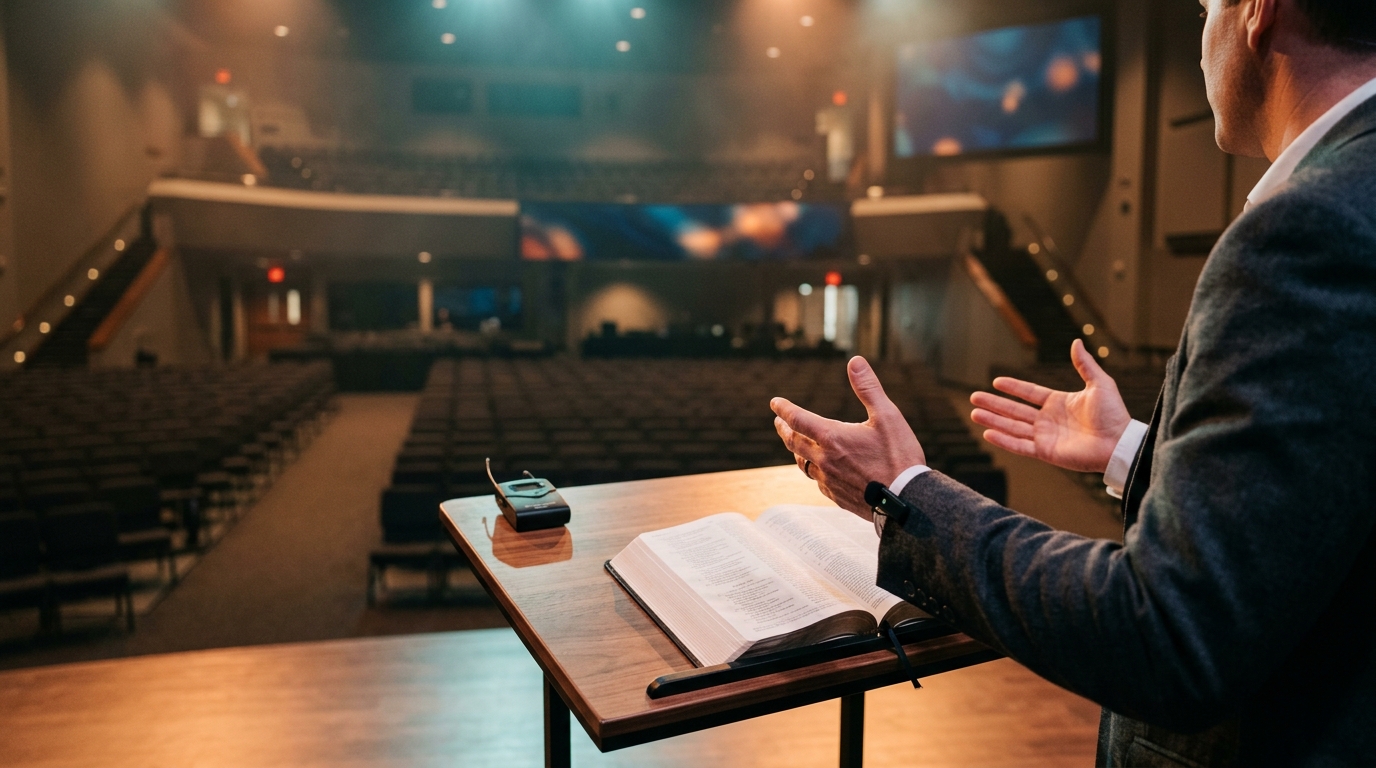
The most powerful gesture in preaching is also the simplest: the open palm. Palms facing up or toward the congregation communicate invitation, honesty, and vulnerability. Palms facing down suggest control or calming. Palms facing away create distance.
This isn't about adopting a single "correct" gesture—it's about understanding the psychological impact of palm orientation. When you want to invite response, open your palms toward people. When you need to acknowledge difficulty before offering hope, turn your palms down briefly, then rotate them up as you transition to the resolution.
The open palm principle also applies to finger positioning. Pointed fingers (especially index fingers aimed at the congregation) trigger defensive responses. Open hands with fingers together or slightly spread feel inclusive rather than accusatory.
Practice this exercise: preach a section of your message three times, changing only your palm orientation. First, with palms consistently facing the congregation. Second, with palms facing down. Third, with palms facing away or closed into fists. Notice how the same words feel different based on hand positioning.
For most sermon content, palms facing the congregation or upward create the most receptive environment. Save closed or downward-facing gestures for specific moments when you need to convey weight, seriousness, or the acknowledgment of difficulty.
Mistake #4: The Pointing Problem (When Emphasis Becomes Accusation)
Pointing is the most overused and misunderstood gesture in preaching. A single pointed finger aimed at the congregation can feel accusatory, even when your intent is emphasis. Extended pointing (holding the gesture for more than a second or two) amplifies this effect.
The problem isn't that pointing is always wrong—it's that most preachers use it reflexively without considering its impact. You're making a strong point, so your finger shoots out. You're emphasizing a truth, so you point for emphasis. But to your congregation, especially in moments of conviction or challenge, that pointed finger can feel like judgment rather than invitation.
Research on public speaking suggests that pointed gestures create psychological barriers. The brain interprets a pointed finger as a threat signal, triggering subtle defensive responses. This is exactly what you don't want when you're inviting people toward transformation.
Here's when pointing works:
Directional reference: "Look at this passage" while pointing to a screen or Bible
Historical reference: "Back then..." with a gesture pointing backward
Future vision: "Imagine what could be..." with a gesture pointing forward
Here's when to avoid pointing:
Direct challenge: Instead of pointing at the congregation, use an open hand gesture
Application moments: Replace pointing with an inclusive "we" gesture (hand on your own chest or open palm toward the group)
Conviction: Use a closed hand (not a fist, but fingers together) moving slowly and deliberately instead of a pointed finger
If you're a habitual pointer, practice substituting an open hand with all fingers together. This maintains the directional emphasis without the accusatory edge. Or use a "gathering" gesture—starting with hands apart and bringing them together—to emphasize unity rather than division.
Mistake #5: Gesture Overload (When More Isn't Better)
Some preachers gesture constantly, filling every sentence with hand movements. This creates visual chaos that competes with your message rather than supporting it. Your congregation's eyes track your hands instead of processing your words.
Studies on audience retention show that excessive gesturing reduces message retention by up to 25%. The brain can only process so many input streams simultaneously. When your hands are in constant motion, they become a distraction rather than an enhancement.
The solution isn't to gesture less—it's to gesture more strategically. Every gesture should serve a purpose: emphasizing a key word, illustrating a concept, marking a transition, or inviting response. Gestures that don't serve one of these purposes are visual noise.
Here's a practical framework for gesture frequency:
Narrative sections: Minimal gestures, letting the story carry itself, with gestures reserved for key moments or dialogue
Explanation sections: Moderate gestures that illustrate concepts or relationships between ideas
Emphasis sections: Controlled, deliberate gestures that punctuate key phrases, with stillness between them
Application sections: Open, invitational gestures that create psychological space for response
Practice this discipline: for every gesture you make, create a moment of stillness afterward. This rhythm—gesture, stillness, gesture, stillness—gives your movements weight and meaning. It also gives your congregation's brains time to process both your words and your nonverbal communication.
Remember: strategic stillness is a form of nonverbal communication. When you stop moving at a critical moment, you signal importance. Your congregation leans in. That stillness, paradoxically, creates more emphasis than constant motion ever could.
Mistake #6: The Barrier Gestures (Crossed Arms and Defensive Positions)
Crossed arms. Hands clasped tightly in front of your body. Arms folded behind your back. These are barrier gestures—nonverbal signals that create psychological distance between you and your congregation.
Best practices in sermon delivery indicate that barrier gestures undermine connection, even when your words are invitational. Your body language communicates defensiveness or discomfort, which your congregation mirrors unconsciously. They lean back. They cross their own arms. They disengage.
The challenge is that barrier gestures often feel comfortable to the preacher. Crossed arms feel confident. Hands clasped feel controlled. But communication isn't about what feels comfortable to you—it's about what creates connection with your audience.
Here's why barrier gestures are particularly problematic for experienced pastors: they often develop after years of preaching as a way to manage nervous energy or project authority. You've learned that this stance feels "pastoral" or "authoritative." But what you're actually communicating is distance.
To break barrier gesture habits:
Identify your default: Record yourself and note when you adopt closed positions—usually during transitions, difficult topics, or moments when you're thinking
Replace with neutral open positions: Use the ready position (hands loosely clasped at waist level) or asymmetric rest (one hand on Bible, one free) instead of crossed arms
Practice vulnerable moments: Intentionally use open gestures during the most challenging parts of your message—this builds trust rather than defense
Use the "chest open" principle: Keep your chest facing the congregation without barriers, even when your hands are at rest
One exception: brief, intentional barrier gestures can illustrate a point. If you're describing someone who was closed off or defensive, adopting that posture for a moment makes sense. But then immediately open back up as you move to the resolution.
Your body language should invite people in, not keep them at arm's length. Open posture communicates that you're accessible, authentic, and confident in your message.
Mistake #7: Ignoring the Gesture-Energy Connection
Your sermon gestures should match your message's energy level. Subdued gestures during a high-energy call to action feel disconnected. Aggressive gestures during a tender pastoral moment feel inappropriate. This is the gesture-energy connection, and ignoring it creates tonal dissonance.
According to homiletics research, gesture intensity should rise and fall with your message's emotional arc. Your opening might have moderate energy with controlled gestures. Your main points might build with increasingly emphatic movements. Your climax might feature your most expansive or intense gestures. Your closing might return to more intimate, invitational movements.
The mistake experienced pastors make is maintaining consistent gesture intensity throughout the message. You've found a gesture style that works, so you use it regardless of whether you're preaching comfort, conviction, celebration, or challenge. This flattens your message's emotional impact.
To match gestures to energy:
Low-energy moments (reflection, confession, lament): Small, controlled gestures close to your body, or strategic stillness
Medium-energy moments (explanation, illustration, teaching): Natural, conversational gestures at chest level
High-energy moments (celebration, vision, call to action): Expansive gestures that use more space, with increased speed and intensity
Transition moments (moving between sections): Neutral positions that reset the energy before building again
Practice preaching the same content with different gesture intensities. Notice how the message feels when your gestures are too subdued for the content, or too aggressive for the tone. Then find the alignment where your hands amplify rather than contradict your message's emotional intent.
The goal isn't to manufacture emotion through gesture—it's to let your genuine passion and conviction express itself through your whole body, not just your words. When you feel the weight of a truth, your gestures should reflect that weight. When you feel the joy of the gospel, your gestures should reflect that joy.
How Preach Better Helps You Identify Your Gesture Patterns
Most pastors have no idea what their hands are doing during a sermon. You're focused on content, delivery, and connection—not on whether you're repeating the same gesture for the fortieth time or contradicting your words with closed body language.
This is where objective feedback becomes invaluable. Preach Better analyzes your sermon delivery across all four pillars—Clarity, Connection, Conviction, and Call to Action—with specific attention to nonverbal communication patterns. The platform identifies your default gestures, notes when your hand movements contradict your message, and flags moments where strategic stillness would create more emphasis than motion.
What makes this feedback different from watching yourself on video is specificity. Instead of a vague sense that "something feels off," you get timestamps tied to specific gesture patterns: "At 14:32, you used the same chopping gesture for the fifth time in two minutes, reducing its emphasis." Or: "At 22:15, you said 'God's expansive grace' while your hands remained in a closed, protective position."
This kind of coaching—grounded in specific moments rather than general impressions—accelerates improvement. You're not guessing what to fix. You're not relying on well-meaning congregation members who don't want to hurt your feelings. You're getting the honest, detailed feedback that actually changes delivery habits.
Because here's the truth: your congregation notices your distracting gestures. They just won't tell you. But those patterns are undermining your message's impact every single week. The pastors who improve fastest are the ones who get specific, honest feedback and act on it.
About Preach Better: Preach Better is a sermon delivery analysis platform that helps pastors get honest, specific feedback on their communication. Built around four pillars—Clarity, Connection, Conviction, and Call to Action—it provides coaching grounded in specific moments from your message, not vague generalities. For gesture analysis, Preach Better identifies repetitive patterns, misalignments, and missed opportunities for nonverbal emphasis, helping you develop a gesture vocabulary that amplifies rather than distracts from your message.
Frequently Asked Questions
Should I plan my sermon gestures in advance or let them happen naturally? The best approach is a hybrid: develop awareness of effective gesture principles, then let your preparation inform your natural expression. Don't choreograph every movement, but do identify 3-4 key moments where a specific gesture would enhance emphasis or illustration. This gives you intentional anchor points while allowing natural gestures to emerge elsewhere.
How can I break a distracting gesture habit I've had for years? Start by recording yourself and identifying your default pattern. Then practice your sermon with your hands intentionally in a neutral position, only gesturing when you make a conscious choice to emphasize something. This interrupts the automatic pattern. Over 4-6 weeks of intentional practice, you'll develop new muscle memory that replaces the old habit.
What if my preaching style is naturally animated—should I tone it down? Animated preaching isn't the problem—repetitive or misaligned gestures are. If you're naturally expressive, focus on expanding your gesture vocabulary so your animation includes variety. The goal isn't to be less animated, but to ensure your energy translates into purposeful, varied movements rather than repetitive patterns.
How do I know if my gestures are distracting without direct feedback? Watch your sermon video with the sound off. If your gestures tell a clear story that matches your message, they're effective. If they're repetitive, random, or contradictory, they're likely distracting. Also notice congregation body language: if people are watching your hands instead of maintaining eye contact, your gestures are pulling focus.
Are there cultural differences in how gestures are perceived in preaching? Yes. Gesture norms vary significantly across cultures. In some contexts, animated gestures signal passion and authenticity. In others, they're seen as undignified or manipulative. If you're preaching cross-culturally, observe respected communicators in that context and adapt your gesture intensity and style accordingly. The principles of alignment and variety remain universal.
What's the biggest mistake experienced pastors make with gestures that new pastors don't? Experienced pastors often develop deeply ingrained gesture habits that were effective early in ministry but have become repetitive over time. New pastors are still experimenting with gesture vocabulary, which creates natural variety. The key for experienced preachers is to periodically audit and refresh their nonverbal communication patterns, treating gesture development as an ongoing discipline rather than a one-time skill.
The Bottom Line on Sermon Gestures
Your hands are preaching whether you're aware of it or not. The question isn't whether to use gestures—it's whether your gestures amplify or undermine your message.
The seven mistakes we've covered—repetitive loops, gesture-word misalignment, pocket hiding, excessive pointing, gesture overload, barrier positions, and ignoring the gesture-energy connection—are fixable with awareness and practice. None of them require natural talent or charisma. They require intentionality.
Start with one mistake. Record your next sermon and watch for that specific pattern. When you identify it, practice the alternative until it becomes natural. Then move to the next mistake. Over time, you'll develop a gesture vocabulary that serves your message rather than distracting from it.
Your congregation is listening with their eyes as much as their ears. Make sure your hands are telling the same story your words are preaching. Because when your nonverbal communication aligns with your message, something powerful happens: people don't just hear the truth—they feel it, remember it, and respond to it.
That's the difference between preaching that informs and preaching that transforms. And it starts with paying attention to what your hands are saying.