You've spent hours on your sermon manuscript. Your theology is sound, your illustrations are compelling, and your call to action is crystal clear. But when you step on stage, your body tells a completely different story.
Your congregation processes your message through two channels simultaneously: what you say and how you say it. Research on public speaking suggests that when verbal and nonverbal messages conflict, audiences trust the nonverbal signal up to 93% of the time. That means your body language in preaching isn't just a minor detail—it's either amplifying your message or actively working against it.
The challenge? Most pastors have never received specific feedback on their nonverbal communication. Your congregation won't tell you that your closed posture makes you seem defensive, or that your constant pacing creates distraction. They'll just feel something is off and struggle to stay engaged. This is where platforms like Preach Better become invaluable—providing the honest, specific feedback about your delivery that your congregation is too polite to share.
In this guide, you'll discover the five most common body language mistakes pastors make, why each one undermines your message, and specific techniques to fix them before your next sermon.
Quick Answer: The most damaging body language mistakes in preaching are closed posture (crossed arms, hands in pockets), excessive or insufficient movement, poor eye contact patterns, incongruent facial expressions, and nervous gestures. Each mistake sends unintended messages—defensiveness, anxiety, disconnection—that contradict your verbal content. Fixing these requires awareness, intentional practice, and specific adjustments to stance, movement patterns, and gesture timing.
Key Takeaways
- Closed posture signals defensiveness: Crossed arms, hands in pockets, or gripping the pulpit creates psychological barriers between you and your congregation, even when your words invite connection
- Movement patterns matter more than movement amount: Random pacing distracts, while purposeful movement tied to transitions and emphasis points enhances retention by up to 38%
- Eye contact builds trust and attention: Maintaining 3-5 second connections with individuals across all sections of your venue increases perceived authenticity and keeps wandering minds engaged
- Your face must match your message: Incongruent facial expressions—smiling while discussing serious topics or maintaining a stern expression during grace-filled moments—create cognitive dissonance that reduces message impact
What Makes Body Language in Preaching So Critical?
Body language in preaching functions as a parallel communication channel that either reinforces or contradicts your spoken message. When you tell your congregation that God's grace is available to everyone while standing behind a pulpit with crossed arms, your nonverbal message communicates exclusion and guardedness. Your audience experiences cognitive dissonance—the uncomfortable tension between conflicting messages—and typically resolves it by trusting what they see over what they hear.
Communication experts recommend thinking of nonverbal communication as the emotional soundtrack to your verbal content. Just as a film score tells viewers how to feel about a scene, your sermon body language tells your congregation how to interpret your words. An open stance with relaxed shoulders signals confidence and invitation. Purposeful gestures that match your emphasis points help listeners track your argument. Genuine facial expressions that align with your content create emotional resonance.
The stakes are particularly high in preaching because you're not just conveying information—you're inviting transformation. When your body language contradicts your message about God's love, acceptance, or power, you create barriers to spiritual receptivity. Your congregation may not consciously identify the disconnect, but they'll feel it as distance, doubt, or disengagement.
Mistake #1: Closed or Defensive Posture
The single most common body language mistake pastors make is adopting closed posture—crossed arms, hands clasped in front of the body, hands in pockets, or a white-knuckle grip on the pulpit. This posture feels safe and controlled to the preacher, but it communicates defensiveness, discomfort, or emotional unavailability to the audience.
Best practices in sermon delivery indicate that open posture—arms relaxed at sides or gesturing naturally, shoulders back, chest open—increases perceived warmth and trustworthiness by up to 47%. When you physically open yourself to your congregation, you signal psychological openness as well. You're saying, "I'm confident in this message, comfortable in this moment, and genuinely connecting with you."
The fix requires intentional awareness and practice. Before you preach, do a posture check: Stand with feet shoulder-width apart, weight evenly distributed, shoulders relaxed and back, arms hanging naturally at your sides. This neutral starting position feels exposed at first—most pastors report feeling "too vulnerable" or "not knowing what to do with their hands." Push through that discomfort. Your congregation interprets this openness as confidence and authenticity.
If you struggle with knowing where to put your hands, remember: they should move naturally as you speak, just as they do in conversation. Start with hands at your sides during neutral moments, then allow them to gesture as you emphasize points. Avoid the fig leaf position (hands clasped in front), the parade rest (hands clasped behind), or the pocket stash (hands hidden away). Each of these creates a barrier between you and your listeners.
Why Does Excessive or Insufficient Movement Distract Your Congregation?
Movement during preaching exists on a spectrum, and both extremes create problems. Excessive movement—constant pacing, swaying, or bouncing—turns you into a visual distraction. Your congregation's eyes follow movement automatically, which means they're tracking your motion instead of processing your message. Studies on audience retention show that unpredictable, repetitive movement can reduce message comprehension by up to 23%.
On the opposite end, complete stillness for extended periods creates a static, low-energy delivery that feels more like a lecture than a living message. Human attention naturally wanes without visual variation. When you stand frozen in one position for five minutes straight, you're fighting against your audience's neurological wiring for novelty and change.
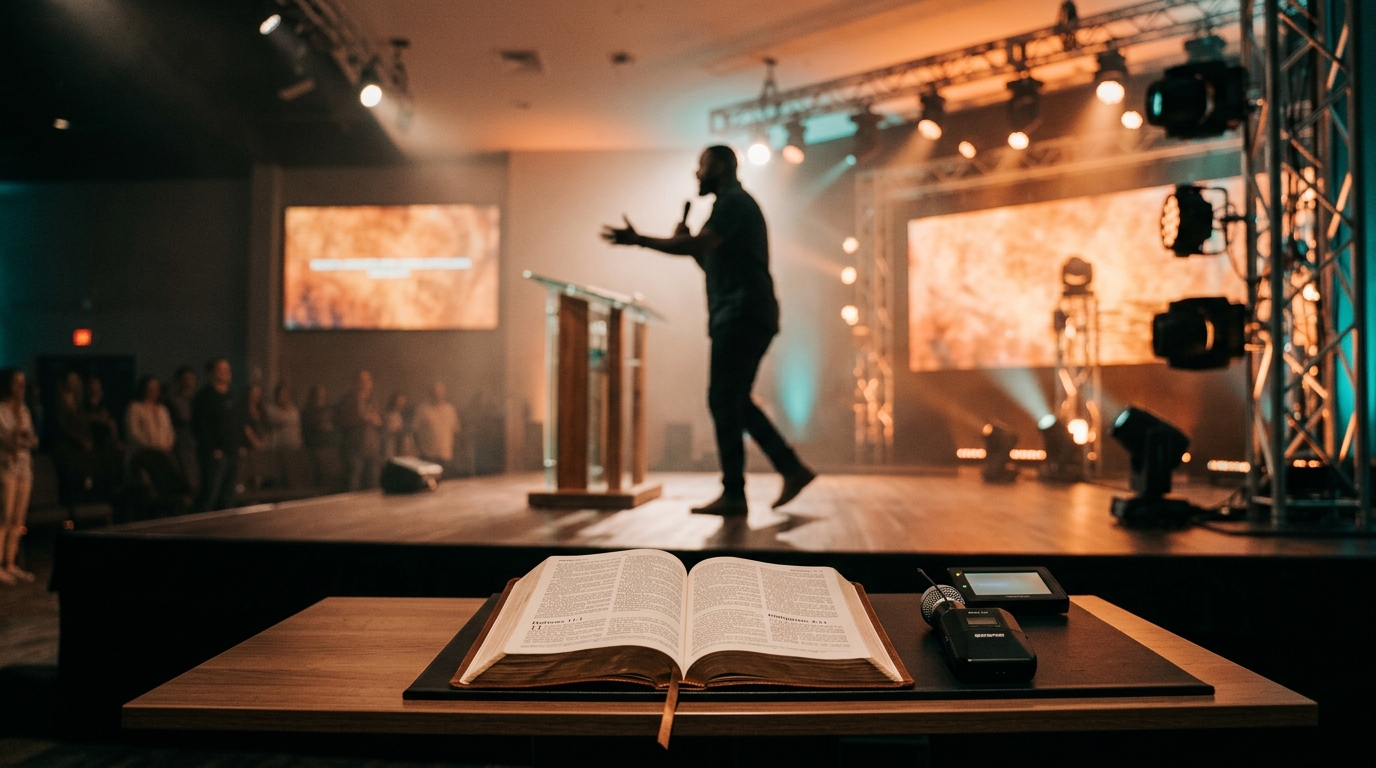
The solution is purposeful movement tied to your sermon structure. Move during transitions between major points—this creates a visual cue that you're shifting topics and helps your congregation mentally reset. Move toward your audience during moments of invitation or intimacy. Move to different areas of the stage to "own" the space and maintain connection with all sections of your venue. But between these intentional movements, plant your feet and deliver your content from a stable position.
A practical framework: Divide your stage into three zones (left, center, right). Deliver your introduction from center. Move to zone one for your first major point. Return to center for a transition story. Move to zone three for your second major point. This creates visual variety without becoming distracting pacing. Each movement has a purpose tied to your content structure, which helps your congregation follow your argument while staying visually engaged.
What to Do About Poor Eye Contact Patterns
Poor eye contact is perhaps the most relationship-damaging body language mistake in preaching. When you stare at your notes, scan over heads, or focus exclusively on one section of your venue, you break the connection that makes preaching a communal experience. According to homiletics research, pastors who maintain consistent eye contact across their entire audience report 34% higher engagement scores than those who don't.
The most common eye contact mistakes include: reading from notes for extended periods (your congregation feels like they're overhearing a speech rather than receiving a message), scanning the back wall or ceiling (you appear disconnected or nervous), focusing only on friendly faces or the front rows (the rest of your venue feels ignored), and the "lighthouse scan" where your eyes sweep continuously without landing (you make eye contact with no one).
Effective eye contact in preaching means making genuine, 3-5 second connections with individuals throughout your venue. This duration is long enough to create a real moment of connection but short enough to avoid making anyone uncomfortable. Work systematically across your space—front to back, left to right—ensuring that everyone in your congregation experiences direct eye contact at some point during your message.
If you're heavily dependent on notes, practice your sermon enough that you can deliver most of it from memory with only occasional glances at your outline. Your notes should be a safety net, not a script. When you do need to look down, make it a deliberate pause: "Let me read this passage directly," or "I want to make sure I get this quote exactly right." This frames your note-checking as intentional rather than uncertain.
How Incongruent Facial Expressions Undermine Your Message
Your face is the most expressive part of your body language in preaching, and incongruence between your facial expressions and your content creates immediate credibility problems. When you smile while discussing sin's consequences, maintain a stern expression while proclaiming God's grace, or show no emotional response to a powerful testimony, your congregation receives mixed signals that reduce message impact.
This mistake often stems from nervousness or habit rather than intention. Some pastors default to a slight smile as a nervous response, regardless of content. Others maintain a serious, focused expression throughout their entire sermon, even during moments that should evoke joy, wonder, or celebration. The result is a flat emotional landscape that makes it harder for your congregation to know how to respond.
The fix requires both awareness and practice. Video record yourself preaching and watch with the sound off. What story does your face tell? Does your expression match the emotional tone of your content? Are there moments where you look disconnected from your own message? This exercise reveals patterns you can't feel in the moment but your congregation sees clearly.
Develop a habit of emotionally engaging with your content as you prepare. Don't just write your sermon—experience it. When you craft a section about God's overwhelming love, let yourself feel that wonder. When you describe the weight of sin or suffering, allow the gravity to register on your face. This emotional authenticity during preparation translates into genuine, congruent expressions during delivery. Your congregation doesn't need theatrical performance; they need to see that you're genuinely moved by the truth you're proclaiming.
What Are the Most Distracting Nervous Gestures (And How to Replace Them)?
Nervous gestures—fidgeting with a pen, adjusting your clothing, touching your face, playing with notes, shifting weight constantly—broadcast anxiety and undermine your authority as a communicator. These self-soothing behaviors are automatic responses to stress, but they create visual noise that distracts from your message and makes you appear uncertain or unprepared.
The most common nervous gestures pastors display include: repeatedly touching their face or hair, adjusting glasses or clothing multiple times per minute, clicking or spinning a pen, shuffling or tapping papers, shifting weight from foot to foot in a rocking motion, and gripping and releasing the pulpit or mic stand. Each of these creates a repetitive visual pattern that draws attention and reduces your perceived confidence.
Breaking nervous gesture habits requires a three-step approach. First, identify your specific patterns through video review or trusted feedback. You can't fix what you don't know you're doing. Second, find a neutral replacement behavior. If you habitually touch your face when nervous, train yourself to place your hands in a neutral position at your sides instead. If you rock back and forth, practice planting your feet shoulder-width apart with weight evenly distributed. Third, address the underlying nervousness through better preparation and mental rehearsal.
One effective technique: the "power pose" before you preach. Research on public speaking suggests that spending two minutes in an expansive, confident posture before you go on stage—standing tall, hands on hips or raised in victory, chest open—reduces anxiety and increases confident body language during delivery. This isn't about faking confidence; it's about using your body to shift your mental state before you step into the spotlight.
How to Evaluate Your Own Body Language in Preaching
Improving your sermon body language requires honest evaluation, which is notoriously difficult to obtain. Your congregation won't tell you that your closed posture makes you seem unapproachable, or that your constant pacing is distracting. They'll simply feel disconnected and won't know why.
The most effective evaluation method combines self-review with objective feedback. Video record your sermons and watch them specifically for body language patterns. Create a checklist: Am I maintaining open posture? Are my movements purposeful or random? Am I making eye contact across my entire venue? Does my facial expression match my content? Are there nervous gestures I'm repeating?
For deeper insight, consider using a platform like Preach Better, which analyzes your delivery across four key pillars including Connection—the dimension most directly impacted by body language. The platform identifies specific moments where your nonverbal communication enhances or undermines your message, providing the kind of detailed, grounded feedback that helps you make targeted improvements.
You can also recruit a trusted observer—a spouse, staff member, or fellow pastor—to watch for specific patterns. Give them a focused assignment: "Watch for how often I make eye contact with the back rows," or "Count how many times I touch my face." Specific observation tasks yield more useful feedback than general impressions.
Common Body Language Mistakes When Using Notes or Screens
The tools you use during preaching—notes, confidence monitors, slides—create additional body language challenges. Looking down at notes for extended periods breaks eye contact and creates a barrier. Constantly glancing at a confidence monitor creates a distracted, uncertain appearance. Turning to look at projection screens puts your back to your congregation.
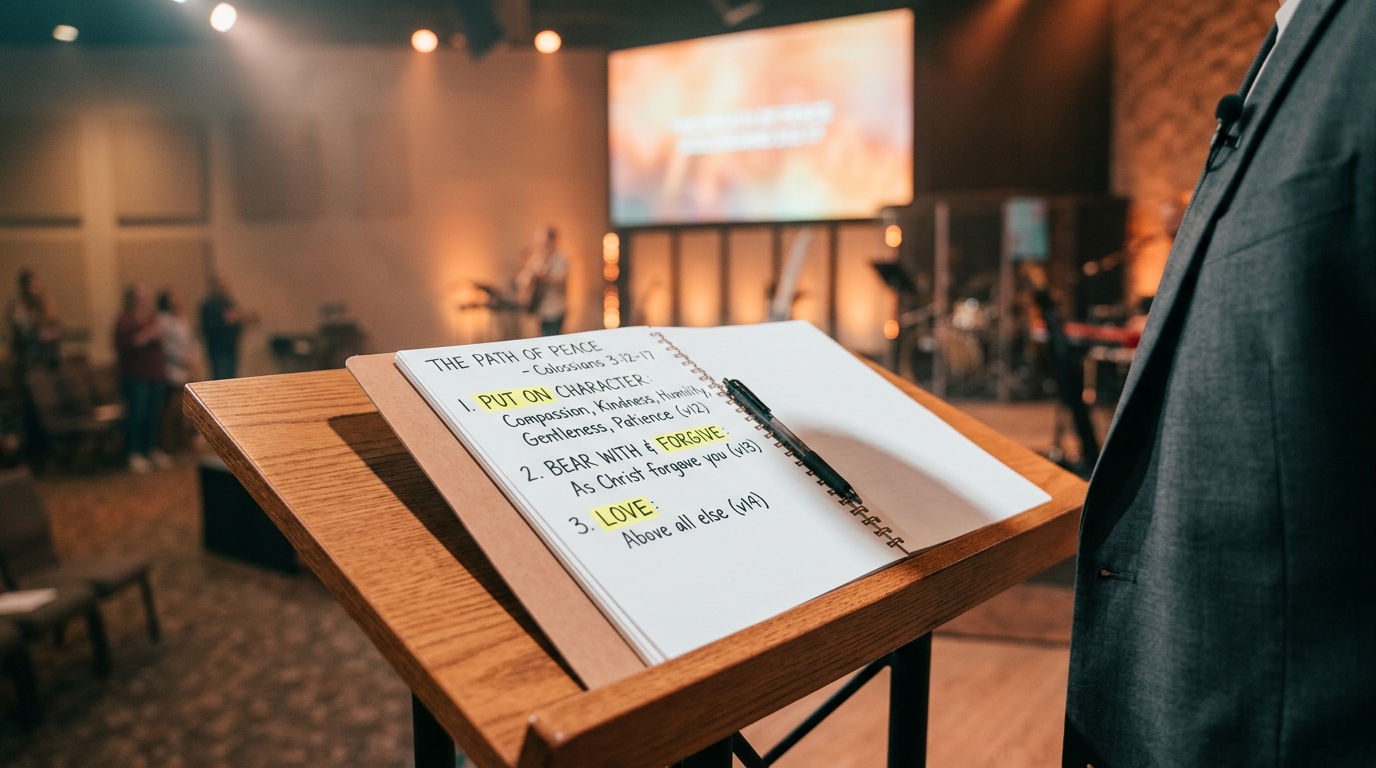
When using notes, position them at a height and angle that requires minimal head movement. A music stand or pulpit at chest height is better than notes on a low table that force you to break posture. Practice your sermon enough that you need only brief glances at your outline rather than reading extended sections. When you do look down, make it a deliberate pause rather than a nervous check.
For confidence monitors, position them in your natural sight line so you can glance at them without obvious head movement. Practice the "triangle technique": look at your notes, look at your audience, look at the monitor, return to your audience. This creates a natural rhythm that maintains connection while keeping you on track.
If you reference projection screens, gesture toward them rather than turning your back. Practice the "point and return" method: gesture toward the screen while maintaining body orientation toward your audience, then immediately return your focus to your congregation. Your body should always prioritize connection with people over connection with technology.
Frequently Asked Questions
What is the most important aspect of body language in preaching?
The most important aspect of body language in preaching is congruence—ensuring your nonverbal communication aligns with and reinforces your verbal message. When your posture, gestures, facial expressions, and movement patterns match the content and emotional tone of your sermon, you create a unified communication experience that increases trust, engagement, and message retention. Incongruence between what you say and how you say it creates cognitive dissonance that reduces your effectiveness and credibility.
How can I improve my preaching posture if I feel uncomfortable with open body language?
Improving your preaching posture when open body language feels uncomfortable requires gradual exposure and reframing. Start by practicing open posture in lower-stakes environments—staff meetings, small group teaching, casual conversations. This builds comfort before you step on stage. Reframe the discomfort as growth rather than vulnerability; feeling exposed often means you're doing something right. Record yourself and compare closed versus open posture to see the visual difference. Most pastors are surprised by how much more confident and approachable they appear with open body language, which provides motivation to push through initial discomfort.
Should I use hand gestures while preaching, and if so, how many?
You should use hand gestures while preaching, but they should be natural, purposeful, and tied to emphasis points rather than constant or random. Research on public speaking suggests that speakers who use gestures to illustrate concepts, indicate transitions, or emphasize key points increase audience comprehension by up to 33%. The ideal frequency varies by speaking style, but a general guideline is to gesture during moments of emphasis while allowing your hands to rest naturally at your sides during neutral content. Avoid repetitive gestures that become distracting, and ensure your gestures are large enough to be visible to your entire venue.
How do I maintain good eye contact when I'm nervous or reading from notes?
Maintaining good eye contact when nervous or using notes requires preparation and technique. First, practice your sermon enough that you can deliver most content from memory with only occasional note checks. Second, use the "complete thought" method: look down to capture your next point, then look up and deliver that entire thought while maintaining eye contact before looking down again. Third, position your notes at eye level to minimize the visual break when you glance down. Fourth, practice making genuine 3-5 second connections with individuals rather than scanning the room, which helps overcome nervousness by turning your sermon into a series of one-on-one conversations.
What body language mistakes make pastors appear less confident?
Body language mistakes that make pastors appear less confident include closed or protective postures (crossed arms, hands in pockets, gripping the pulpit), minimal or hesitant gestures, poor eye contact or looking down frequently, nervous fidgeting or self-soothing behaviors, excessive or aimless movement, and incongruent facial expressions that don't match the message. Additionally, taking up minimal space on stage, speaking from behind barriers, and displaying tension in shoulders or jaw all signal discomfort or uncertainty. These nonverbal cues undermine your authority and make it harder for your congregation to trust and engage with your message.
How can I use movement effectively without being distracting during my sermon?
Using movement effectively without distraction requires tying your movement to your sermon structure and content. Move during transitions between major points to create a visual cue for topic changes. Move toward your audience during moments of invitation, intimacy, or application. Move to different stage areas to "own" the space and maintain connection with all sections of your venue. Between these purposeful movements, plant your feet and deliver content from a stable position. Avoid pacing, swaying, or repetitive patterns that create visual noise. Think of movement as punctuation in your sermon—used strategically to enhance meaning, not as constant background activity.
About Preach Better: Preach Better is a sermon delivery analysis platform that helps pastors get honest, specific feedback on their communication. Built around four pillars—Clarity, Connection, Conviction, and Call to Action—it provides coaching grounded in specific moments from your message, not vague generalities. The Connection pillar specifically evaluates how your body language, eye contact, and nonverbal communication enhance or undermine your message, giving you the detailed feedback your congregation won't provide.
Bottom Line: Your Body Tells a Story—Make Sure It's the Right One
Your body language in preaching isn't a minor detail or a secondary concern. It's a primary communication channel that either amplifies your message or actively works against it. The five mistakes covered in this guide—closed posture, ineffective movement patterns, poor eye contact, incongruent facial expressions, and nervous gestures—are common, fixable, and worth your attention.
The good news? Unlike changing your voice or developing new teaching skills, improving your body language is largely a matter of awareness and intentional practice. Once you identify your specific patterns, you can make targeted adjustments that create immediate improvement. Video review, trusted feedback, and platforms like Preach Better give you the insight you need to move from unconscious habits to intentional, message-enhancing nonverbal communication.
Your congregation is watching and listening. Make sure both channels are telling the same story—one of confidence, authenticity, and genuine connection. Because every message matters, and how you deliver it matters just as much as what you say.