
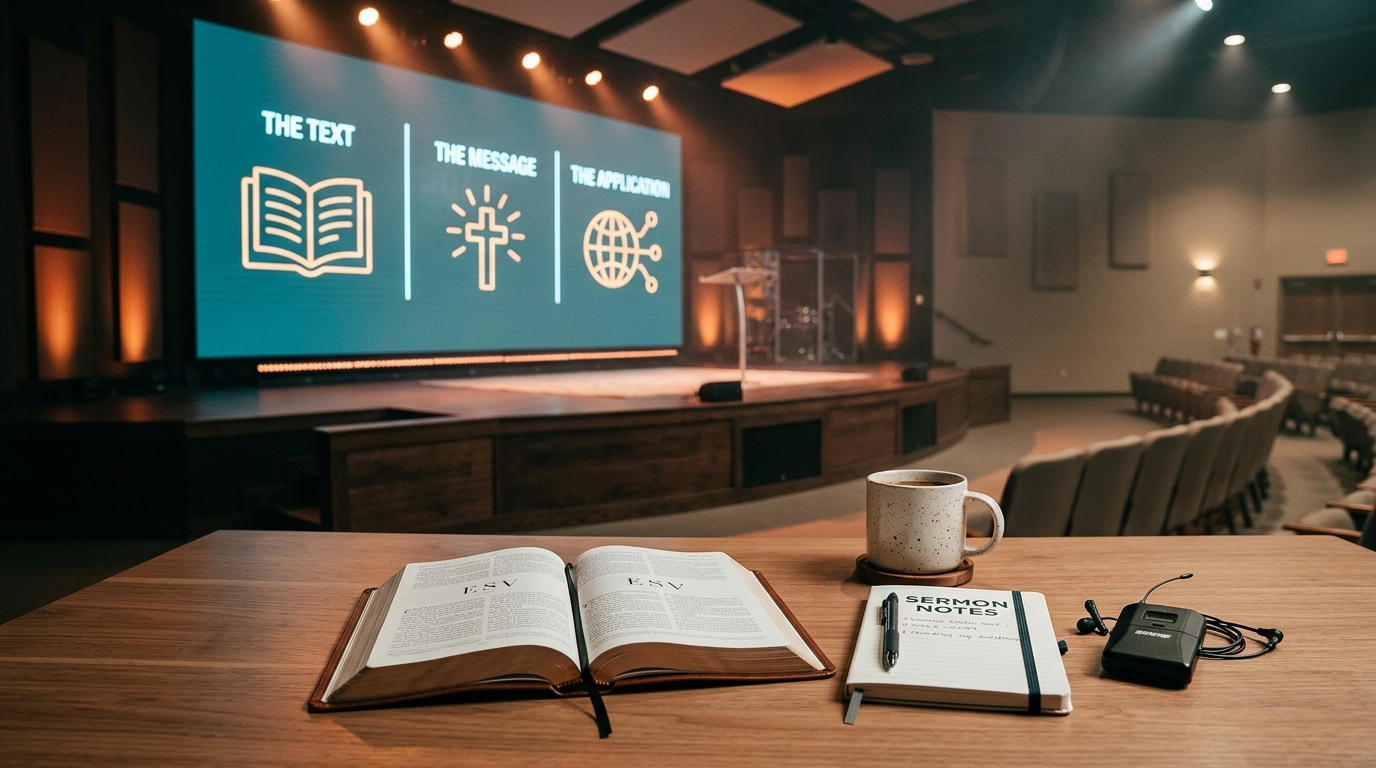
You've spent hours in your study. You've wrestled with the text, prayed over the passage, and filled pages with notes. But when you sit down to actually write your sermon, you stare at a blank document wondering: How do I organize all this into something people can actually follow?
The three-point sermon structure isn't just a homiletics classroom exercise — it's one of the most effective frameworks for helping your congregation track with you from opening to closing. When done well, it creates natural mental bookmarks that make your message easier to follow, remember, and apply. When done poorly, it turns into a rigid formula that feels forced and disconnected.
The difference isn't the structure itself. It's how you use it. In this guide, you'll learn how to build a three-point sermon that serves your message instead of constraining it, keeps your congregation engaged instead of checking out, and creates clarity instead of confusion. Whether you're preaching your first sermon or your five hundredth, understanding how to organize your content around three clear movements will transform how people receive what you're teaching.
Quick Answer: A three-point sermon structure organizes your message around three main ideas or movements that support your central thesis. Each point should be distinct but connected, typically taking 8-12 minutes to develop, with clear transitions between them. This framework helps congregations follow complex biblical teaching by breaking it into digestible, memorable segments that build toward a unified conclusion.
Key Takeaways
- Three points create cognitive scaffolding — your congregation can mentally organize and retain information more effectively when it's grouped into three distinct movements
- Unity matters more than uniformity — your three points don't need to follow identical grammatical patterns; they need to serve the same central idea
- Development depth beats point quantity — three well-developed points with specific examples and application will always outperform five shallow observations
- Transitions are structural glue — the connections between your points determine whether your sermon feels cohesive or fragmented
What Makes Three-Point Sermon Structure Effective?
The three-point sermon structure works because it aligns with how people process and retain information. Communication experts recommend chunking complex information into three to five main ideas, with three being the cognitive sweet spot for most audiences. Your congregation isn't taking notes on everything you say — they're mentally filing key concepts. Three points give them a framework to hang those concepts on.
Here's what happens when you organize around three clear movements: First, people know where they are in your message. When you transition to point two, they're not wondering if you're still on point one or if you've jumped to something new. Second, they can anticipate the arc. Once they understand you're working through three ideas, they subconsciously track progress and stay engaged. Third, they remember more. Studies on audience retention show that messages organized into three distinct sections have significantly higher recall rates than messages with five or more points or no clear structure at all.
The structure also forces you to be selective. When you commit to three points, you can't include every observation from your study. You have to choose what matters most, which actually strengthens your message. The discipline of saying "this doesn't fit" makes what you do include more powerful.
How to Build Your Three-Point Sermon Structure
Start with your big idea — the one sentence that captures what you want your congregation to understand or do. Everything in your sermon, including your three points, should support this central thesis. If a point doesn't directly advance your big idea, it doesn't belong in this message.
Next, identify three movements that develop your big idea. These could be three aspects of a biblical concept, three steps in a process, three problems and their solutions, or three applications of a principle. The key is that each point should be substantial enough to stand on its own while also contributing to the whole.
For example, if your big idea is "God's grace transforms how we relate to others," your three points might explore grace in conflict, grace in forgiveness, and grace in service. Each point is distinct, but all three work together to show the breadth of grace's impact on relationships.
Once you have your three points, develop each one with the same basic structure: state the point clearly, ground it in Scripture, illustrate it with a concrete example, and apply it to real life. This doesn't mean every point needs the same amount of time — some points naturally require more development — but each should include these four elements.
Finally, write transitions that explicitly connect your points. Don't just move from point one to point two without showing your congregation how they relate. A simple transition like "We've seen how grace changes conflict. Now let's look at how that same grace reshapes forgiveness" keeps people oriented and reinforces the unity of your message.
Common Three-Point Sermon Mistakes (and How to Fix Them)
The biggest mistake new pastors make with three-point sermons is treating the structure like a straitjacket instead of a skeleton. You've probably heard sermons where every point starts with the same letter (alliteration) or follows the exact same grammatical pattern. This can work, but it often forces you to twist your content to fit the formula. Your points should flow naturally from the text and your big idea, not from a clever outline trick.
Another common problem is uneven development. You spend twenty minutes on point one, rush through point two in five minutes, and barely mention point three before jumping to your conclusion. This usually happens because you haven't planned your time allocation before you start preaching. Research on public speaking suggests that each major section of a message should receive proportional development time — if you have three points in a thirty-minute sermon, aim for roughly eight to ten minutes per point, with time for introduction and conclusion.
The third mistake is creating points that don't actually connect to each other. You might have three good observations about a passage, but if they don't work together to advance a single big idea, you don't have a three-point sermon — you have three mini-sermons competing for attention. Test this by asking: "Could I remove one of these points and still communicate my big idea?" If yes, that point might belong in a different message.
Finally, many pastors neglect transitions between points. They finish point one, take a breath, and dive into point two without showing the connection. Your congregation needs signposts. Simple phrases like "That leads us to the second way grace transforms us" or "Building on what we just saw" create continuity and help people follow your logic.
What to Look For When Evaluating Your Three-Point Structure
After you preach, ask yourself: Did my congregation know where we were at any given moment? If people looked confused during transitions or seemed to lose the thread halfway through, your structure might not have been as clear as you thought. According to homiletics research, congregational comprehension drops significantly when listeners can't identify the main movements of a message.
Look at your time allocation. Pull up your sermon recording and note when each point started and ended. Did one point dominate? Did you rush the conclusion because you ran long on point two? Uneven pacing often signals that your points weren't equally developed in preparation, which means you probably need to either expand the thin points or condense the overweight ones.
Evaluate your transitions. Listen specifically to the moments between points. Did you explicitly state that you were moving to a new idea? Did you show how the new point connected to what came before? Weak transitions are one of the most common reasons three-point sermons feel disjointed, even when the individual points are strong.
Finally, assess unity. Do all three points actually support the same big idea, or did you drift into related but distinct concepts? If someone asked a congregation member "What was the sermon about?" the next day, could they summarize your big idea and remember at least two of your three points? If not, you might have sacrificed clarity for coverage.
For detailed feedback on how your structure actually landed with listeners, tools like Preach Better can analyze your sermon delivery and show you exactly where transitions worked, where points felt rushed, and where your organizational clarity broke down — all grounded in specific moments from your message.
Five Ways to Strengthen Your Three-Point Sermon Organization
1. Start with application, not observation. Instead of asking "What does this passage teach?" ask "What does this passage call people to do or believe?" Then build your three points around that application. This keeps your sermon focused on transformation, not just information.
2. Use parallel structure strategically, not religiously. If alliteration or parallel phrasing helps your points stick, use it. But don't force it. "Receive grace, reflect grace, release grace" works because the concepts naturally align. "Pray, play, and pay attention" probably doesn't serve your message — it just serves your outline.
3. Develop each point with a specific story or example. Generic illustrations feel interchangeable. A concrete story tied to each point makes that point memorable. If you're preaching on patience, don't use three examples of traffic jams. Use one story about traffic, one about parenting, and one about career setbacks. Variety in your examples creates depth.
4. Build in internal summaries. At the end of each point, take fifteen seconds to recap what you just said before moving on. "So we've seen that grace changes how we handle conflict — it moves us from defensiveness to humility." This reinforces the point and helps people who zoned out for a moment catch back up.
5. Test your structure with a trusted listener. Before Sunday, walk through your three points with a spouse, staff member, or mentor. If they can't immediately see how the points connect or if they suggest a different order, your structure might need refinement. Best practices in sermon delivery indicate that peer review catches structural problems you'll miss on your own.
How Three Points Fit Into Your Overall Sermon Framework
Your three-point structure sits within a larger sermon architecture that includes your introduction, transitions, and conclusion. The introduction sets up the need for your message and previews your big idea. Your three points develop that idea. Your transitions connect the points. And your conclusion drives home the application and calls for response.
Think of it like this: your introduction is the question, your three points are the answer in three parts, and your conclusion is the "so what." If your introduction asks "How does God's grace transform relationships?" your three points show three specific ways, and your conclusion challenges people to live in light of that grace this week.
This framework also connects to the Four Sermon Delivery Pillars that shape how your message actually lands. Your structure supports Clarity by organizing complex ideas into trackable movements. It enhances Connection when your points include relatable stories and examples. It builds Conviction when each point is grounded in Scripture and developed with depth. And it strengthens your Call to Action when your three points naturally lead to a specific response.
Understanding how structure and delivery work together is crucial. You can have a perfectly organized three-point outline and still lose your congregation if your sermon pacing drags or your transitions feel abrupt. Structure is the skeleton; delivery is the muscle and skin that make the message come alive.
When Three Points Isn't the Right Structure
Not every sermon needs three points. Narrative preaching through a story often works better with a chronological structure that follows the text's plot. Topical messages addressing a single question might need only one main idea with multiple supporting examples. Expository preaching through a passage might naturally divide into two movements or four, depending on the text.
The three-point structure works best when you're teaching a concept that has multiple facets, developing a principle with several applications, or answering a question that requires a multi-part response. It's less effective when you're preaching a narrative text that doesn't naturally break into three sections or when you're addressing a single, focused idea that doesn't need subdivision.
If you find yourself forcing a text into three points, stop. Let the text dictate the structure. Sometimes the most faithful preaching follows the shape of Scripture rather than imposing a predetermined outline on it. For more on how different sermon styles require different structural approaches, see our guide on expository vs topical preaching.
Frequently Asked Questions
Do all three points need to be the same length? Not necessarily, but they should be roughly proportional. If one point takes five minutes and another takes twenty, your sermon will feel unbalanced. Aim for each point to receive adequate development — typically 25-35% of your total message time — even if they're not identical in length. The goal is balance, not uniformity.
Should I announce my three points in the introduction? It depends on your preaching style and the nature of your message. Previewing your points can help people follow along and creates anticipation. But sometimes revealing the structure too early removes the element of discovery. If your points build on each other sequentially, previewing helps. If they're meant to surprise or challenge, save the reveal for each transition.
How do I know if my three points are actually distinct from each other? Test this by writing a one-sentence summary of each point. If the sentences overlap significantly or if you struggle to differentiate them, your points might be too similar. Each point should address a different aspect of your big idea or advance the argument in a new direction. If point two is just restating point one with different words, combine them and find a genuinely new third point.
Can I use three points in a narrative sermon? Yes, but be careful not to fragment the story. Instead of dividing the narrative into three arbitrary sections, identify three key moments or themes within the story that support your big idea. For example, in the prodigal son parable, you might focus on three characters (younger son, father, older son) or three movements (rebellion, return, reconciliation). The structure should emerge from the narrative, not be imposed on it.
What if I have more than three important ideas to communicate? You probably don't — you have one big idea with more than three supporting details. Identify which three ideas are most essential to your thesis and develop those fully. Save the other observations for a different sermon or weave them into your existing points as sub-points. Communication experts recommend limiting main ideas to three because that's what most people can retain. More points usually means less impact per point.
How detailed should my sermon outline be when using three points? Your outline should be detailed enough to keep you on track but flexible enough to allow for Spirit-led moments. For each point, include your main statement, key Scripture references, your primary illustration, and your application. Don't script every word unless you're preaching from a manuscript, but do have enough structure that you won't lose your place or forget a crucial element mid-sermon.
About Preach Better: Preach Better is a sermon delivery analysis platform that helps pastors get honest, specific feedback on their communication. Built around four pillars — Clarity, Connection, Conviction, and Call to Action — it provides coaching grounded in specific moments from your message, not vague generalities. When you upload a sermon, Preach Better analyzes how your three-point structure actually landed, showing you where transitions worked, where points felt rushed, and where organizational clarity broke down.
Bottom Line: Structure Serves the Message, Not the Other Way Around
The three-point sermon structure is a tool, not a rule. When used well, it creates clarity, aids retention, and helps your congregation follow complex biblical teaching. When used poorly, it becomes a straitjacket that forces content into artificial categories and fragments what should be unified.
Here's what matters most: Your three points should advance a single big idea, receive proportional development, and connect through clear transitions. They should emerge naturally from your text and thesis, not from a desire to fit a predetermined template. And they should serve your congregation's understanding, not your outline's symmetry.
The best sermon structure is the one your congregation doesn't notice because they're too engaged with the content. When your three points create a clear path from introduction to application, people follow. When they feel forced or disconnected, people check out. The difference isn't the number of points — it's how well those points work together to communicate truth that transforms.
As you prepare your next message, start with your big idea. Then ask: What three movements will help my congregation understand and apply this truth? Build from there, and let the structure serve the message. That's when three-point preaching becomes not just a homiletics technique, but a powerful framework for life-changing communication.
For specific feedback on how your sermon structure is working — including where your points landed clearly and where transitions could be stronger — try Preach Better. Because the best way to improve your preaching isn't guessing what worked. It's getting honest, specific feedback grounded in what actually happened when you stepped into the pulpit.