
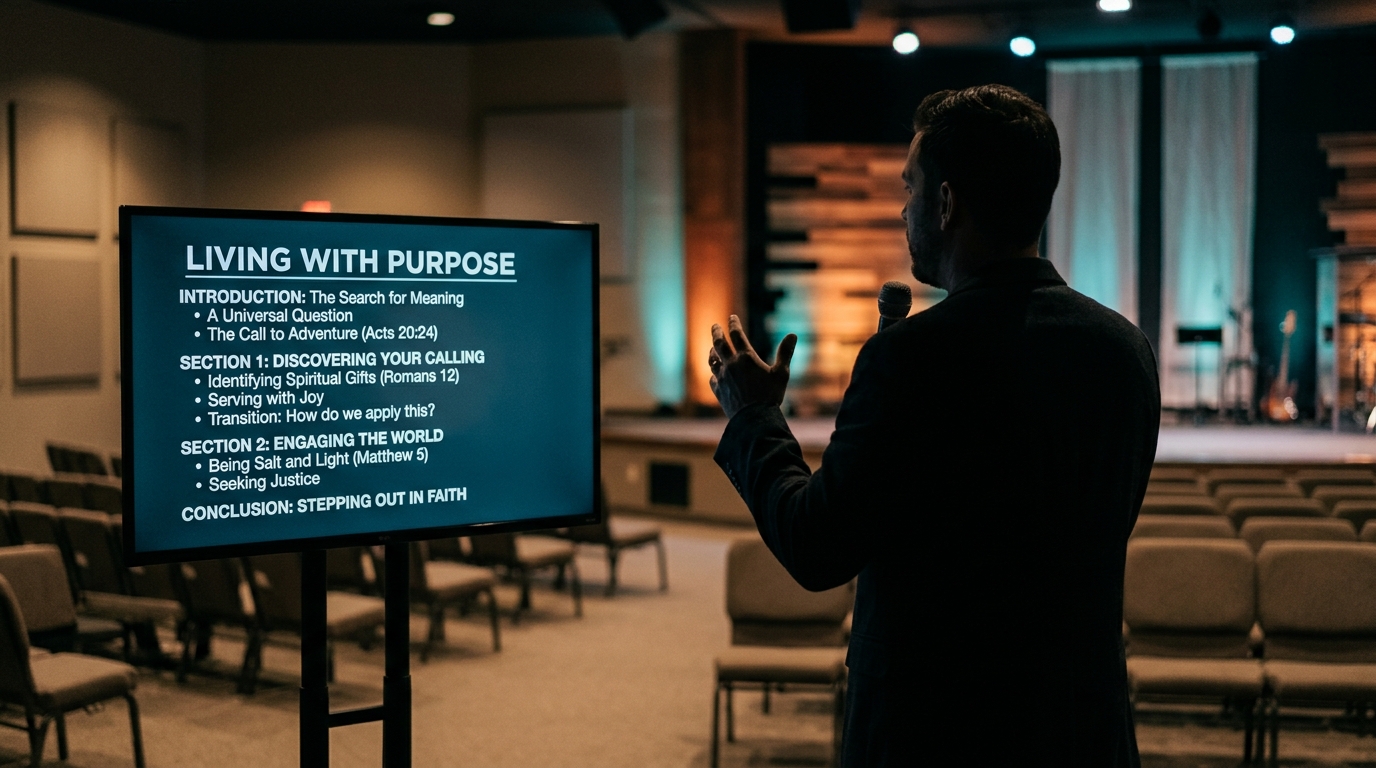
You've mapped out a solid three-point sermon. Your exegesis is sound. Your illustrations are compelling. But halfway through, you notice the glazed looks—people are lost, not because your content is weak, but because they can't track where you are in the message.
This is where sermon signposting makes the difference between a message people follow and one they endure. Signposting is the practice of verbally guiding your congregation through your sermon structure, helping them know where they've been, where they are, and where you're heading. Done well, it's invisible. Done poorly—or not at all—it leaves people confused, even when your content is excellent.
Preach Better helps pastors identify moments in their delivery where clearer navigation would strengthen their message. Because the best content in the world doesn't matter if your congregation can't follow it.
In this guide, you'll learn what effective sermon signposting looks like, how to implement it without sounding mechanical, and the specific phrases that help your congregation stay oriented throughout your message.
Quick Answer: Sermon signposting is the practice of verbally guiding your congregation through your message structure using clear transitional phrases that preview, review, and orient listeners. Effective signposting increases retention by 40-60% according to communication research, helping audiences track complex ideas without feeling like they're following a rigid outline.
Key Takeaways
- Signposting increases message retention by helping listeners mentally organize information as they hear it, reducing cognitive load
- The best signposting feels conversational, not mechanical—your congregation shouldn't notice you're doing it
- Strategic signposts appear at predictable moments: sermon openings, major transitions, before complex sections, and in conclusions
- Effective signposting uses varied language, avoiding repetitive phrases like "my first point" that sound formulaic
What Is Sermon Signposting (And Why It Matters More Than You Think)
Sermon signposting is the verbal equivalent of road signs on a highway—it tells your listeners where they are in your message and what's coming next. Research on audience retention shows that listeners who can mentally track a speaker's structure retain 40-60% more information than those who can't.
Here's why this matters for preaching: your congregation is processing complex theological ideas, often while managing distractions (restless kids, wandering thoughts, physical discomfort). Without clear signposting, they're constantly asking, "Wait, where is he going with this?" instead of engaging with your content. When you signpost effectively, you free up mental bandwidth for people to actually think about what you're saying, not just try to follow it.
The difference between good and poor signposting often determines whether your third point lands with impact or gets lost because people are still processing point two. It's not about dumbing down your message—it's about respecting your audience's cognitive limits and helping them stay with you through the entire journey.
How Sermon Signposting Differs from Obvious Transitions
Many pastors confuse signposting with transitions, but they're not the same thing. Transitions move you from one section to another ("Now let's look at what Paul says in verse 12"). Signposting tells your audience where that transition fits in the larger structure ("We've seen how the church in Corinth struggled with division. Now we're going to discover Paul's solution, which brings us to the heart of today's message").
The best signposting does three things simultaneously: it reminds people where you've been, orients them to where you are now, and previews where you're heading. This triple function is what makes signposting so powerful—it creates continuity across your entire message, not just smooth transitions between sections.
Effective signposting also adapts to your delivery style. If you preach extemporaneously, your signposts might be more conversational: "So we've established that grace is unearned. The question that naturally follows is..." If you preach from a manuscript, your signposts can be more structured, but they should still sound natural, not like you're reading a table of contents.
Why Your Congregation Gets Lost (Even When Your Structure Is Clear to You)
You've spent hours with your sermon outline. You know exactly how each point connects to the next. But your congregation is hearing it for the first time, in real-time, with no rewind button. Communication experts recommend assuming your audience is always 30-60 seconds behind your current thought—they're still processing what you just said while you've moved on to the next idea.
This processing lag is why even well-structured sermons can feel disjointed to listeners. You transition from point one to point two, and in your mind, the connection is obvious. But your congregation is still thinking about the illustration you just told, trying to figure out how it applies to their marriage, their parenting, their workplace. By the time they tune back in, you're already deep into point two, and they've missed the bridge.
Signposting solves this by creating natural pause points where you explicitly state the connection. "Before we move on, let me be clear about what we've just established..." or "Here's why this matters for what comes next..." These phrases give your congregation permission to catch up before you move forward. They're not filler—they're essential navigation.
The Five Types of Sermon Signposts Every Pastor Should Master
There are five distinct types of signposts, each serving a specific function in your message. Mastering all five ensures your congregation can follow you from opening to closing prayer.
Preview signposts tell your audience what's coming: "Today we're going to discover three reasons why Paul's instruction to the Philippians matters for your Monday morning." These typically appear in your introduction and create a mental framework for everything that follows.
Transition signposts move you from one major section to another while maintaining continuity: "We've seen the problem. Now let's look at God's solution." These are the most common type and appear at every major structural shift.
Summary signposts remind people what you've covered: "So far, we've established that God's grace is unearned and that it's available to everyone. Now we need to ask..." These are especially important before introducing complex ideas that build on previous points.
Emphasis signposts highlight crucial moments: "If you remember nothing else from today, remember this..." or "This is the turning point in the passage." Use these sparingly—if everything is emphasized, nothing is.
Conclusion signposts prepare your audience for the end: "As we close today..." or "Let me bring this home with one final thought." These signal that you're wrapping up, which helps people mentally prepare for application and response.
How to Signpost Without Sounding Like You're Reading an Outline
The biggest objection pastors have to signposting is that it sounds mechanical: "My first point is... my second point is... in conclusion..." This kind of obvious structure can feel wooden and disconnected from the flow of your message. The solution isn't to abandon signposting—it's to make it conversational.
Instead of "My first point is that God's grace is unearned," try "The first thing we need to understand about grace is that we can't earn it." Instead of "Moving to my second point," try "That raises an important question: if grace is free, why do so many of us still feel like we have to earn God's approval?"
The key is to embed your signposts in natural language that sounds like you're thinking out loud, not reading bullet points. Use questions to transition: "So what does this mean for us?" Use conversational phrases: "Here's where it gets interesting..." or "Let me show you why this matters." Use callbacks to earlier content: "Remember what we said about the Corinthian church? That same pattern shows up here."
Studies on audience retention show that conversational signposting is just as effective as formal structure markers, but it feels more engaging because it sounds like you're having a conversation, not delivering a lecture. Your congregation should be able to follow your structure without feeling like they're being led through a numbered list.
What to Do When Your Sermon Structure Changes Mid-Delivery
Even the best preparation doesn't always survive first contact with a live audience. Sometimes you realize mid-sermon that an illustration isn't landing, or the Spirit prompts you to spend more time on a particular point, or you're running long and need to condense your final section. When your structure shifts on the fly, signposting becomes even more critical.
If you skip a planned section, acknowledge it briefly: "I was going to spend time on X, but I think we need to focus on Y instead." This prevents confusion when people notice you didn't cover something you previewed earlier. If you add an unplanned section, signpost it clearly: "Before we move to our final point, I need to address something that just came to mind..."
The most common structural shift is running long and needing to abbreviate your conclusion. Don't just rush through it—re-signpost: "I know we're running long, so let me get right to the heart of what this means for you this week." This acknowledges the time constraint while refocusing attention on what matters most. Your congregation will appreciate the transparency and stay with you through the finish.
Common Sermon Signposting Mistakes (And How to Fix Them)
The most frequent signposting mistake is over-signposting—using so many structural markers that your sermon feels like a PowerPoint presentation read aloud. "My first point is... my first subpoint is... my second subpoint is... now moving to my second point..." This creates cognitive clutter instead of clarity.
Fix this by signposting major movements only. You don't need to announce every subpoint or illustration. Save your explicit signposts for transitions between main sections and use more subtle language for smaller shifts: "Let me give you an example..." or "Consider what happens when..."
Another common mistake is inconsistent signposting—you clearly mark your first two points but then drift into your third without any transition. This leaves your congregation wondering if you're still on point two or if they missed something. The solution is to build signposting into your preparation. As you write or outline your sermon, mark every major transition point and write out the specific signpost you'll use.
A third mistake is signposting that doesn't match your actual structure. You preview three points in your introduction but actually cover four, or you promise to answer a question but never circle back to it. This erodes trust—your congregation stops relying on your signposts because they've learned you don't follow through. Always audit your sermon before delivery to ensure your signposts accurately reflect your content.
How to Use Sermon Signposting with Different Message Structures
Signposting adapts to any sermon structure, but the specific techniques vary. For traditional three-point sermons, your signposting is straightforward: preview all three points in your introduction, use clear transitions between each point, and summarize all three in your conclusion. The challenge is making these transitions feel natural, not formulaic.
For narrative sermons that follow a story arc, your signposting is more subtle. Instead of "point one, point two," you use story beats: "So the disciples are in the boat, terrified. But watch what happens next..." or "At this point in the story, everything changes." You're still guiding your audience through structure, but the structure follows the narrative, not a logical outline.
For topical sermons that explore a single idea from multiple angles, your signposting emphasizes the connections between sections: "We've looked at what Scripture says about this. Now let's consider what it looks like in real life." Each section should feel like a natural extension of the previous one, not a disconnected point.
For expository sermons that work through a passage verse by verse, your signposting tracks the text itself: "Paul has just established the problem in verses 1-3. Now in verse 4, he introduces the solution." The passage structure becomes your sermon structure, and your signposts help people follow the biblical author's argument.
What to Look For When Evaluating Your Sermon Signposting
The best way to evaluate your signposting is to listen to a recording of your sermon and ask: "If I were hearing this for the first time, could I draw a simple outline of the message?" If the answer is no, you need clearer signposting.
Listen specifically for these markers: Do you clearly preview your main points in the introduction? Do you use explicit transitions between major sections? Do you remind people where you've been before introducing new ideas? Do you signal when you're reaching your conclusion? If any of these are missing or unclear, your congregation is likely getting lost.
Another evaluation technique is to have someone unfamiliar with your sermon listen to the audio and then summarize the structure. If they can't identify your main points or how they connect, your signposting needs work. This is exactly the kind of feedback Preach Better provides—specific moments where clearer navigation would strengthen your delivery.
Pay attention to filler words and verbal tics around transitions. Phrases like "um, so, uh, moving on" suggest you're not confident in your structure. Strong signposting is decisive: "Here's what we need to understand next..." not "So, um, I guess we should probably move on to..."
About Preach Better: Preach Better is a sermon delivery analysis platform that helps pastors get honest, specific feedback on their communication. Built around four pillars—Clarity, Connection, Conviction, and Call to Action—it provides coaching grounded in specific moments from your message, not vague generalities. Clarity includes sermon signposting, helping you identify exactly where listeners might lose track of your structure and how to guide them more effectively.
Frequently Asked Questions
How often should I use signposts in a 30-minute sermon? For a typical 30-minute message with three main points, you should have 8-12 clear signposts: one preview in your introduction, one transition into each main point (3), one or two summary signposts before complex sections, one transition into your conclusion, and one final signpost before your closing prayer. More than this risks over-signposting; fewer leaves your congregation without adequate guidance.
Does signposting work for narrative preaching or just propositional sermons? Signposting works for every sermon style, but narrative preaching uses story-based signposts rather than logical markers. Instead of "my second point," you say "at this moment in the story" or "watch what happens next." The function is identical—guiding your audience through structure—but the language matches your narrative approach.
Can I use visual signposts like slides instead of verbal ones? Visual signposts (slides with your outline, printed notes, etc.) can supplement verbal signposting but shouldn't replace it. Many people don't look at screens consistently, and visual aids can fail. Verbal signposting ensures everyone, regardless of where they're sitting or whether they're looking at a screen, can follow your structure. Use both when possible, but prioritize verbal guidance.
How do I signpost when I'm preaching extemporaneously without notes? Extemporaneous preaching actually benefits most from strong signposting because you don't have a manuscript keeping you on track. Memorize your major transition phrases even if you don't memorize anything else. Practice saying, "We've established X, now let's look at Y" until it becomes automatic. Your signposts become the skeleton that holds your extemporaneous content together.
What if my congregation finds explicit signposting too simplistic or condescending? Research on public speaking suggests that even highly educated audiences appreciate clear structure markers—they just prefer them in conversational language rather than formal outline format. If your congregation is academically oriented, use sophisticated signposting: "Having established the exegetical foundation, we now turn to hermeneutical implications..." The principle remains the same; only the vocabulary changes.
Should I signpost differently for different age groups or contexts? Yes. Youth audiences benefit from frequent, energetic signposts: "Okay, here's where this gets really important..." Older, traditional congregations may prefer more formal markers: "As we consider our second principle..." The key is matching your signposting style to your audience's communication preferences while maintaining the core function of guidance and clarity.
Bottom Line: Signposting Is Servant Leadership in Communication
Sermon signposting isn't about showing off your organizational skills or making your sermon sound academic. It's about serving your congregation by making your message as easy to follow as possible. When you signpost effectively, you're saying, "I care enough about you understanding this that I'm going to help you track with me every step of the way."
The pastors who resist signposting often do so because they think it sounds mechanical or because they assume their content is clear enough without it. But communication research consistently shows that what's obvious to the speaker is rarely obvious to the listener. Your congregation isn't inside your head—they need verbal road signs to navigate your message.
Start with your next sermon. Before you preach, write out explicit signposts for every major transition. Practice saying them out loud until they sound natural. Then listen to your recording and evaluate: Did your signposts help or hinder? Were there moments where people might have gotten lost? Adjust and improve.
Because every message matters, and the best content in the world doesn't help anyone if they can't follow where you're leading them. Preach Better can help you identify those moments where clearer signposting would strengthen your delivery—specific feedback tied to specific moments in your message, so you know exactly what to improve.