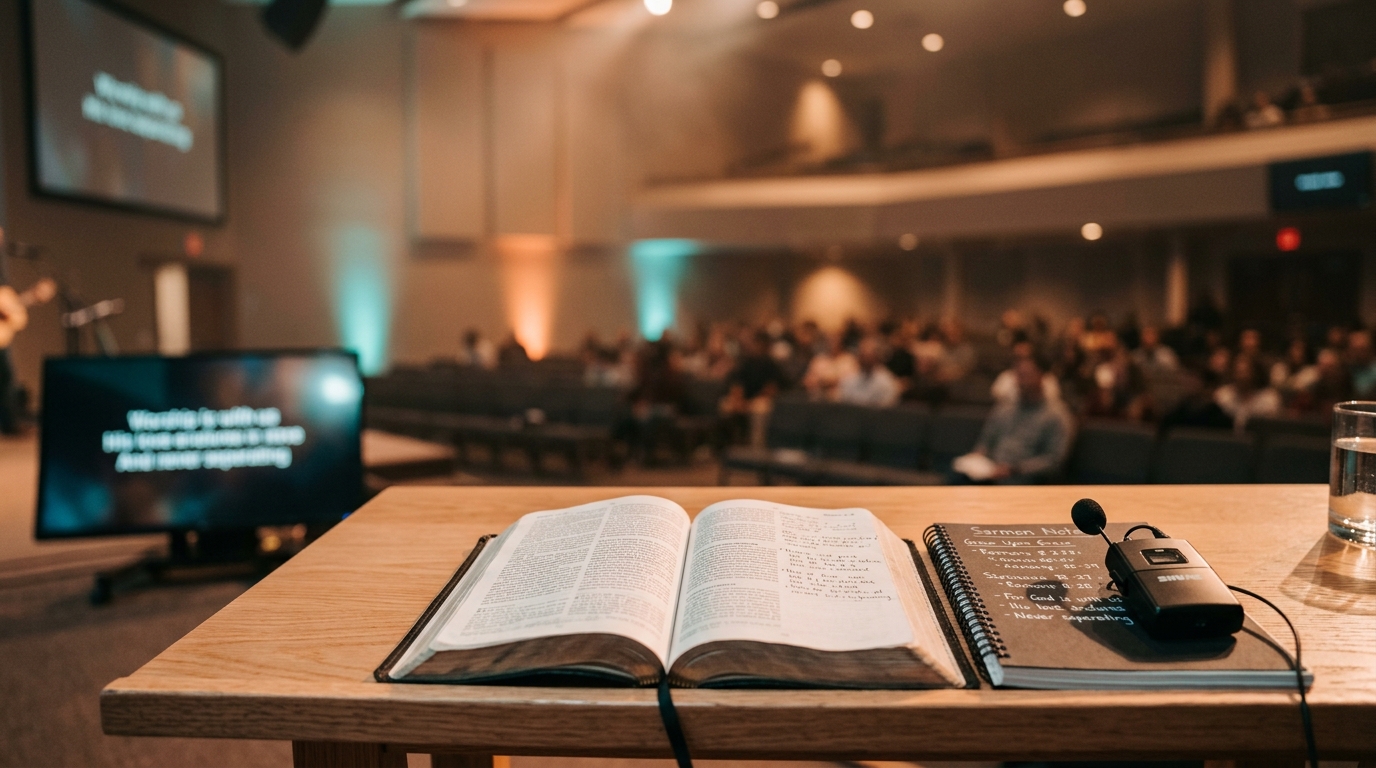

You've spent hours in the text. Your exegesis is solid. Your illustrations land. But when Monday morning comes, your congregation can't remember what they're supposed to do with Sunday's message.
This isn't a content problem—it's an application problem. Research on adult learning shows that people forget up to 90% of what they hear within 72 hours unless it's connected to specific, actionable steps. The gap between "great sermon" and "life change" isn't more biblical depth. It's better sermon application—the bridge that moves people from insight to action.
Preach Better exists to help pastors close that gap. When you understand how to structure application that sticks, your messages don't just inform—they transform. In this guide, you'll learn the framework for crafting practical sermon application that your congregation can remember, repeat, and actually implement in their daily lives.
Quick Answer: Effective sermon application requires three elements: specificity (concrete actions, not vague principles), accessibility (steps anyone can take regardless of spiritual maturity), and memorability (simple enough to recall on Tuesday morning). The best applications answer "What exactly do I do?" and "When do I do it?" rather than just "Why does this matter?"
Key Takeaways
- Specific beats spiritual-sounding: Application like "pray more" fails because it's unmeasurable; "set a 5-minute prayer timer before breakfast" succeeds because it's concrete
- One clear action trumps five vague suggestions: Your congregation will remember and act on one specific step far more than a list of general principles
- Application works best when it answers "by when?": Timebound actions ("this week," "before you leave the parking lot") dramatically increase follow-through
- The best applications create immediate next steps: What someone can do in the next 24 hours matters more than what they might do "someday"
What Makes Sermon Application Actually Work?
Effective sermon application transforms abstract biblical truth into concrete Monday-morning decisions. The difference between application that sticks and application that fades by lunch comes down to three criteria: specificity, accessibility, and immediacy.
Specificity means your congregation knows exactly what to do. "Love your neighbor" is a principle. "Text your neighbor this week and ask if they need anything from the grocery store" is application. Communication experts recommend the "could I film this?" test—if you can't visualize the specific action, it's not specific enough.
Accessibility ensures everyone can participate regardless of spiritual maturity, life stage, or circumstances. The single parent working two jobs needs different application than the retired couple with margin. The best applications offer a range of entry points: "If you have 5 minutes, do this. If you have an hour, do this."
Immediacy creates urgency. Applications with deadlines get done; applications without them get forgotten. "Sometime this month" becomes never. "Before you go to bed tonight" becomes action. Studies on audience retention show that immediate next steps increase follow-through by up to 300% compared to open-ended suggestions.
When you combine all three—specific, accessible, immediate—you create sermon takeaways that actually translate into life change. Your congregation leaves knowing not just what the Bible says, but how to live it out before the week ends.
How to Structure Application in Your Sermon
The placement and structure of your application determines whether people remember it. Best practices in sermon delivery indicate that application works best when it's woven throughout the message, not just tacked on at the end.
Start with early application signals. Within your first five minutes, tell your congregation where you're headed: "By the end of today's message, you're going to know exactly how to..." This primes them to listen for practical steps, not just information.
Build application into each major point. Don't wait until your conclusion to make things practical. After each section, pause and ask: "So what does this mean for you this week?" Then give one specific example. This creates multiple reinforcement moments instead of one overwhelming list at the end.
Use the "One Thing" framework for your main application. After you've woven practical steps throughout, your conclusion should focus on one primary action you want everyone to take. According to homiletics research, sermons with a single clear call to action see 4x higher implementation rates than sermons with multiple competing applications.
Create a memorable phrase or acronym. If your one thing is "Start your day with Scripture before your phone," give it a handle: "Bible Before Browser." Simple, repeatable phrases stick in people's minds during the week when they need them most.
End with immediate activation. Before your final prayer, give people something to do right now: "Pull out your phone and set a reminder for tomorrow morning." Or "Turn to someone near you and tell them the one thing you're committing to this week." Immediate action creates momentum that carries into the week.
Why Most Sermon Application Fails (And How to Fix It)
The most common application mistake is staying at the principle level instead of descending to the action level. Pastors say "Be more generous" when they should say "Give $20 to someone in need this week." We say "Prioritize your marriage" when we should say "Put your phone in another room during dinner tonight."
This happens because we're afraid of being prescriptive. We don't want to seem legalistic or assume everyone's situation. But vagueness isn't humility—it's abdication. Your congregation doesn't need more principles; they need a starting point. You can offer specific application while acknowledging different contexts: "This might look like X for you, or Y for someone else, but here's a concrete example to get you started."
Another failure point is application without context. You tell people what to do but not why it matters or how it connects to the text. Effective application always ties back to the biblical foundation: "Because Jesus modeled sacrificial love in John 13, we're going to practice that this week by..." The "because-therefore" structure keeps application grounded in Scripture, not just self-improvement.
The third mistake is assuming application is obvious. You've spent 20 hours in the text; your congregation spent 20 minutes. What seems clear to you is often foggy to them. Never assume they'll connect the dots. Make the application explicit, even if it feels redundant to you.
Finally, many pastors front-load information and rush application. You spend 25 minutes on exposition and 2 minutes on "so what." Flip that ratio. Cut your content by 20% if necessary to give application the time and emphasis it deserves. Your congregation will remember the one thing they're supposed to do far longer than your third sub-point about Greek verb tenses.
What Are the Five Types of Actionable Sermon Application?
Not all application serves the same purpose. Understanding the five types helps you choose the right approach for your text and your congregation's needs.
Immediate application happens before people leave the building. Examples: "Write one thing you're grateful for on the card in your seat." "Text someone right now and tell them you're praying for them." This type creates instant momentum and proves that obedience doesn't require perfect circumstances.
Daily discipline application builds long-term habits. Examples: "Read one Psalm every morning this week." "Pray for your coworkers by name during your commute." This type works best when you provide a specific time trigger ("when you pour your coffee," "before you check email").
Relational application focuses on specific interactions. Examples: "Ask your spouse one question about their day and listen without interrupting." "Apologize to someone you've wronged before Sunday." These work because they're measurable—either you did it or you didn't.
Sacrificial application calls for tangible generosity. Examples: "Skip one meal this week and give that money to someone in need." "Serve in the nursery once this month." This type should always include a clear mechanism—how exactly do they give, serve, or participate?
Reflective application creates space for personal assessment. Examples: "Journal for 10 minutes about where you see this pattern in your life." "Take a 15-minute walk and ask God to show you one area where you need to grow." Even reflection should be specific about time and method.
The strongest sermons often combine types. You might include immediate application ("Do this before you leave"), daily discipline ("Do this every morning this week"), and relational application ("Do this in one conversation before Sunday"). This gives people multiple entry points while reinforcing the same core truth.
How to Make Your Sermon Takeaways Memorable
Your congregation won't apply what they can't remember. Communication experts recommend several techniques to increase recall and implementation.
Use the "Rule of Three." If you must give multiple applications, limit yourself to three. Our brains naturally chunk information in threes, making it easier to recall. More than three, and retention drops dramatically.
Create visual anchors. Pair your application with a physical object or mental image. "Every time you see a red light this week, use those 30 seconds to pray for someone." The red light becomes a trigger that reminds them of the application.
Repeat your main application at least three times during the message. State it early ("Here's where we're going"), reinforce it in the middle ("Remember, we're focusing on..."), and emphasize it at the end ("The one thing I want you to remember is..."). Repetition isn't redundancy when it serves retention.
Make it alliterative or rhythmic. "Bible Before Browser" sticks because of the alliteration. "Pray, Pay, Play" (pray for your kids, pay attention to them, play with them) works because of the rhythm. These devices feel cheesy to preachers but work brilliantly for congregations.
Provide a take-home tool. A simple card with your one main application, a QR code linking to a resource, or a text-to-subscribe reminder service can bridge the gap between Sunday and Monday. The physical reminder keeps application top of mind.
Test your application with the "Tuesday morning test." If someone from your congregation can't remember and articulate your main application 48 hours later, it wasn't clear or memorable enough. Simplicity always wins over comprehensiveness.
What to Look For When Evaluating Your Sermon Application
Self-assessment is crucial for improving your application over time. After you preach, ask yourself these diagnostic questions.
Clarity check: Could a middle schooler explain what you asked people to do? If your application requires theological sophistication to understand, it's too complex. The best applications are simple enough for a child and profound enough for a scholar.
Specificity check: Could someone do exactly what you described without needing to interpret or adapt it? "Be kinder" requires interpretation. "Hold the door for someone and make eye contact" doesn't. Specificity eliminates ambiguity.
Accessibility check: Can someone with limited time, resources, or spiritual maturity do this? If your application requires an hour of free time or advanced biblical knowledge, you've lost a significant portion of your congregation. The best applications work for everyone.
Immediacy check: Did you give a deadline or timeframe? "This week" is better than "soon." "Before you go to bed tonight" is better than "this week." Urgency drives action.
Connection check: Did you clearly tie the application back to the biblical text? Application without biblical grounding is just life coaching. Your congregation should be able to trace a straight line from the Scripture to the action step.
Measurement check: Will people know if they did it? Vague applications like "trust God more" can't be measured. Concrete applications like "Name one fear and pray about it daily" can. Measurability creates accountability.
The Four Sermon Delivery Pillars framework includes "Call to Action" as a core element because application isn't optional—it's the destination of every sermon. When you evaluate your delivery, pay special attention to whether your application was clear, compelling, and connected to the text.
How to Handle Different Application Needs in Your Congregation
Your congregation includes new believers, mature Christians, singles, families, young adults, and retirees. How do you craft application that works for everyone without watering it down or overwhelming people?
Use tiered application. Offer a basic step anyone can take, then a deeper step for those with more capacity: "If you're new to prayer, start with one minute before bed. If you're more experienced, try 15 minutes of structured prayer using the ACTS model." This honors different starting points without making anyone feel excluded.
Acknowledge different life stages explicitly. "If you're single, this might mean... If you're married, this might mean... If you have young kids, this might mean..." This shows you understand their context and helps them translate the principle into their reality.
Focus on the heart posture, then offer varied expressions. "The heart issue here is generosity. For some of you, that's giving money. For others, it's giving time. For others, it's giving attention to someone who needs it." The principle unifies; the expressions diversify.
Avoid application that requires specific circumstances. Don't say "Talk to your kids about this" if a third of your congregation doesn't have kids. Instead, say "Talk to someone in your sphere of influence about this—a child, a coworker, a friend." Inclusive language expands application rather than limiting it.
Provide "if-then" options. "If you struggle with anxiety, do this. If you struggle with anger, do this. If you struggle with apathy, do this." This lets people self-select the most relevant application while keeping your message focused.
Remember that one clear, universal application is better than five segmented applications. If you can find the one thing everyone can do—pray, read a specific passage, have a conversation, serve someone—that unity creates powerful momentum in your congregation.
Frequently Asked Questions
How much of my sermon should be application versus teaching?
There's no magic ratio, but a helpful guideline is the 70/30 rule: 70% teaching and context-setting, 30% application and practical steps. However, this doesn't mean application only happens at the end. Weave practical implications throughout your message, then spend your final 5-7 minutes reinforcing your primary call to action. The key is that application shouldn't feel tacked on—it should feel like the natural destination of your teaching.
Should I give different applications for different groups in my congregation?
Occasionally, yes, but sparingly. Segmented application ("If you're married, do this; if you're single, do this") can be helpful for highly relational or situational topics. However, most weeks you're better served by finding one universal application that everyone can practice in their unique context. Universal applications build congregational unity and are easier to remember. Save segmented applications for when the text or topic truly demands it.
What if my text doesn't have obvious practical application?
Every text has application—you just might need to work harder to find it. Start by asking: "What does this text reveal about God's character?" Then ask: "How should knowing this change how I live this week?" Even doctrinal or historical passages have implications for daily life. For example, a genealogy in Matthew teaches us that God works through ordinary people, which applies to how we view our own significance in God's story. Don't force application, but don't give up too quickly either.
How do I make application feel natural instead of preachy or legalistic?
Frame application as invitation, not obligation. Instead of "You need to..." try "What if we..." or "Imagine what could happen if..." Use first-person plural language ("we" and "us") to show you're in this with them, not above them. Share your own struggles and commitments: "I'm going to try this this week, and I invite you to join me." When application flows from grace rather than guilt, it feels like freedom, not legalism.
Should I follow up on application from previous sermons?
Absolutely. Brief follow-up creates accountability and shows you take application seriously. Start your next sermon with: "Last week I challenged us to [specific action]. How many of you tried it? What did you discover?" Or share a story from someone who implemented the application. This reinforces that you're not just giving theoretical advice—you expect real change. It also gives you valuable feedback on whether your applications are clear and doable.
How can I tell if my congregation is actually applying what I preach?
Ask them directly. Create simple feedback mechanisms: a text-to-respond number where people can share how they applied the message, a brief survey after the service, or informal conversations throughout the week. You can also watch for indirect indicators: increased serving sign-ups after a message on generosity, more prayer requests after a message on vulnerability, changed conversations in the lobby. The best indicator is life change stories—when people volunteer how Sunday's message affected their Monday, you know your application is working.
About Preach Better: Preach Better is a sermon delivery analysis platform that helps pastors get honest, specific feedback on their communication. Built around four pillars—Clarity, Connection, Conviction, and Call to Action—it provides coaching grounded in specific moments from your message, not vague generalities. The Call to Action pillar specifically evaluates whether your application is clear, compelling, and actionable, helping you close the gap between Sunday insight and Monday obedience.
The Bottom Line on Sermon Application
Great preaching doesn't end with information—it begins with transformation. Your congregation doesn't need more biblical knowledge as much as they need help applying the knowledge they already have. When you craft sermon application that is specific, accessible, and immediate, you give people a clear path from hearing to doing.
The difference between a sermon people praise and a sermon that changes lives often comes down to one thing: whether they know exactly what to do when they walk out the door. Stop assuming application is obvious. Make it explicit, make it memorable, and make it doable.
This week, evaluate your next sermon with fresh eyes. Is your application specific enough that someone could film it? Simple enough that they'll remember it on Tuesday? Urgent enough that they'll do it before Sunday comes around again? If not, you have an opportunity to turn a good sermon into a life-changing message.
Because every message matters—and every message should move people not just to think differently, but to live differently. That's the power of practical sermon application done well.